IN Brief:
- The US Army has awarded IperionX an $18.5 million base task order, with $11.5 million currently funded and obligated.
- The programme expands HSPT processing, dehydride capacity, fastener finishing, and manufacture of titanium track pins, bolts, and fasteners.
- Unfunded options could lift the task order to $25.4 million; the separate overarching SBIR Phase III IDIQ remains capped at $99 million.
IperionX has secured an $18.5 million US Army task order to expand domestic titanium powder-to-part manufacturing in Virginia, adding processing equipment and bringing further production stages in-house as the company moves from component qualification towards larger-scale defence manufacturing.
The firm-fixed-price Task Order 2 sits under IperionX’s existing Small Business Innovation Research Phase III indefinite-delivery, indefinite-quantity contract for low-cost domestic titanium for defence applications. Of the $18.5 million base value, $11.5 million is currently funded and obligated. A further $6.9 million of unexercised and unfunded options could take the task order to a maximum of $25.4 million if the US government chooses to exercise them.
Those figures are distinct from the $99 million ceiling on the wider IDIQ contract. IperionX says its first two Army task orders have an aggregate stated value of approximately $19.8 million, leaving $79.2 million available under the contracting vehicle for possible future qualifying work. That remaining capacity is not an awarded order book and depends on subsequent government requirements and funding.
Funding targets the powder-to-part chain
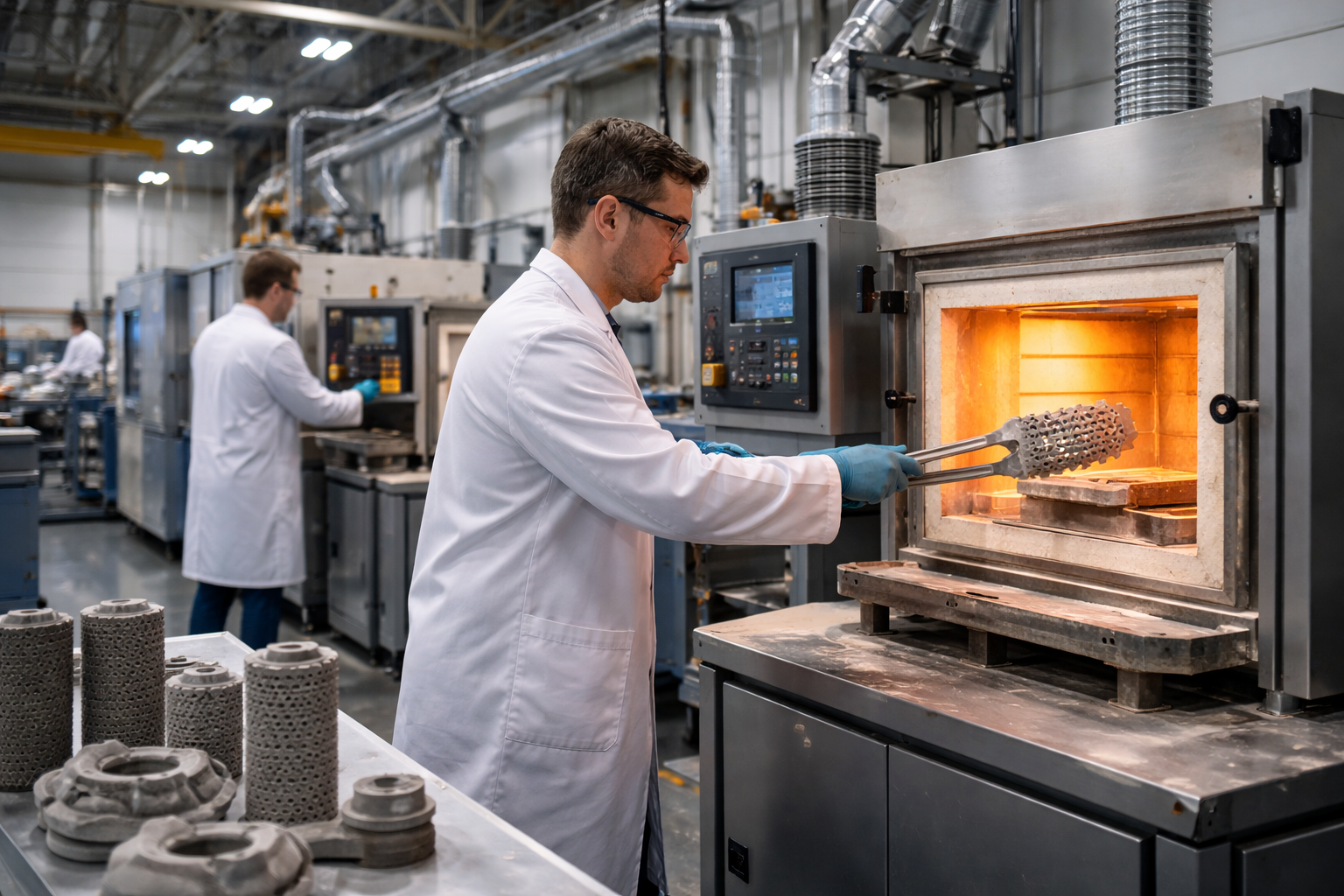
The new Army work is focused primarily on manufacturing systems rather than the purchase of a single batch of finished components. IperionX will increase continuous Hydrogen Sintering and Phase Transformation processing capacity, expand dehydride furnace capability, and install equipment intended to bring titanium fastener finishing fully in-house at its Virginia operation.
The programme also supports manufacture of titanium track pins, bolts, and fasteners for defence applications. Inspection and acceptance are planned through Detroit Arsenal and the US Army Research Laboratory at Aberdeen Proving Ground, giving the scale-up programme defined component applications against which the manufacturing processes can be assessed.
Bringing more of the production chain onto one site has a practical industrial rationale. Every outsourced process adds transport, queueing, supplier availability, documentation, and quality-control interfaces. Vertical integration can shorten those paths, although only if the new in-house processes reach the repeatability and qualification standards required for defence components.
IperionX’s HSPT process forms the downstream manufacturing side of that strategy. The company is developing it alongside GenX, its planned continuous HAMR titanium-production platform, with the objective of creating a more integrated route from titanium material through powder and into finished components.
The Army task order therefore addresses more than raw-material availability. A domestic titanium supply chain is of limited use if finished defence parts still depend on constrained processing capacity elsewhere. Forming, sintering, heat treatment, finishing, inspection, and qualification determine how quickly metal becomes an accepted component.
Virginia capacity is already moving through commissioning
IperionX has been expanding its Virginia Titanium Manufacturing Campus throughout 2026. Its June-quarter report said powder operations continued on a 24-hour production schedule while HAMR systems moved through ramp-up, with production supporting customer qualification, engineered-product programmes, and direct powder requirements.
The company is targeting an approximately 200-tonne-per-year titanium-powder run rate by the end of 2026, subject to completion of ramp-up and process optimisation. That figure is a capacity target rather than a statement that the plant is already operating continuously at that rate.
Downstream equipment has been added in parallel. A 300-tonne six-axis powder-metallurgy press completed site acceptance and commissioning in May, with IperionX saying the machine triples its existing powder-metallurgy capacity and broadens the range and repeatability of components that can be produced. Additional HSPT sintering furnaces have also been entering installation and commissioning.
The Army work gives that equipment a more defined defence application. Titanium track pins are a useful test because they are repeated, mechanically loaded components rather than demonstration shapes produced only to show that a manufacturing process works. Bolts and fasteners similarly provide a route to assess material behaviour, dimensional control, finishing, and repeatability across serial parts.
IperionX has also been developing titanium fasteners for US military vehicle applications. Its June report said testing of Ti-6Al-4V fasteners by US Army DEVCOM GVSC and an independent laboratory exceeded SAE Grade 8 steel torque-to-yield performance and surpassed standard aerospace-grade titanium fastener benchmarks in tensile testing. Those results relate to development and qualification activity rather than full-rate Army adoption.
The latest task order funds industrialisation around that technical work. Three priority manufacturing packages are fully covered by the currently obligated funding, while an initial allocation supports a fourth. Further options could extend activity into aerospace-grade components and refractory-alloy processing, but those line items remain unexercised and should not be treated as current programme commitments.
Scaling the processes will place more pressure on quality assurance. Powder characteristics, thermal cycles, dimensional tolerances, finishing, and inspection all have to remain controlled as throughput rises. A process that produces acceptable prototypes intermittently is not automatically ready for sustained serial manufacture.
The Army’s interest is tied to the resilience of the broader titanium supply chain. Defence and aerospace programmes value the material for its strength-to-weight ratio, corrosion resistance, and temperature performance, but conventional titanium production can involve long processing chains and significant cost. Domestic powder alone does not solve those constraints if the subsequent manufacturing steps remain slow or dependent on limited suppliers.
IperionX is attempting to shorten that chain by linking material production, powder processing, near-net-shape manufacture, and component finishing at the Virginia site. The $18.5 million base task order gives the company government-backed funding to install more of that capability and apply it to defined Army parts.
The next useful evidence will come from the factory rather than the contract ceiling. Commissioned equipment, accepted track pins and fasteners, repeatable production yields, and sustained component deliveries will determine whether the programme has moved from promising metallurgy into dependable industrial capacity.