IN Brief:
- RFA Resurgent has reached keel laying at Appledore, while the remaining Fleet Solid Support ships have been named RFA Reliant and RFA Resourceful.
- Modules are being produced across UK and Spanish yards before final assembly, integration, and trials in Belfast.
- The £1.634 billion programme combines fleet replenishment capability with substantial UK shipyard investment, employment, and industrial rebuilding.
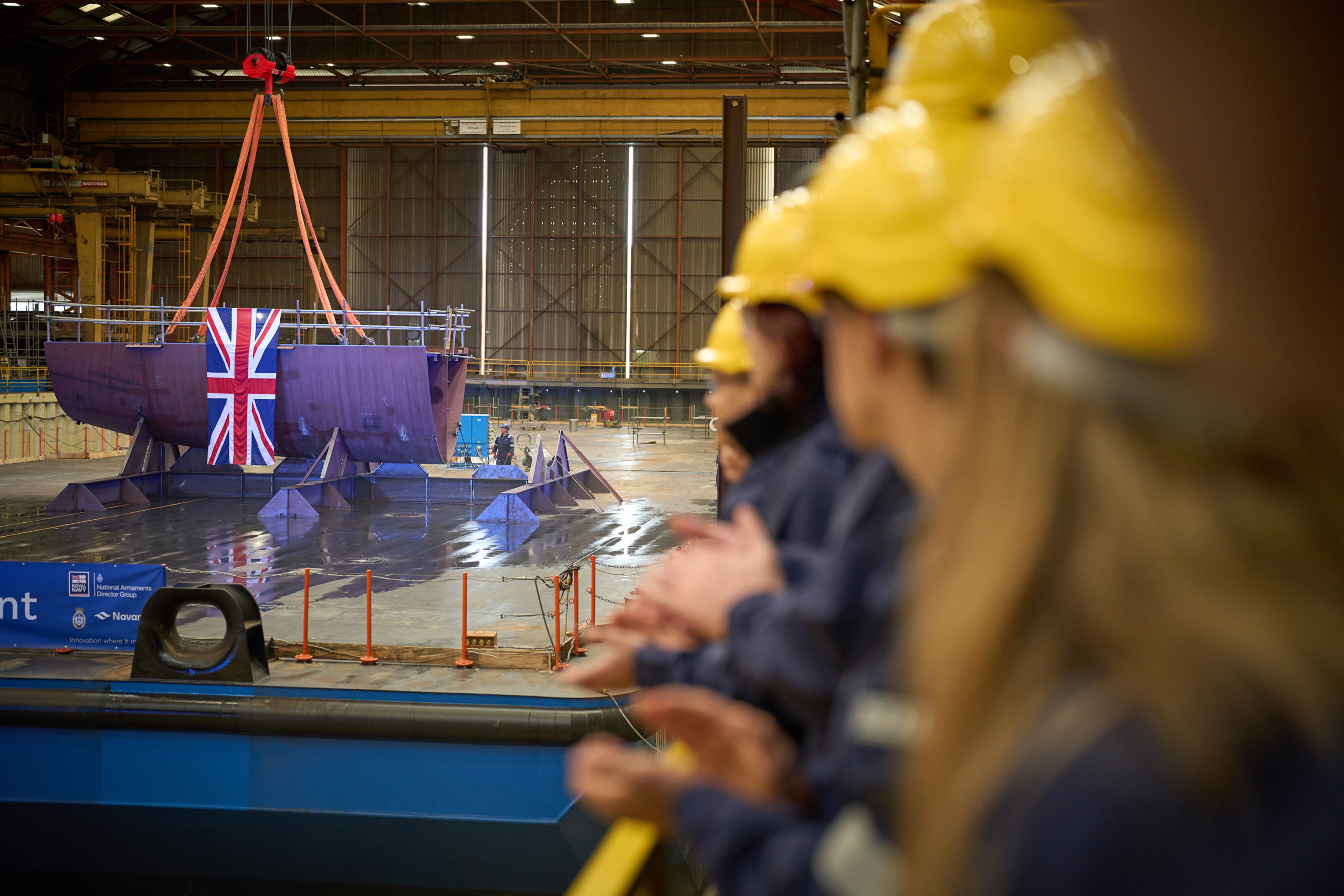
RFA Resurgent, the first of three new Fleet Solid Support ships, has reached keel laying at Navantia UK‘s Appledore shipyard in Devon, moving the vessel into formal assembly. The ceremony also confirmed the remaining ships will be named RFA Reliant and RFA Resourceful, establishing the identities of the full three-vessel class.
The ships are being built for the Royal Fleet Auxiliary to carry munitions, spares, food, and other solid stores to Royal Navy task groups at sea. RFA Resurgent is expected to enter service in the early 2030s, supporting sustained naval deployments including carrier strike operations. Each ship is designed around a core RFA crew of 101, with accommodation for a further 80 personnel involved in aviation, boat operations, or other embarked roles.
Keel laying is a traditional shipbuilding milestone, although in a modular programme it marks formal assembly rather than the start of all manufacturing work. Steel for Resurgent was cut at Appledore in December 2025, and ship blocks and modules are being produced across several yards before final integration.
Appledore is manufacturing sections in Devon, Spanish facilities are contributing modules, and final assembly, integration, and trials will take place at the Harland & Wolff yard in Belfast. The model allows fabrication to progress in parallel, but it also places heavier demands on dimensional control, configuration management, transport sequencing, and interface discipline.
A module completed on schedule at one yard is useful only if the adjoining structure, outfitting package, and integration plan are ready when it arrives. Distributed construction can compress fabrication times, but it also spreads programme risk across several production sites and makes late design changes more difficult to contain.
The manufacturing contract was awarded in 2023 and is recorded at £1.634 billion excluding VAT for the three ships. The programme is also being used to rebuild shipbuilding capability in the UK, with substantial investment associated with Belfast and Appledore, around 1,200 UK shipyard jobs, and hundreds of apprenticeships expected across the wider programme.
The Ministry of Defence has also been examining whether the Fleet Solid Support delivery schedule can be accelerated. No revised contractual timetable has been announced, so the keel-laying milestone demonstrates production progress without establishing that an earlier delivery date has been secured.
That distinction is important on a first-of-class vessel. Fabrication can be accelerated only where design maturity, material availability, labour, and downstream integration can absorb the additional output. Once large modules reach final assembly, programme pace depends increasingly on systems installation, cable and pipe integration, harbour work, software, test, certification, and the resolution of defects found during commissioning.
Resurgent also carries the engineering burden of establishing the class baseline. Problems discovered during integration and trials can require design changes that affect Reliant and Resourceful, so pushing early fabrication too far ahead of first-ship feedback can transfer risk into later construction rather than remove it.
The operational requirement is more straightforward. Carrier strike groups and other deployed naval formations cannot remain at range indefinitely without replenishment of ammunition, stores, and food. Solid-support shipping therefore sets practical limits on how long high-value combatants can remain effective away from port, even though the support vessels themselves attract less attention than destroyers, submarines, or aircraft carriers.
The programme also provides a test of Navantia UK’s wider industrial plan following its acquisition of the former Harland & Wolff yards. Appledore has returned to substantial naval construction, Belfast is being prepared for final integration, and investment in plant, infrastructure, and skills is intended to leave capacity that can support future shipbuilding work after the FSS programme.
Delivery performance will determine how much weight those ambitions carry. The keel-laying ceremony confirms that Resurgent has progressed from steel cutting and block manufacture into assembly, while the naming of Reliant and Resourceful brings the remaining vessels formally into the public programme. The more demanding phase now lies in keeping three production locations aligned as the first ship approaches Belfast integration and the later hulls follow behind it.