IN Brief:
- Rolls-Royce Solutions America has received a $39.12m modification for Eitan armoured vehicle power packs.
- The award raises the cumulative contract value to $158.9m and funds production work in South Carolina.
- Eitan propulsion remains part of a US-Israeli industrial chain supporting serial vehicle production and fleet sustainment.
Rolls-Royce Solutions America has received a $39.12m US Army contract modification for Eitan armoured vehicle power packs, increasing the cumulative value of the contract to $158.9m. Work will be performed in Graniteville, South Carolina, and is scheduled to run until 11 September 2027. The full modification value is being funded through non-expiring Foreign Military Sales money for Israel.
The award adds to contract W56HZV-23-C-0054, an established procurement route for Eitan propulsion. Rolls-Royce Solutions America is the US subsidiary of Rolls-Royce Power Systems, whose mtu business supplies engines and integrated PowerPack systems for military land vehicles. Army Contracting Command at Detroit Arsenal is administering the latest modification.
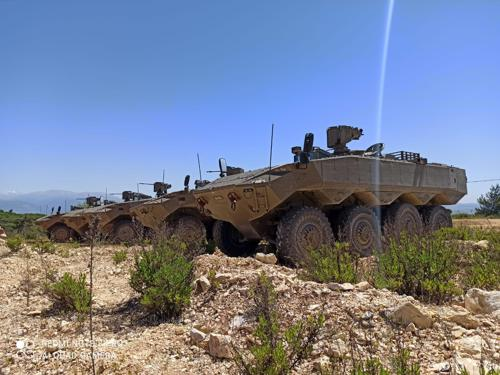
The Eitan is Israel’s eight-wheeled armoured personnel carrier, developed by the Ministry of Defense Tank and APC Directorate and assembled through the country’s armoured vehicle production system. The roughly 750-horsepower platform can carry 12 personnel and travel at about 90km/h, combining protected troop transport with the road speed and cross-country mobility associated with a wheeled configuration.
US Foreign Military Sales documentation identifies the Eitan engine package as the 8V199TE21-D PowerPack family and names Rolls-Royce Solutions America as principal contractor. An earlier US notification covered an estimated $180m package of engines, components, technical assistance, non-recurring engineering, and programme support. The latest Army modification is an awarded and funded action inside that wider supply relationship rather than another notification of a possible sale.
Power-pack supply is a substantial part of armoured vehicle production because it combines the engine with the surrounding propulsion package needed to operate as an integrated system. Eitan’s propulsion chain has also involved Allison 4800-series automatic transmissions incorporated into the vehicle power pack. Final vehicle output therefore depends on coordination between US propulsion suppliers and Israeli assembly, armour, electronics, protection, and integration activity.
The South Carolina work places a material part of that chain inside Rolls-Royce’s US manufacturing footprint. The company’s Power Systems operation has engine manufacturing, machining, research, development, and remanufacturing capability in the state and uses the broader mtu Series 199 family on other military vehicle programmes. Series 199 PowerPacks are also assembled and tested in South Carolina for the US Army’s M10 Booker programme, although the Eitan equipment is a separate customer-specific configuration.
Serial Eitan deliveries to the Israel Defense Forces began in 2023 following several years of development, testing, and manufacturing preparation. The programme combines domestic and international industry while retaining final vehicle assembly in Israel. Continued US-funded propulsion procurement therefore feeds an established production system rather than an early prototype effort.
The earlier US sale notification also shows that propulsion is being procured as a through-life package rather than an isolated engine purchase. Alongside the 8V199TE21-D units, the approved scope included engine components, technical assistance, non-recurring engineering, and logistics support. Those elements become increasingly important as fleets expand because propulsion availability depends on documentation, test capability, repair routes, and component supply as much as on complete engine deliveries.
Production fleets continue to create propulsion demand after vehicles enter service. Additional engines may be required for new-build vehicles, replacement units, spares, repairs, and engineering support, while changes in vehicle configuration can generate further non-recurring work. The September modification does not disclose the number of power packs covered, so the contract value cannot be converted reliably into a vehicle quantity.
Schedule coordination is equally important at the vehicle-integration stage. Engines, transmissions, cooling systems, controls, installation hardware, and final assembly all have to reach the programme at compatible rates. Propulsion capacity provides little benefit if it cannot be matched to the wider vehicle build plan, while interruptions in a specialist component stream can slow output even where the rest of the assembly system has capacity available.
The international structure gives Israel access to an established US propulsion supply base while retaining control of final vehicle integration. It also spreads the programme’s manufacturing dependencies across national borders, making contract continuity, logistics, spares availability, and configuration management part of the vehicle production equation rather than separate sustainment issues.
With the cumulative contract now approaching $159m and work extending into September 2027, Rolls-Royce has a defined near-term production load tied directly to Eitan fleet growth and support. Further output will depend on subsequent orders and the wider vehicle production schedule, but another funded tranche of propulsion work is now in place through the next year.