IN Brief:
- DroneShield and AIM Defence will make the Fractl high-power laser interoperable with the DroneSentry counter-UAS platform.
- The integration adds a directed-energy hard-kill layer alongside RF sensing, electronic warfare, sensor fusion, and command-and-control.
- Initial work will focus on selected military and government users before potential wider deployment.
DroneShield is expanding its DroneSentry counter-uncrewed-aircraft architecture to incorporate AIM Defence’s Fractl high-power laser, adding a directed-energy hard-kill option to a system already built around radio-frequency sensing, electronic warfare, sensor fusion, and command-and-control.
The Australian companies will work to make Fractl interoperable with the DroneSentry operational platform, allowing operators to coordinate detection and defeat technologies through a common environment rather than treat the laser as a standalone effector. Initial activity will focus on selected military and government users, with demonstrations and interoperability work intended to establish how the systems can be deployed together under operational conditions.
DroneShield has positioned DroneSentry as an open counter-UAS architecture capable of taking inputs from different sensor types and combining them with multiple defeat mechanisms. Adding Fractl extends that architecture beyond radio-frequency disruption, which remains effective against many conventionally controlled drones but cannot provide a universal response to increasingly autonomous, frequency-agile, or emission-controlled threats.
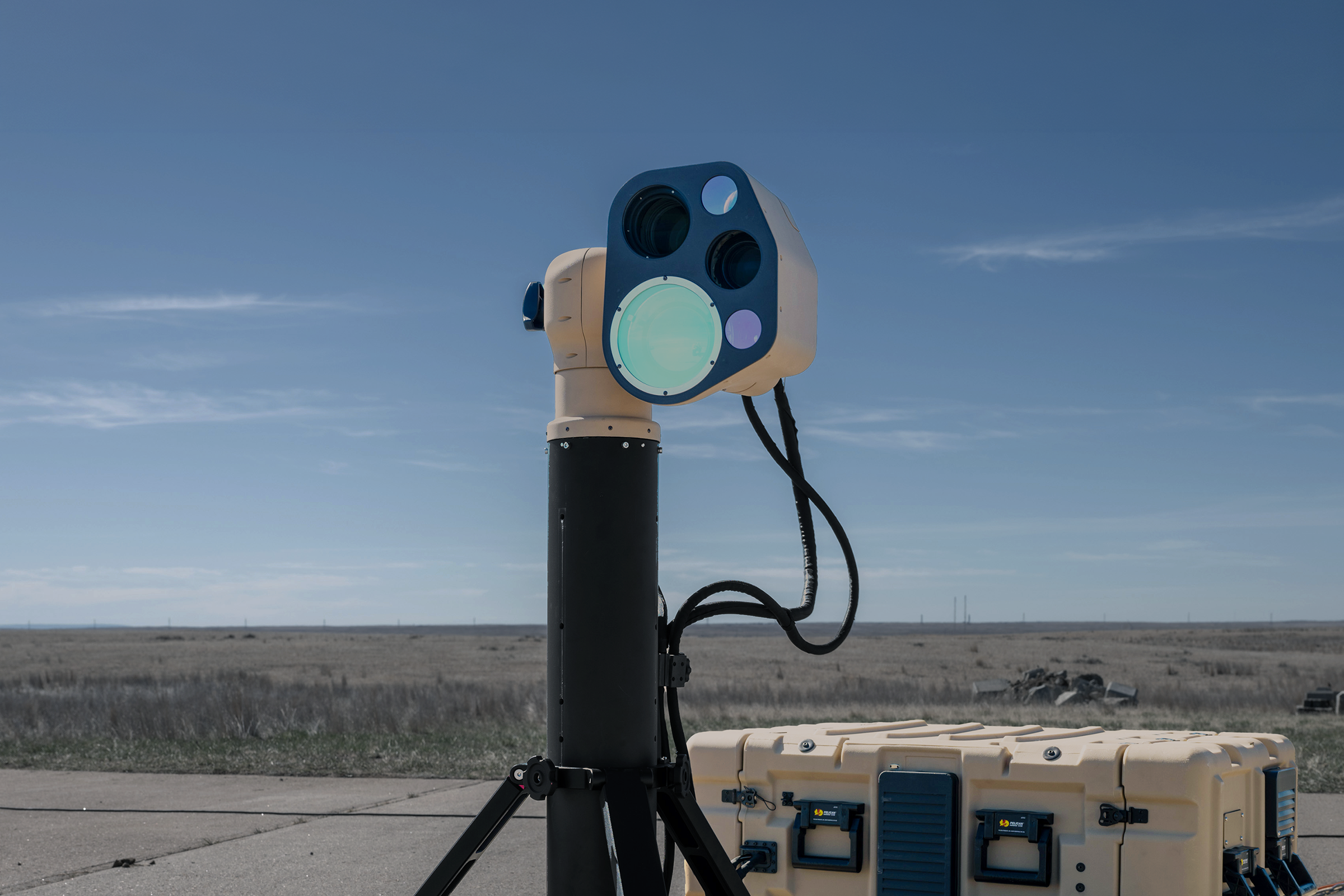
AIM Defence’s Fractl system uses AI-enabled tracking and a high-power fibre laser intended to damage or disable airborne targets through concentrated energy rather than kinetic interception. AIM lists a track range of 3km, sensor-destruction capability beyond 2km, and hard-kill engagement beyond 1.5km, although usable performance depends on target type, atmospheric conditions, line of sight, and the wider sensor architecture supporting the engagement.
The company also lists a system mass below 120kg and up to 50 engagements per charge. Those characteristics influence integration because counter-UAS systems increasingly have to balance magazine depth, mobility, power demand, and cost per engagement rather than maximise the performance of a single interceptor.
Electronic attack remains attractive where command links or navigation signals can be disrupted, while kinetic or directed-energy systems are required when an aircraft continues operating autonomously or the mission requires physical destruction of the target. A layered architecture therefore depends on command software, engagement logic, and reliable interfaces as much as on the individual sensor or effector.
DroneShield’s model is to keep those layers modular. DroneSentry can combine RF detection with radar and optical sensors, while its software provides target information and command functions that can be adapted to fixed, mobile, and mission-specific configurations. Integrating Fractl creates another effector path without requiring a customer to discard detection and command infrastructure already in service.
Open architecture has become a recurring requirement in counter-UAS procurement because threat types and available defeat technologies are changing faster than traditional monolithic systems can be replaced. The UK’s Project PANOPTES, for example, calls for integrated systems able to move from detection through defeat while supporting open architectures and future upgrades.
The more difficult work sits between those layers. Track quality has to be sufficient for engagement, interfaces must transfer data with predictable latency, and command systems must prevent different effectors competing for the same target or creating unsafe engagement conditions. A laser adds further demands around stable target tracking, electrical power, thermal management, safety controls, and the effect of atmospheric conditions on usable range.
Those requirements make interoperability testing more consequential than a simple software connection, particularly where systems are intended for mobile or rapidly deployable use. A common operating environment has to translate sensor data into an engagement-quality track, hand that track to the laser control chain, and preserve enough context for an operator to select the appropriate response rather than merely display another icon.
AIM says Fractl has already been operationally deployed and exported, giving the integration programme an existing hardware baseline rather than starting with a laboratory demonstrator. DroneShield, meanwhile, has a counter-UAS product family spanning fixed, mobile, and portable configurations, creating several potential routes for demonstrations without assuming that every DroneSentry configuration will ultimately carry a laser.
The first practical measure will be whether a DroneSentry operator can receive a track from the wider sensor network, pass it reliably into the Fractl engagement chain, and manage the laser alongside electronic and other defeat options from the same operational picture. Repeating that process under representative conditions will expose latency, tracking, power, and command issues that remain hidden when the components are demonstrated separately.
The collaboration also shifts attention from individual counter-drone components to system integration. Sensors, jammers, guns, missiles, and lasers are already available in quantity; combining them into a coherent defensive layer, with enough data quality and command discipline to select the right effect against the right target, is the harder engineering task.
For DroneShield and AIM Defence, the initial customer work will show whether an Australian RF-and-software architecture and an Australian directed-energy effector can be turned into a repeatable operational package. If the interface proves robust, the commercial value will lie less in the novelty of adding a laser than in giving users another defeat option without rebuilding the rest of their counter-UAS system around it.