IN Brief:
- Two F-16s exchanged Legion sensor data through a pre-production L3Harris HiveLink connection during Air National Guard flight testing.
- Combining the passive infrared tracks increased accuracy and provided rapid ranging against multiple airborne targets.
- Future work will examine software-defined radios, multiple waveforms, gateways and support for crewed-uncrewed teaming.
Lockheed Martin has demonstrated a dedicated data link between Legion infrared sensor pods carried by two F-16s, allowing the aircraft to combine passive tracking information and improve target accuracy during US Air National Guard flight trials.
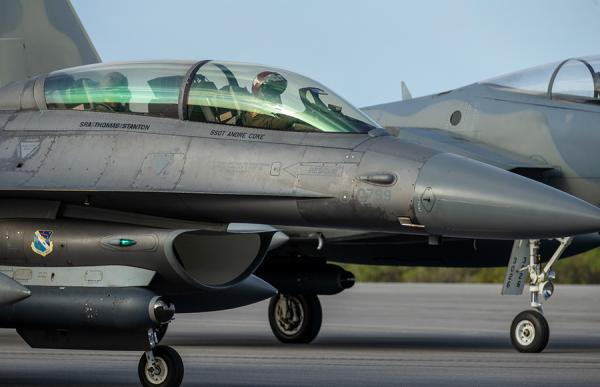
The aircraft flew from Morris Air National Guard Base in Tucson, Arizona, during tests involving the Air National Guard and Air Force Reserve Test Center. Each F-16 carried a Legion system equipped with a pre-production version of HiveLink, a data link developed by L3Harris.
The pods connected in flight and exchanged sensor information, with Lockheed Martin reporting improved track accuracy from the combined data. The company also says the networked configuration can establish range rapidly against multiple airborne targets, adding another measurement dimension to a sensor that does not need to transmit radar energy to search for aircraft.
Legion, previously known as IRST21, is a passive infrared search-and-track system. It detects thermal signatures rather than emitting radio-frequency energy towards a target, allowing an aircraft to search and track without using its radar for the same task.
A passive sensor still faces a geometry problem when precise range is required. A single aircraft can establish bearing and track changes over time, but combining observations from sensors in different locations provides additional information from which the target position can be calculated more accurately.
Pod-to-pod networking makes that cooperative geometry available without requiring the sensors to be designed into the aircraft from the outset. Legion’s podded form and modular open-system architecture provide space for additional communications equipment, allowing the sensor to evolve independently of the F-16’s core airframe.
HiveLink provides the communications path in the current trials. L3Harris designed the link for line-of-sight and beyond-line-of-sight operation, with mesh networking and waveform flexibility intended for platforms where size, weight and power are constrained.
Lockheed Martin says the trials improved track accuracy while reducing the need to use aircraft bandwidth for raw sensor exchange. Local processing inside each Legion installation allows the system to share useful tracking information rather than transmitting every element of infrared sensor data across the link.
That distinction will become more important as networks expand beyond two aircraft. A distributed sensor architecture can add useful observations from several positions, but communications traffic grows quickly if each node attempts to pass large volumes of raw data. Processing and correlating information close to the sensor reduces that pressure and allows tactical networks to retain capacity for other mission traffic.
Emissions management remains part of the engineering problem. Legion itself is passive, but exchanging tracks requires a communications link that transmits energy and can potentially be detected, jammed or disrupted. A useful passive targeting network therefore depends on communications that remain resilient without undermining the operating advantages sought from infrared sensing.
The current work is being conducted under an Air National Guard contract to validate performance, transportability and interoperability on F-16s. Lockheed Martin says later phases are expected to introduce software-defined radios, multi-waveform gateways and support for crewed-uncrewed teaming.
Those additions would turn the pod into a wider network node rather than a sensor feeding only its host aircraft. A gateway capable of exchanging information across different waveforms could allow Legion tracks to move between aircraft and mission networks that do not share the same native communications architecture.
The sensor is already fielded and in production in podded form for the US Air Force, with interoperability across F-15 and F-16 platforms. The latest demonstration therefore concerns an added networking capability around an established infrared sensor rather than qualification of the underlying IRST technology itself.
Open architecture provides a route for that capability to continue changing after production begins. Communications hardware, processors and software generally evolve more rapidly than combat aircraft, so a pod that can accept new modules provides a way to introduce additional functions without waiting for a major host-aircraft redesign.
The next engineering step is to establish how well the cooperative targeting model scales. Additional aircraft can improve geometry and resilience, but they also introduce more tracks, more communications paths and more decisions about which sensor data should be trusted when observations disagree.
Trials involving larger formations, degraded links and different aircraft types will provide stronger evidence of whether Legion can operate as part of a distributed passive targeting network. The two-F-16 demonstration has established the basic exchange and track improvement; the remaining work is to show that the architecture remains useful when the network becomes larger and less predictable.