IN Brief:
- Two TB2s carried ANTIDOT electronic-support and attack equipment plus the FULMAR 200 radar.
- The demonstration linked emitter detection and geolocation with electronic attack and radar imaging.
- Delegations from 18 countries attended the export-focused demonstration in Konya.
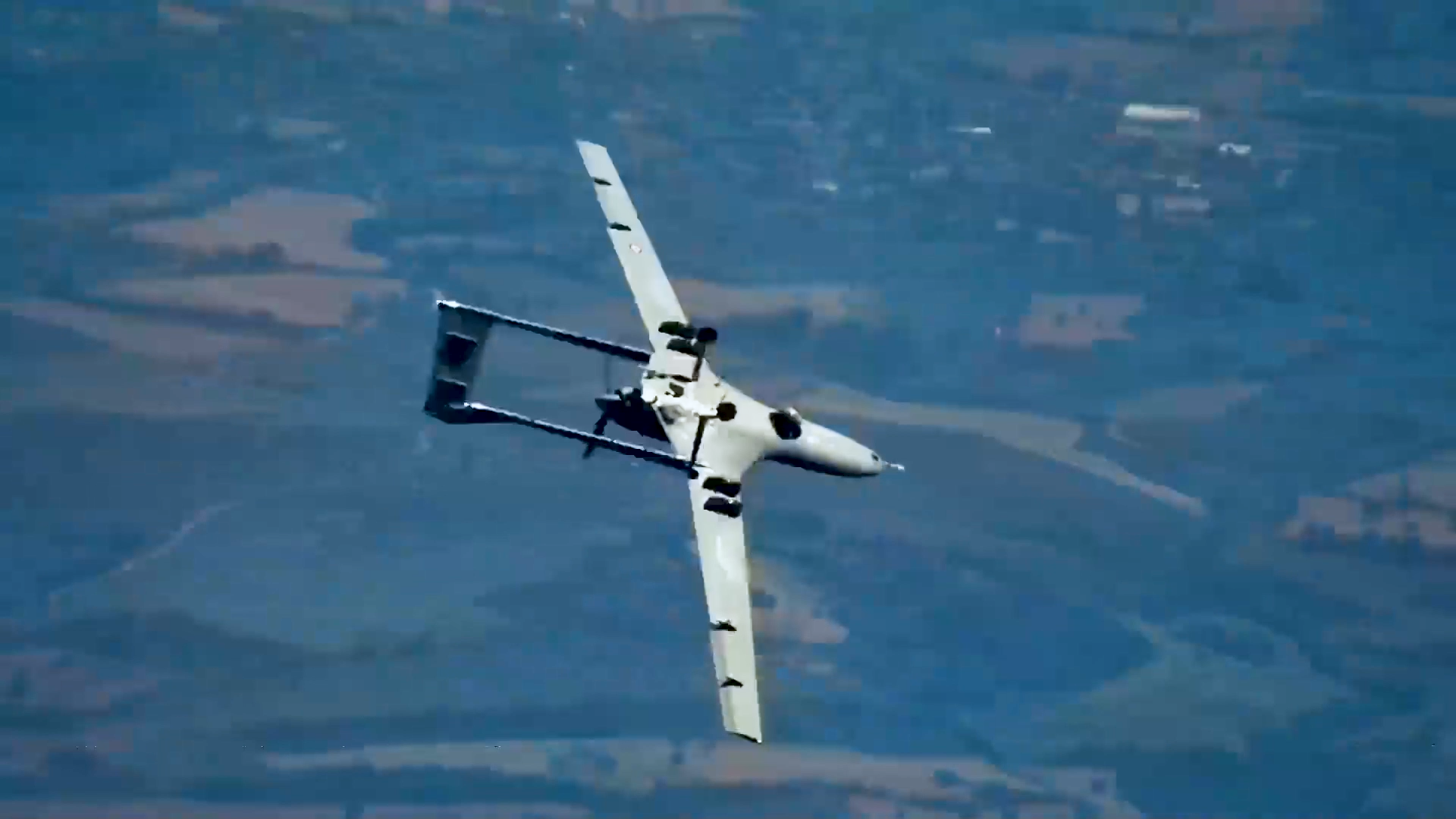
ASELSAN has demonstrated electronic-support, electronic-attack, and synthetic-aperture-radar payloads on two Bayraktar TB2 unmanned aircraft, using a coordinated flight scenario to link emitter detection and geolocation with electronic attack and radar reconnaissance.
One TB2 carried the ANTIDOT 2ES 100 electronic-support pod and ANTIDOT 2EA 200 electronic-attack pod, while a second aircraft carried the FULMAR 200 synthetic-aperture-radar payload. Defence delegations from 18 countries attended the demonstration in Konya, giving the company an export audience for a mission package built around several separate airborne payloads.
The electronic-warfare sequence began with ANTIDOT detecting and locating a target radar. That information was then used by the electronic-attack element to act against the emitter. The second aircraft contributed radar imagery of the target area through FULMAR, adding reconnaissance to the electronic-support and attack functions carried by the first TB2.
Splitting those functions across two medium-altitude unmanned aircraft avoids concentrating every sensor and effector on one larger platform. Electronic warfare and synthetic-aperture radar impose different power, cooling, processing, and electromagnetic-compatibility demands, so a distributed arrangement can preserve payload flexibility while allowing aircraft to be configured according to the mission.
ASELSAN describes FULMAR 200-A as a compact X-band AESA synthetic-aperture-radar pod for manned and unmanned aircraft. Published technical data gives an instrumental range of 80 nautical miles and an imaging range of 22 nautical miles, with system mass below 20 kg and power consumption below 300 W.
The radar supports synthetic-aperture and inverse synthetic-aperture imaging, maritime search, ground and maritime moving-target indication, and automatic target detection. Its physical and electrical limits are particularly relevant on aircraft in the TB2 class, where payload mass and generated electrical power are considerably tighter than on a large dedicated intelligence, surveillance, and reconnaissance aircraft.
Pod-based equipment also changes how a fleet can be managed. A permanently installed mission system commits weight, space, and maintenance effort to every sortie, whereas an external payload can be moved between suitably integrated aircraft as tasking changes. That approach depends on standardised interfaces, mission software, and reliable ground procedures if operators are to reconfigure aircraft without lengthy engineering intervention.
The ANTIDOT family covers the electromagnetic side of the mission. Electronic-support equipment detects, classifies, and locates emitters, while electronic attack applies energy or techniques against selected radar or communications systems. Keeping those capabilities modular can simplify technology refresh as threat libraries, processing hardware, and countermeasure techniques evolve.
ASELSAN had advanced both product lines before the latest demonstration. FULMAR 200-A was developed as a lightweight pod compatible with unmanned aircraft around the size of TB2 and ANKA, while earlier company material recorded preparations for airborne testing. ANTIDOT equipment has also moved into export and demonstration activity rather than remaining a laboratory project.
The Konya event concentrated those capabilities into a common mission sequence. Sensors, jammers, and radar imagers have limited operational value if their data cannot be combined quickly enough to support a coherent task. Distributed operations add demands on datalinks, time synchronisation, command software, and electromagnetic deconfliction, particularly when friendly aircraft transmit and receive across overlapping frequency ranges.
For the TB2, the demonstration broadens the available payload set beyond the electro-optical surveillance and armed roles most commonly associated with the platform. The aircraft does not provide the power, aperture size, or processing capacity of a dedicated high-end electronic-warfare platform, but it offers a lower-mass route to distribute selected sensing and electronic effects across additional airframes.
The export proposition follows the same modular approach. Customers already operating TB2 could consider specialist payloads without procuring a separate aircraft type for every mission, subject to integration, export approval, and support arrangements. ASELSAN can in turn offer the electronic-support, electronic-attack, and radar payloads as a connected capability set rather than unrelated sensors.
Operational adoption will require mission-data preparation, operator training, maintenance, software support, and integration into each customer’s wider command-and-control network. The demonstration establishes that the payloads can work together in an airborne scenario; repeatable deployments and customer orders will determine whether that integration develops into a sustained production and support programme.