IN Brief:
- Sentinel’s StarForge consortium combines deployable manufacturing, UAS and counter-UAS technology, communications, sensing, power, and mission software.
- University of Alberta research activity and Lockheed Martin Skunk Works Calgary technology form part of the announced integration ecosystem.
- A C$10 million Lockheed Martin industrial-benefits contribution linked to Canada’s HIMARS acquisition supports development, but does not represent a StarForge equipment order.
Sentinel Advanced Military Solutions has launched a Canadian defence technology consortium built around its StarForge platform, combining deployable manufacturing, autonomous systems, communications, sensing, power, and mission software within a common integration programme.
The Quebec-based company is a wholly owned subsidiary of CMP Advanced Mechanical Solutions and is bringing together Canadian and allied technology partners around the StarForge architecture. The University of Alberta is providing research and testing capability, while Lockheed Martin Skunk Works Calgary is contributing VCSi command-and-control software and sensor-fusion expertise.
The consortium is supported by a C$10 million Industrial and Technological Benefits contribution from Lockheed Martin associated with Canada’s acquisition of 26 HIMARS launchers. The contribution supports development of the industrial and technology ecosystem; it is not an order for StarForge equipment and does not establish that the Canadian Armed Forces has accepted an integrated Sentinel system.
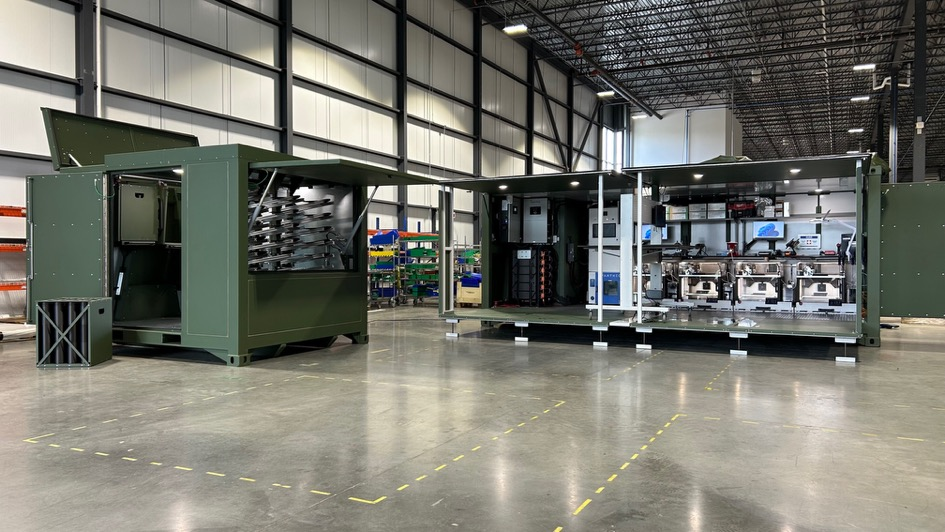
That distinction is important because StarForge currently represents an integration proposition rather than a fielded fleet. Sentinel describes modular infrastructure able to bring together unmanned and counter-UAS systems, communications, sensing, local power, command functions, and manufacturing equipment for use at remote operating locations.
The field-manufacturing element is one of the more unusual parts of the concept. Sentinel proposes combining additive manufacturing with controlled digital inventories so selected replacement parts and mission components can be produced closer to the point of use rather than held physically throughout a distributed logistics network.
That approach has practical limits. Additive manufacturing still depends on qualified material, controlled design data, appropriate machines, trained personnel, inspection, and sometimes post-processing. Safety-critical or tightly certified components cannot simply be produced because a digital file exists. The more realistic opportunity is to identify classes of lower-volume parts for which controlled local production is faster or more resilient than carrying inventory into every remote location.
The benefit could be particularly relevant in Canada’s geography. Arctic locations and dispersed operating sites impose long transport distances and can make conventional resupply slow or vulnerable. Replacing selected physical stock with secure digital inventories could reduce some logistics demand, provided the customer has established which parts may be manufactured locally and how those parts are inspected and released for use.
Sentinel’s relationship with CMP gives the initiative access to an established electromechanical manufacturing organisation rather than leaving industrialisation entirely to a technology start-up. That matters because integrating prototypes into repeatable defence hardware requires production engineering, supplier control, documentation, test processes, and configuration management in addition to technology development.
The University of Alberta adds a separate research and testing role, with the consortium placing emphasis on development of sovereign Canadian intellectual property. Lockheed Martin’s Calgary organisation contributes VCSi mission software, command-and-control, and sensor fusion, providing a potential digital layer through which information from otherwise separate sensors and systems can be combined.
Those contributions also illustrate the central difficulty facing StarForge. Combining many technologies in one deployed architecture increases the number of interfaces that have to be controlled. Sensors, autonomous vehicles, communications equipment, power systems, manufacturing cells, and command software each arrive with separate data standards, cyber requirements, environmental limits, and maintenance arrangements.
A collection of capable subsystems does not automatically become a coherent operational system. Sensor data must be usable by command software, network capacity has to support the required traffic, power generation has to meet variable loads, and manufacturing equipment must operate within whatever environmental and security constraints exist at the deployed site.
The same applies to UAS and counter-UAS functions. Public material describes StarForge as capable of integrating autonomous and protective technologies, but it does not establish the performance of a particular sensor, interceptor, or effector configuration. Those details would depend on the specific equipment selected and the customer’s acceptance requirements.
The C$10 million contribution therefore supports a capability-development environment rather than demonstrating that those integration questions have already been resolved. Lockheed Martin’s obligation arises through Canada’s Industrial and Technological Benefits policy, which uses major defence procurement to generate domestic industrial and technology activity elsewhere in the national supply base.
Sentinel now has to turn that support into evidence that the architecture can function outside a trade-show or laboratory environment. Useful milestones would include defined baseline configurations, integrated trials, approved manufacturing use cases, field demonstrations, and customer requirements identifying which StarForge functions are actually needed together.
The consortium gives Canada another attempt at linking sovereign technology development with domestic manufacturing and allied expertise. Its success will depend less on the number of technologies gathered under the StarForge name than on whether those technologies can be integrated, supported, and accepted as a practical deployed capability.