IN Brief:
- Lyntris has qualified a wedgelock assembly used within the SPY-6 Radar Modular Assembly chassis.
- The component secures electronics and assists heat transfer from high power hardware inside the radar module.
- Raytheon plans to double SPY-6 output by 2028 as US Navy and international demand expands.
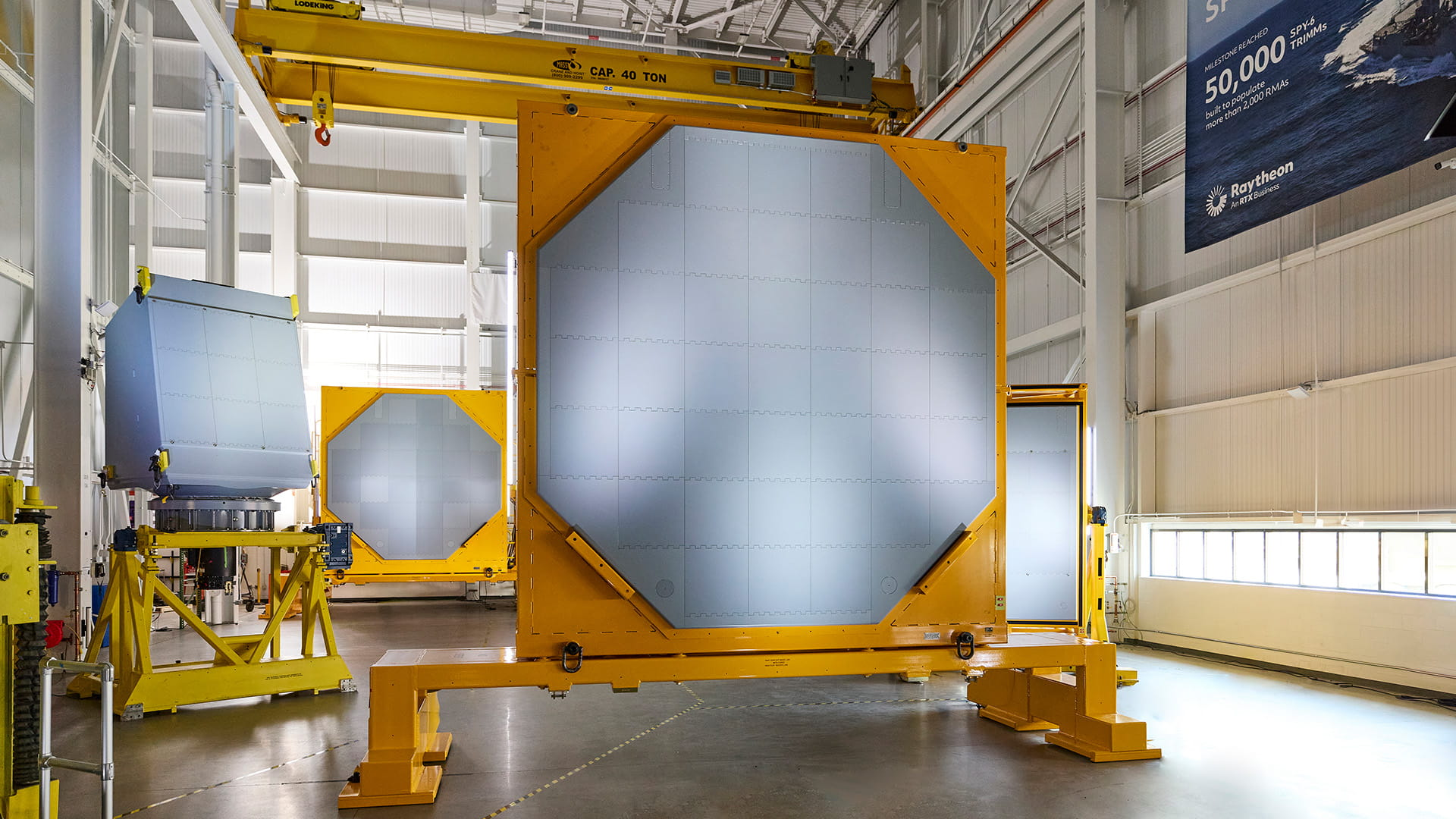
Lyntris has qualified a critical hardware assembly for Raytheon’s SPY-6 naval radar family after almost two years of manufacturing development and validation. The work creates an additional scalable source for the wedgelock assembly used within the Radar Modular Assembly chassis that forms the common building block of SPY-6 arrays.
Raytheon asked Lyntris to examine potential supply constraints as SPY-6 moved towards higher production rates. Lyntris already operated vertically integrated manufacturing and test capability in California and Nevada for much of the Radar Modular Assembly chassis, and the review identified the wedgelock as a component that could restrict output if its supply remained constrained.
The wedgelock performs a mechanical and thermal function inside the array. It secures electronic components within the thermally managed chassis while helping transfer heat away from high power hardware, protecting reliability under demanding maritime operating conditions. The component is small compared with the complete radar, but its repeat use across modular assemblies makes dependable availability important when production volumes rise.
Over the qualification programme, Lyntris and Raytheon established manufacturing processes, validated performance and demonstrated that the assemblies met US Navy requirements. Qualification does not itself define future order volume, but it gives Raytheon an additional production route for an item previously identified as a supply risk.
SPY-6 is built around common Radar Modular Assemblies that can be combined in different quantities for several ship classes. The architecture supports radar variants for destroyers, aircraft carriers, amphibious ships and frigates, allowing hardware and software commonality across a broad portion of the US Navy surface fleet. That commonality can simplify manufacturing, but it also increases the impact of a shortage affecting a component used throughout the family.
The production system behind the radar has already moved well beyond low volume development. Raytheon reported in 2025 that its manufacturing operation had produced 150,000 RF heads and 50,000 transmit and receive modules for more than 2,000 Radar Modular Assemblies. The process covers semiconductor work, circuit cards, precision metal fabrication, array assembly, calibration and final test, leaving multiple points where a delay in one recurring part can interrupt a much larger production flow.
Raytheon is also expanding capacity. A US Navy hardware production and sustainment contract extension announced in July 2026 was valued at $1.8 billion, with options that could take the cumulative contract value to $3.3 billion. The company said it had invested more than $800 million in radar manufacturing facilities and planned to double SPY-6 output by 2028.
That expansion changes the economics of supply chain resilience. A specialist component that was manageable at development volumes can become a rate limiting item when several radar variants are being built simultaneously. Adding qualified manufacturing sources, increasing vertical integration and reducing long lead material exposure can protect final assembly schedules without changing the radar’s core design.
The importance of repeatable sub assembly production will grow as SPY-6 is installed across more ship classes. The radar is already being fielded in the US Navy, while backfit work is extending the family to additional destroyers. Germany has also selected SPY-6 for its planned F127 frigates, adding an international demand path to the domestic production programme.
That export and production expansion has already placed manufacturing capacity alongside radar performance in the programme. Raytheon’s wider SPY-6 production programme is being scaled around the same common Radar Modular Assembly architecture, increasing the value of qualified sources for components repeated across multiple arrays.
Shared hardware across the variants is one of the programme’s main industrial advantages. Engineering changes and manufacturing improvements can be applied across a larger installed base, and higher aggregate volume can justify dedicated tooling and automation. The same commonality raises the cost of a weak point in the supply base because a recurring component can affect several customer and platform schedules at once.
Lyntris says the approach used to qualify the wedgelock could be applied to other long lead components in radar and sensing systems. Each part would require its own process development and qualification, but the underlying method is familiar: identify a constrained item, establish controlled manufacturing, validate performance and qualify a source before demand reaches the point where the bottleneck disrupts final production.
The immediate programme result is narrower. SPY-6 now has an additional qualified route for a thermally important assembly at the point when Raytheon is preparing for higher output. As the radar family shifts further into repeat production, availability will increasingly depend on the consistency of such component level manufacturing rather than on completion of the radar’s original development programme.