IN Brief:
- Raytheon-Rafael Protection Systems has delivered its first Tamir interceptors manufactured in Camden, Arkansas.
- The factory opened in late 2025 and is the first production site for Tamir interceptors outside Israel.
- The facility also plans to manufacture a US variant for the Marine Corps' Medium Range Intercept Capability.
Raytheon-Rafael Protection Systems has delivered the first Tamir air-defence interceptors manufactured at its facility in Camden, Arkansas, establishing a US production source for a missile previously manufactured in Israel. The milestone marks the transition of the new manufacturing operation into delivery activity after the facility opened in late 2025.
The joint venture between Raytheon and Rafael Advanced Defense Systems announced the deliveries on 9 October. It says production is now being scaled to address demand associated with the Iron Dome system and potential US applications. The company has not specified how many interceptors formed the initial delivery or published a target annual production rate.
Tamir is the interceptor used by Iron Dome, which is designed to defend against certain short-range aerial threats. Its manufacturing requirements encompass rocket propulsion, control equipment, guidance components, structural assemblies and final acceptance testing. Producing an interceptor in a second country requires more than transferring drawings or installing another assembly line.
Manufacturers must establish whether the new site can repeatedly build units that conform to the qualified configuration. That includes controlling raw materials and specialist components, preparing production procedures, training operators and validating test equipment. Transfer of a production process can reveal dependencies that were previously handled within an established supplier network.
Raytheon-Rafael describes Camden as the first site outside Israel to manufacture Tamir interceptors. This distinction makes the milestone significant for industrial resilience. A second production location potentially reduces reliance on one national manufacturing system, although the extent of supply chain independence depends on which subsystems are made locally and where key materials originate.
The joint venture has not published a detailed localisation breakdown. The delivery of completed interceptors from Arkansas establishes local manufacturing and acceptance, but does not by itself demonstrate that every component is sourced from the United States. The distinction matters when assessing whether additional national capacity also provides an independent source for constrained electronic or propulsion components.
Camden operations began after what the company describes as a substantial capital investment. Production facilities for guided munitions need environmental controls, appropriate safety arrangements, handling equipment and inspection capability. Where propellants or energetic components are processed, regulations and process design place particular demands on plant configuration and workforce training.
Moving from the first production articles to sustained output can take considerable work. Early units verify that equipment and processes can deliver a complete product, while serial production requires consistent yields, predictable material supply and manageable rework. A new factory must demonstrate its ability to maintain those conditions over multiple production cycles.
The Camden site is also intended to manufacture a US variant of Tamir for the Marine Corps’ Medium Range Intercept Capability. That planned application is distinct from the first delivery of the Israeli configuration. The company has not disclosed a start date for US-variant deliveries or described which engineering changes will be required for that configuration.
Integrating an interceptor into another country’s system can involve interfaces between missiles, launchers, communications and command software. The missile’s underlying design may be established, but the complete weapon system still requires verification of operational compatibility, safety and support arrangements. Those steps should not be treated as complete solely because the manufacturing plant has delivered its first Tamir interceptors.
The supply base around Camden may also be affected as production expands. Specialist subcontractors can contribute components, fixtures, machining, electronics and test services, although the company has not publicly identified the suppliers involved in this delivery. Contracting decisions will determine the proportion of activity that remains in Arkansas and the wider US industrial base.
For customers, an additional source of missiles potentially changes the way inventory replenishment can be planned. Air-defence demand can fluctuate sharply, while complex components may require months of preparation before final assembly. Multiple production locations can provide additional flexibility, provided that common dependencies do not constrain both facilities at the same time.
The October announcement documents an industrial milestone rather than a newly tested interceptor design. Tamir’s wider operating history supplies context, but the manufacturing achievement is the successful delivery of US-built rounds from a recently established plant. Subsequent reporting will be needed to establish output growth, local component participation and production of the Marine Corps variant.
Production in Camden now moves beyond the initial delivery milestone into the harder task of sustained production. Its contribution to air-defence readiness will depend on whether that output can be maintained at quality, scaled within the limits of the supplier network, and integrated into the stockpiles and systems of the customers it is intended to serve.
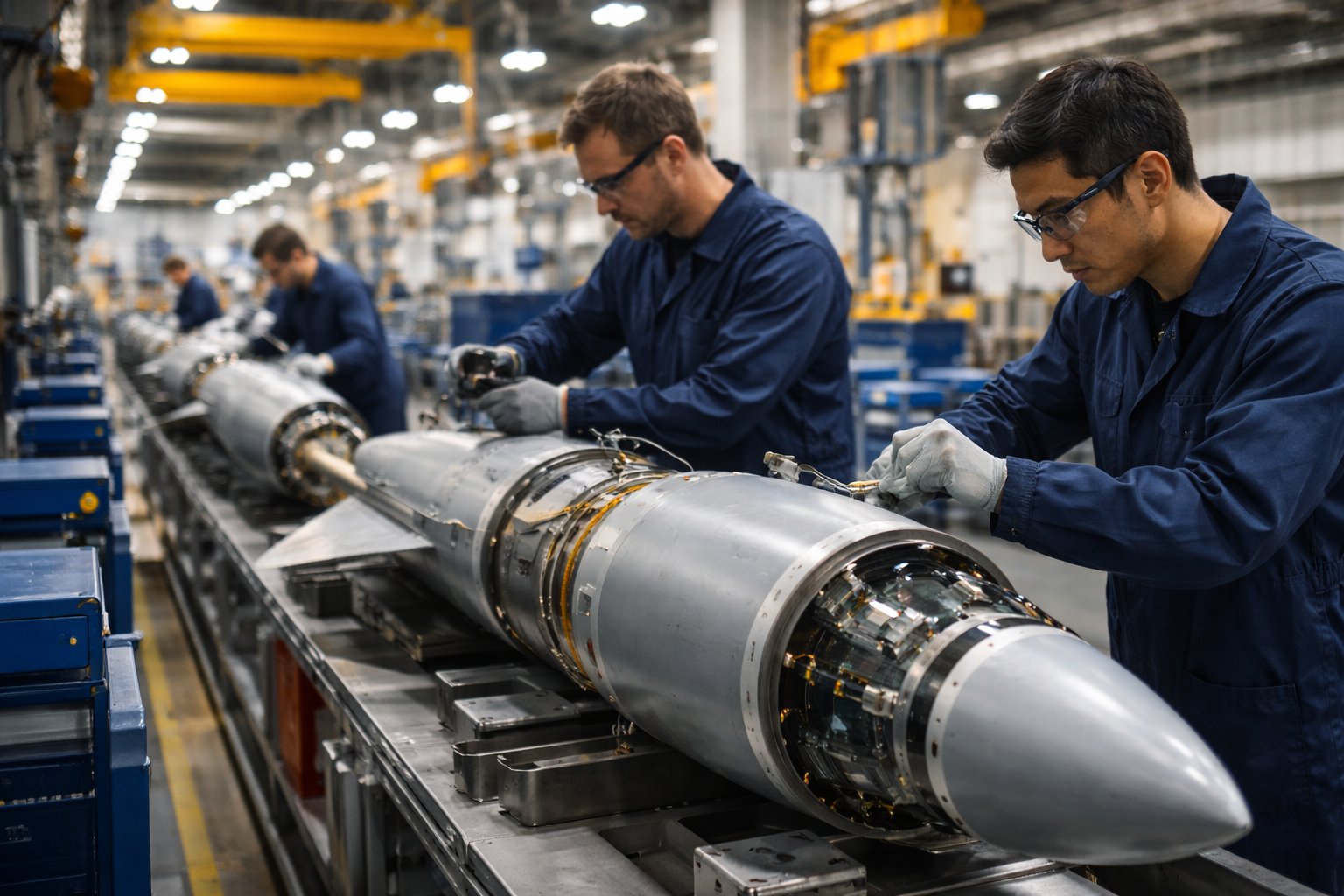
Featured image: Precision munitions assembly line (illustrative), not the Tamir factory.