IN Brief:
- Hunter WOLF advanced after evaluation of BLADE’s initial GroundBreaker 1 solution brief.
- A live hardware demonstration is scheduled for 19–23 October at Camp Grafton, North Dakota.
- Successful Phase II participants may be invited to propose a Prototype Other Transaction Authority award.
BLADE has been selected to advance its Hunter WOLF unmanned ground vehicle into Phase II of the GroundBreaker 1 demonstration, following a government technical evaluation of the company’s initial solution brief. The selection was announced on 8 October 2026.
The next stage is a live hardware demonstration scheduled for 19–23 October at Camp Grafton in North Dakota. Government evaluators intend to consider technology maturity, operational readiness and cross-domain interoperability rather than relying solely on the company’s description of the vehicle’s capabilities.
HDT Robotics, operating as BLADE, presents Hunter WOLF as a multi-mission unmanned vehicle with potential applications in tactical logistics, intelligence, surveillance and reconnaissance, casualty evacuation and communications support. The announcement does not identify a new production order or a committed vehicle quantity.
Ground robotics is increasingly considered for tasks that expose service personnel to unnecessary risk. Moving supplies across difficult terrain is one such application. Ammunition, water and equipment have to reach dispersed units, often in locations poorly suited to conventional vehicles or routes that cannot be used safely.
A remotely controlled or autonomous carrier can potentially undertake some of those movements, but useful performance depends on more than advertised payload. Off-road stability, energy consumption, route selection, obstacle detection and the ability to recover from a fault all influence the practical operating envelope.
BLADE says Hunter WOLF combines off-road mobility, high payload capacity, onboard power and autonomous and remote-control functions. Different mission configurations create different engineering trade-offs. A vehicle carrying supplies has different requirements from one fitted with sensors or communications equipment.
For example, a reconnaissance payload may require continuous electrical power and a reliable path for transmitting collected information. A casualty evacuation configuration demands appropriate handling, restraint, movement and safe loading considerations. A single adaptable platform still needs separate testing of the specific arrangements in which it is intended to operate.
Autonomy introduces additional questions about navigation and situational awareness. A vehicle must estimate its location, recognise changes in terrain and respond to obstacles. Operating conditions may include poor visibility, limited positioning signals or surfaces that reduce traction and make planned movements unreliable.
Remote control offers an alternative means of operation but does not eliminate dependence on communications. The operator must receive enough information to understand the vehicle’s surroundings, and the command link must remain suitable for the level of control required. Combining autonomous and remote modes therefore brings both flexibility and integration challenges.
Interoperability is one of the declared GroundBreaker assessment criteria. The ability to exchange commands, vehicle status and mission information with existing military systems can determine whether a robot is practical to operate alongside personnel and other equipment. New capabilities may be difficult to deploy if their interfaces demand extensive changes to established workflows.
BLADE says Hunter WOLF has been evaluated in exercises and training and has supported operational use in Ukraine. Those company-reported experiences can inform the design and test programme, but they do not replace independent evidence from the GroundBreaker Phase II evaluation.
The company’s robotics sector president, Tom Van Doren, described the vehicle as mature and mission-ready. That assessment is the company’s position; the government demonstration will examine readiness under its own requirements. The announcement provides no independently published performance score or detailed test schedule.
Maintenance and support also matter for a military robotic platform. Spare parts, fault diagnosis, battery or fuel logistics and operator training can determine how much time a vehicle actually spends available for tasks. A platform that performs well in an isolated demonstration may still require changes before it is supportable in wider service.
Following Phase II, participants whose demonstrations are evaluated successfully may be invited to submit proposals under Phase III for a Prototype Other Transaction Authority award. Such an invitation would be another selection stage rather than automatic approval for procurement or fielding.
The October milestone establishes that Hunter WOLF has progressed into a live demonstration. The next source of meaningful evidence will be the government’s evaluation and any subsequent prototype award, which will indicate whether the vehicle advances beyond this stage.
Advancement to demonstration is fundamentally different from an operational procurement contract. GroundBreaker evaluators will see working hardware in October, but the company’s selection has not established acceptance for frontline deployment. Reporting should preserve that sequence and avoid describing Hunter WOLF as selected for Army procurement.
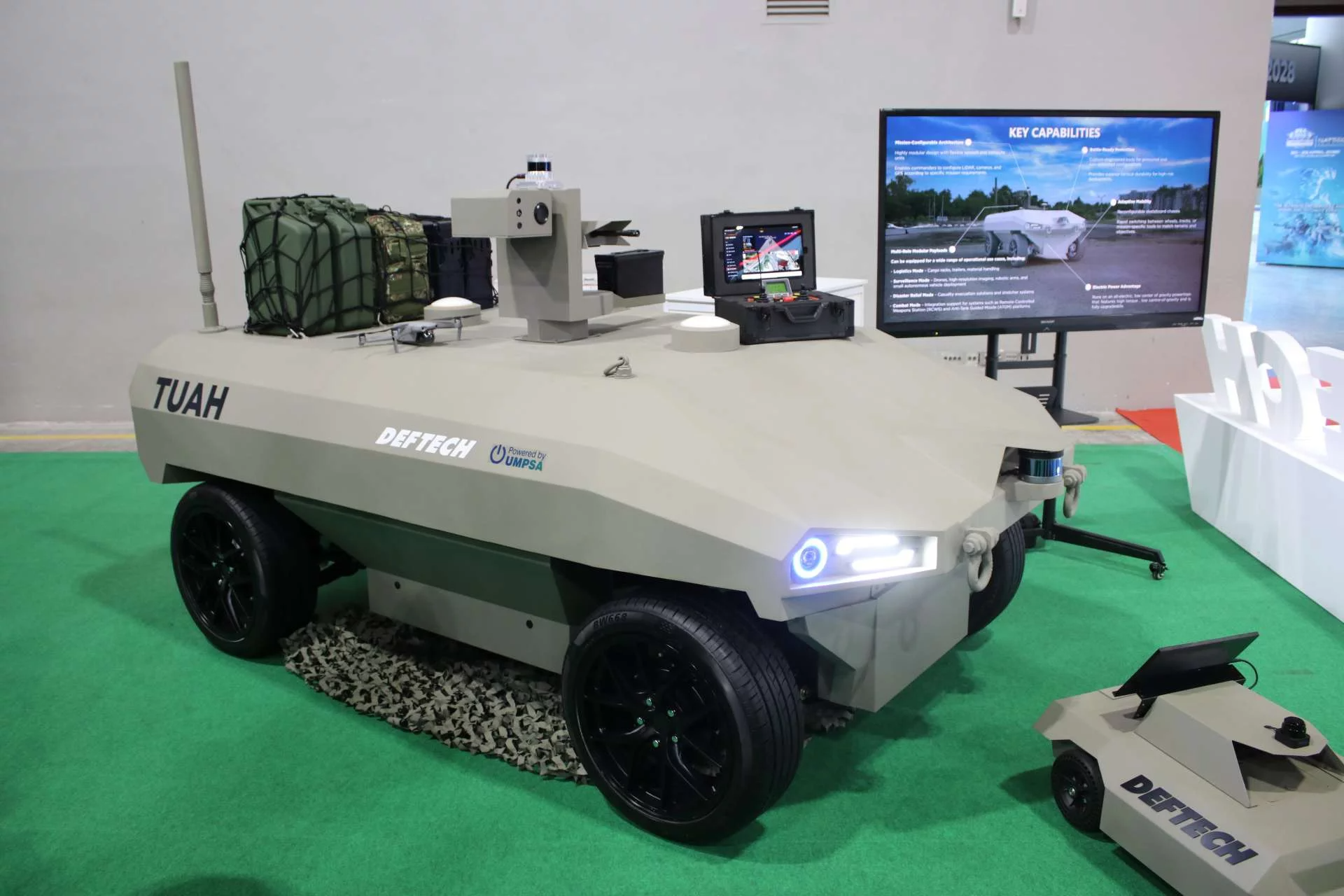
Featured image: Malaysian TUAH robotic vehicle (illustrative), not Hunter WOLF.