IN Brief:
- A $74,294,440 modification supports AN/SLQ-32(V)6 shipboard electronic warfare production for Canada, Japan and the US Coast Guard.
- Canada accounts for 52% of the funding, Japan 47%, and the Coast Guard 1%, with production in New York and Pennsylvania.
- The award was made on 9 October and disclosed in the 14 October contracts bulletin; completion is scheduled for September 2029.
Lockheed Martin has received a $74,294,440 modification for production of AN/SLQ-32(V)6 naval electronic warfare systems for Canada, Japan and the US Coast Guard. The award, made on 9 October and disclosed in the US government’s 14 October contracts bulletin, extends an existing Surface Electronic Warfare Improvement Program (SEWIP) contract. It does not constitute the first procurement of the equipment by these customers or a new system development programme.
The firm-fixed-price modification combines two Foreign Military Sales allocations and a smaller Coast Guard allocation. Canada’s share is $38,388,165, equivalent to approximately 52% of the modification, while Japan’s is $35,448,507, about 47%. The US Coast Guard accounts for the remaining $457,768, or 1%. Those amounts describe this particular award; they are not the full values of the customers’ ship programmes or their overall electronic warfare spending.
Lockheed Martin will undertake 78% of the work at Liverpool, New York, and 22% at Lansdale, Pennsylvania, with completion scheduled for September 2029. The notice identifies funding, workshare and completion dates but gives no ship-set quantity, installation sequence or breakdown of equipment by vessel. A value per installation cannot therefore be calculated from the contract total.
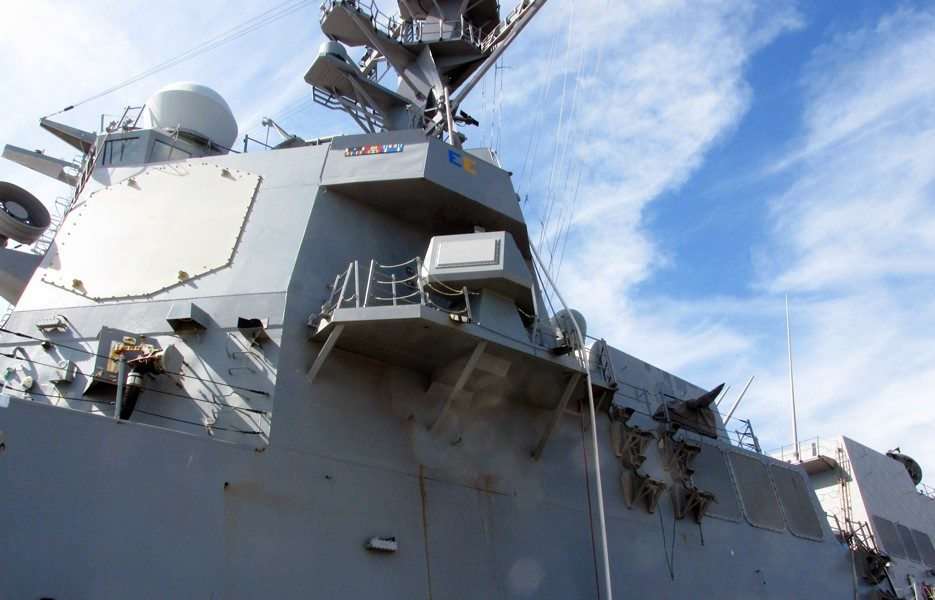
The AN/SLQ-32(V)6 is a SEWIP Block 2 electronic support configuration for surface vessels. It modernises the receiver, antenna and combat-system connections of earlier AN/SLQ-32 equipment so a ship can detect, identify and assess radio-frequency emissions associated with potential threats. Its role includes giving combat-system operators an additional source of warning data, rather than independently determining an entire defensive response.
Electronic support is different from electronic attack. A passive receiver monitors emissions rather than transmitting energy to jam an opposing system. Antennas and receiving electronics measure the characteristics of signals present around the vessel; processing equipment evaluates those measurements to assist with emitter identification and an assessment of bearing or other relevant properties. The ship’s combat system can then correlate that information with additional sensor inputs.
Under Block 2, redesigned receiving hardware and interfaces allow collected electronic support information to be transferred to the ship’s wider combat system. Lockheed Martin describes enhanced sensitivity and threat recognition compared with earlier configurations, but the October procurement notice contains no comparative test results or newly demonstrated detection-range figures. Published product claims must therefore remain separate from the facts of the latest production modification.
The combat system may correlate an electronic warning with radar, optical or other information before cueing appropriate defensive equipment. The response depends on the particular vessel’s fitted sensors, decoys and countermeasures. AN/SLQ-32(V)6 is principally a passive electronic support installation; this modification does not announce procurement of SEWIP’s separate electronic attack functions, and it should not be described as an order for shipboard jammers.
Using a common equipment family across fleets offers opportunities to reuse maintenance procedures, software support and selected spares. It does not eliminate customer-specific engineering. Antenna positioning, vessel structure, electromagnetic interference, cooling provision and combat-system interfaces must still be assessed for each installation. No technical configuration for the latest Canadian, Japanese or Coast Guard units has been released.
Japan had previously contracted for SEWIP Block 2, with Lockheed Martin announcing its first international sale in 2024. Canada has also been associated with the technology for its River-class destroyer programme. The October award represents additional funded production activity, although it does not specify which vessels will receive which equipment or whether the order changes existing installation schedules.
Manufacturing a shipboard electronic warfare installation involves more than producing receiver electronics. Assemblies must retain their performance characteristics when installed among the ship’s own high-power transmitters, antennas, communications equipment and other sources of electromagnetic interference. Cables, cooling arrangements, enclosure protection and software interfaces affect whether equipment behaves as expected after installation. The award notice does not detail the acceptance tests or integration schedule assigned to the latest units.
The funded production period stretching to September 2029 gives a defined horizon for the added work in New York and Pennsylvania. Even so, the published allocation by country does not reveal unit prices or quantities. Engineering support, material procurement and system configuration can vary between customers, and there is no public itemisation with which to calculate a price per fitted ship.
Shipboard electronic support also needs to remain distinct from radar target detection and active electronic attack. Radar sends out energy to observe reflections, while this part of SEWIP assesses electromagnetic signals emitted by other systems. Jamming equipment, where fitted, transmits interference as an effect. The different functions can exchange information through a combat system, but the Navy’s award identifies the passive AN/SLQ-32(V)6 production scope.
The published award gives Lockheed Martin production work through September 2029, with spending allocated between two foreign customers and the US Coast Guard. Delivery, acceptance and shipboard integration dates have not been identified; those milestones will determine when the contracted equipment enters individual fleets.