IN Brief:
- The second ANKA III line has been constructed in Ankara but is not yet operating; opening is planned for November.
- A company official projects one aircraft every five months on the new line, not a proven production rate.
- The proposed 1.75-tonne payload for an enlarged ANKA III has not been flight-qualified, and baseline figures differ between sources.
Turkish Aerospace has finished building a second ANKA III production line at its Ankara facility, according to a company official speaking during an industry visit. The line is due to open in November 2026 and is intended to manufacture a larger variant of the flying-wing uncrewed combat aircraft. Completion of the installation is an industrial milestone, but the company has not reported aircraft production, acceptance or delivery from the new line. Its enlarged aircraft has yet to complete the flight testing needed to establish its performance.
The Turkish Aerospace official said the new line was expected to support production of one ANKA III every five months. That is a proposed output rate for this line, not an achieved manufacturing cadence, an independently verified capacity test or a delivery rate for the entire ANKA III programme. The first aircraft from the expansion is expected to roll out soon and enter flight testing afterwards, according to the same account. No fixed rollout, maiden-flight or customer-acceptance date was provided. Output will depend on the commissioning of the line, material availability, assembly and inspection work, and successful testing of the upgraded configuration.
The company official described a projected 1.75-tonne payload for the enlarged aircraft, compared with approximately 1.3 tonnes cited during the interview for the earlier version. Turkish Aerospace’s published ANKA III technical data separately specifies 1,200kg for the existing aircraft. The 1.3-tonne interview figure and 1,200kg published specification therefore have different source contexts and should not be presented as a reconciled measurement. The 1.75-tonne figure is an announced target for the proposed new variant, not a flight-qualified payload. Structural, propulsion, control-system and internal-bay changes associated with the enlarged airframe were not fully specified.
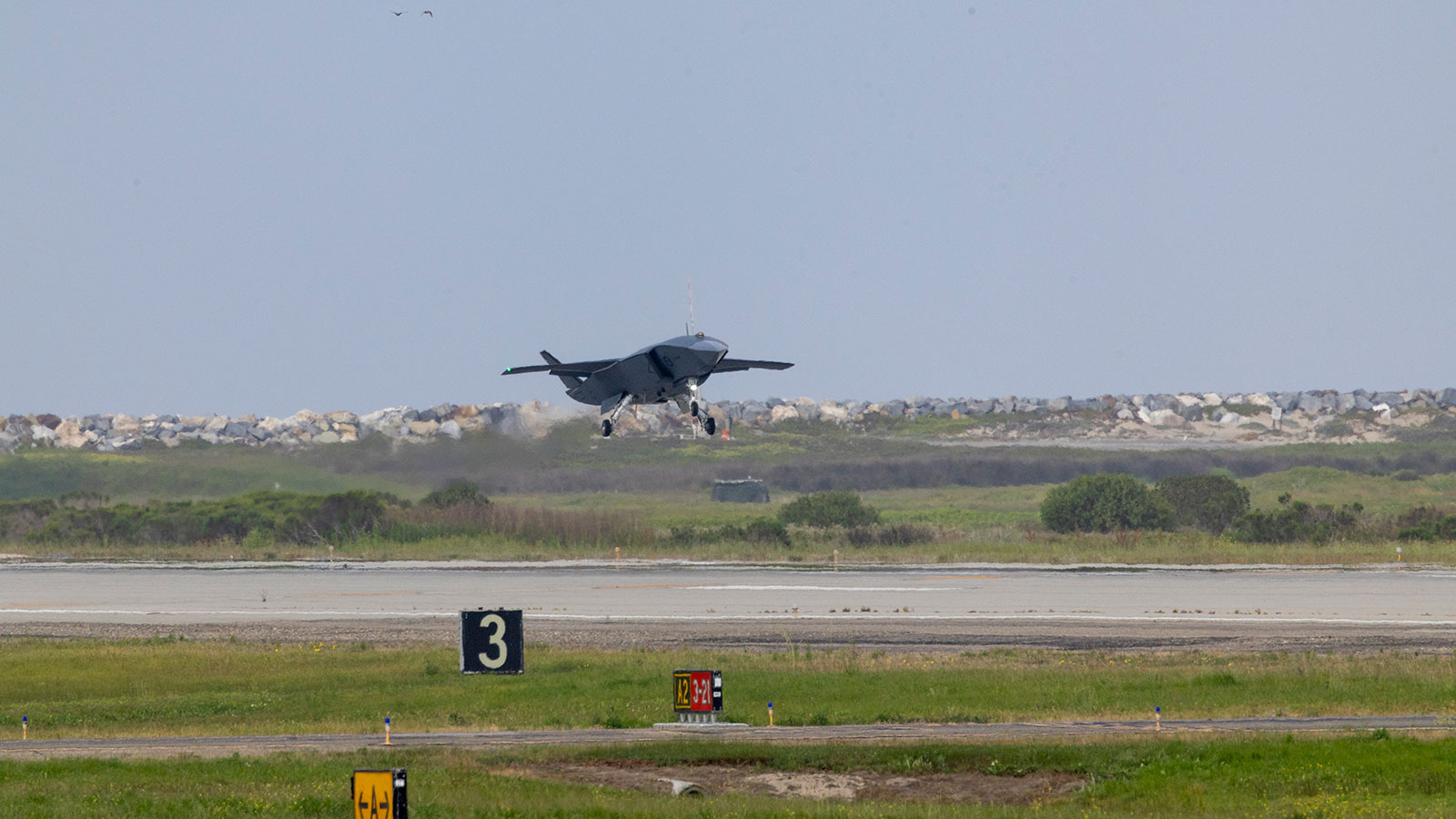
ANKA III uses a flying-wing configuration and turbofan propulsion. The absence of a conventional tail and the aircraft’s low observable design are intended to help control its radar signature, while internal payload stations allow stores to be carried without relying entirely on external pylons. Those design choices also place considerable demands on flight control software because stabilisation, manoeuvring and mission control must be achieved without a traditional tailplane arrangement. The manufacturer says the aircraft shares an avionics architecture and ground segment with the ANKA and AKSUNGUR families.
Turkish Aerospace publishes a maximum speed of Mach 0.7, a service ceiling of 40,000ft and endurance of ten hours at 30,000ft for the existing ANKA III. Those are published specifications for the baseline aircraft and should not be transferred automatically to the enlarged variant. Increasing payload allowance can change structural loads, mass distribution, available fuel and handling characteristics. Separate flight testing and engineering acceptance will be necessary to establish the upgraded aircraft’s performance envelope, with no independently confirmed speed or endurance figures for that version.
Turkish Aerospace has already tested the original ANKA III in flight, including weapon releases described on its website. Its published payload options include precision-guided bombs, guided rockets, electro-optical sensors, radar and electronic warfare equipment. Installing a new store demands compatible mounts, power and data connections, separation testing and suitable flight control responses. Greater proposed payload mass for the enlarged airframe does not amount to qualification of particular munitions or sensors, and the company’s published trials refer to the existing configuration.
During the visit, the company official said the Turkish armed forces had ordered 80 ANKA III aircraft and expected the first delivery in 2027. Those details are attributed to the official’s briefing; an independent order schedule, aircraft configuration split and contractual delivery sequence were not provided. The projected output of the second line, even if achieved, cannot be used by itself to calculate the order’s overall delivery rate because the contribution of the existing production operation and subsequent manufacturing increases has not been established.
At Ankara, conventional ANKA airframes were visible at different stages of assembly alongside other Turkish Aerospace uncrewed systems. The factory therefore supports several separate aircraft families, and completion of another ANKA III line does not demonstrate that staff, parts or tooling can move freely between programmes. Repeatable output from the enlarged aircraft line will depend on structural components, qualified technicians, software installation, inspection routines and flight acceptance facilities. The manufacturing plans have not been accompanied by audited output figures.
The next identifiable milestones are opening the additional production line, completing its first enlarged airframe, and beginning the promised flight tests. The company has announced manufacturing plans and projected payload and throughput figures, but the line’s repeatable production rate and the variant’s operating limits remain to be demonstrated. Actual deliveries, acceptance and confirmed configuration data will provide the basis for assessing progress beyond the new facility’s construction.