IN Brief:
- The UK and Germany reviewed established defence programmes at Lancaster House on 15 October, with an announcement the following day.
- Deep Precision Strike remains a bilateral development initiative rather than a newly awarded weapons production contract.
- The talks built on the 2024 Trinity House Agreement and 2025 Kensington Treaty without announcing qualified systems or deliveries.
The UK Ministry of Defence and German defence officials have reviewed existing bilateral equipment programmes and opportunities for industrial cooperation at Lancaster House in London. The talks included the joint Deep Precision Strike initiative and collaboration across air, land, maritime and space capabilities. Announced on 16 October, the discussions continued work under established bilateral agreements; the ministers did not announce a new weapons production contract, completed missile design, qualified system or new delivery schedule.
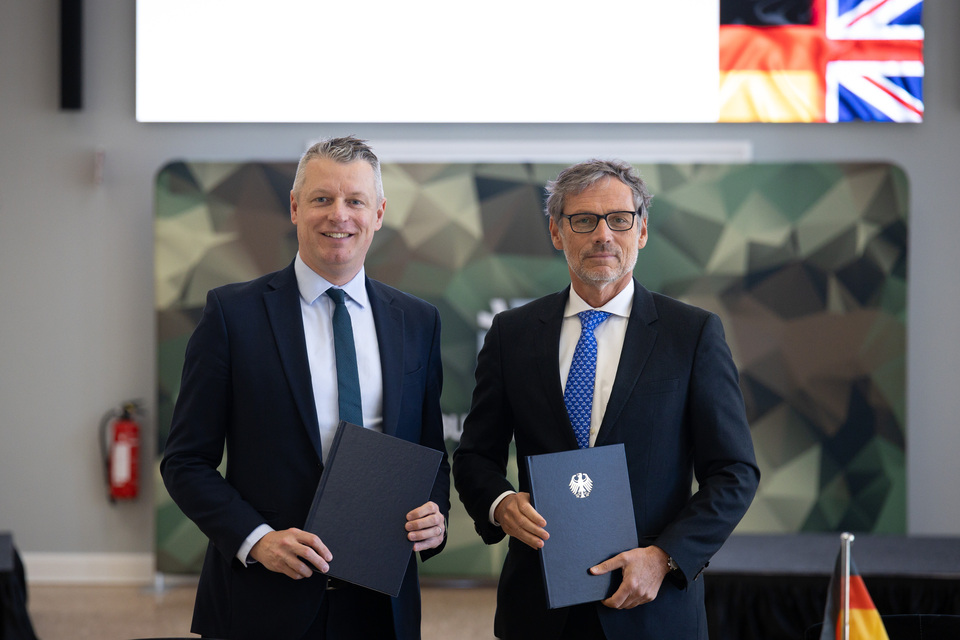
The Ministerial Group on Equipment and Capability Cooperation, known as MECC, met on 15 October, hosted by UK Minister for Defence Readiness and Industry Luke Pollard. Germany was represented by State Secretary for Armament, Innovation and Cyber Jens Plötner and senior armaments officials. The Ministry of Defence described the meeting the following day as a review of joint programme progress and future priorities. It provided no new contract value, manufacturing allocation, approved system specification or industrial workshare arising from that session.
Deep Precision Strike remains one of the bilateral initiatives under discussion. The UK and Germany have pursued a future long-range precision strike capability under their earlier cooperation arrangements, with the technical effort potentially spanning propulsion, guidance, communications, platform integration and eventual manufacture. The programme was already under discussion at ministerial meetings in March 2026, when the government described a prospective capability of more than 2,000 kilometres and a service ambition in the 2030s. The October meeting did not certify those performance objectives, settle a missile configuration or announce completion of a development phase.
Work of this kind places substantial demands on suppliers because propulsion and guidance components must be developed alongside structural hardware, control electronics, mission planning interfaces and production quality systems. Qualification involves verifying performance under stated operating conditions and demonstrating that subsystems work together reliably. Those requirements help explain the industrial content of bilateral development, but the meeting did not identify newly selected subcontractors, launch new test activity or allocate a production share between the two countries. Any such allocation would need confirmation through programme documents or contractor announcements.
The latest meeting builds on the Trinity House Agreement signed in October 2024, which established defence cooperation objectives across several capability areas. It also sits within the Kensington Treaty concluded in July 2025, providing a broader bilateral framework. These agreements can help the parties align requirements and identify development opportunities, but they do not themselves constitute authority for individual production orders. Design approval, funding, supplier selection and customer acceptance remain programme-specific decisions that were not resolved by the latest ministerial talks.
The industrial dimension extends beyond the lead manufacturers of large equipment. A joint programme needs compatible electronics, software assurance, materials supply, machine tooling, test equipment and through-life support arrangements. Suppliers in both countries may offer different manufacturing processes and qualification experience, while authorities need traceable configuration control when more than one national organisation contributes to a system. The London statement does not establish a new common technical standard or a specific rule for sharing sensitive design information; those questions remain dependent on the arrangements for each programme.
Ministers also considered the broader environment for industrial resilience, following an October meeting in Berlin at which the countries agreed to develop cooperation in space and counter-hybrid threats. Space capability can involve spacecraft, ground infrastructure, terminals and secure information exchange, each with different ownership, assurance and operational requirements. Counter-hybrid resilience likewise spans several areas rather than a single procurement item. The government announcement did not identify a particular new satellite purchase or cyber technology contract as the outcome of the Lancaster House talks.
Industry representatives also joined a panel at the German Embassy. Participants named in the government announcement included Philipp Kerth, co-founder and chief executive of Hypersonica, and Katherine Williams, Rolls-Royce’s vice-president for UK and international government relations. Their involvement reflects the industrial topics discussed, not a new supplier appointment to Deep Precision Strike or any other capability programme. No contract award or confirmed manufacturing role for either company was disclosed at the event.
Industrial cooperation is frequently measured in contracts placed, production capacity created and systems delivered. The latest UK-German session supplies evidence of continued joint planning, with the possibility of more closely aligned requirements and technology development, but it does not yet yield measurable output in those terms. The distinction is especially important for long-range weapons, where early discussions can precede several years of systems design and qualification before production capacity is needed.
The next measurable progress will come from funded development phases, documented design requirements, supplier awards and verified testing milestones. The 15 October talks maintained political and industrial cooperation around Deep Precision Strike and other capabilities, but left manufacturing commitments, technical approvals and delivery plans to future programme decisions. In the absence of those decisions, the latest development is cooperation and planning rather than completed weapons engineering or a new procurement award.