IN Brief:
- Australia's National Reconstruction Fund Corporation is providing A$245 million in conditional debt financing for Austal Defence Australia's Henderson shipbuilding facilities.
- The investment will support modular manufacturing for eight Landing Craft Heavy vessels under an existing contract worth approximately A$4 billion.
- Austal currently employs around 1,200 people in Australia, with the additional facilities expected to support 780 new Western Australian jobs.
Australia’s National Reconstruction Fund Corporation is providing A$245 million in conditional debt financing to Austal Defence Australia for expanded naval manufacturing facilities at Henderson, Western Australia, supporting construction of eight Landing Craft Heavy vessels for the Australian Army.
The funding will be used to construct and equip facilities at the Australian Marine Complex with modular manufacturing capabilities. The investment addresses the industrial infrastructure required for a shipbuilding programme already awarded to Austal, rather than increasing the number of vessels ordered or representing an additional ship procurement contract.
Austal Defence Australia is the Commonwealth’s strategic shipbuilder in Western Australia under a Strategic Shipbuilding Agreement executed in August 2025. Its existing Landing Craft Heavy contract, signed in February 2026 and valued at approximately A$4 billion, covers construction of eight vessels, with the final ship scheduled for delivery in 2038.
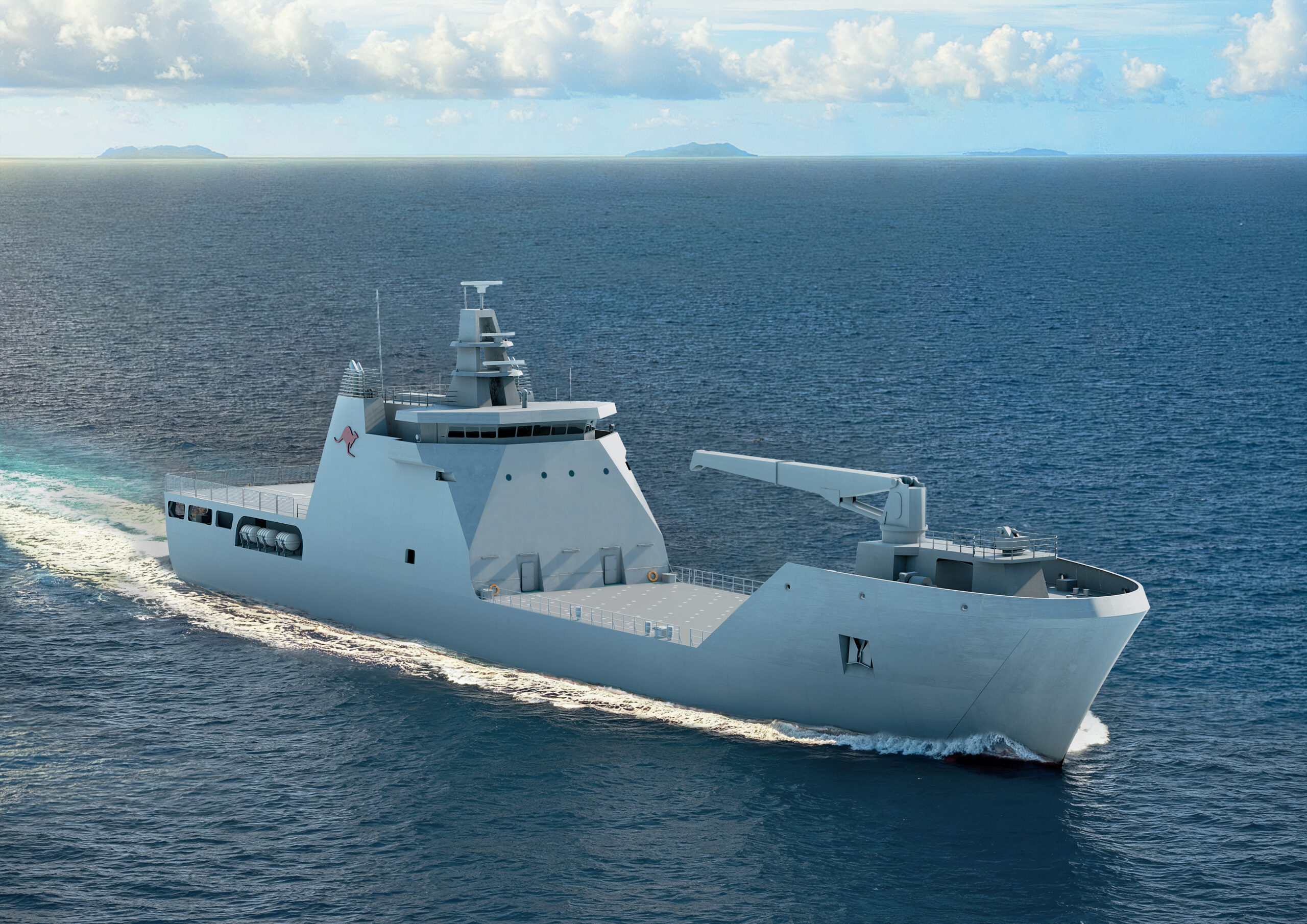
The Landing Craft Heavy design is based on Damen’s LST100 platform and is intended to move personnel, vehicles and equipment between maritime operating areas and the shore. Austal’s published specifications describe vessels approximately 100 metres long and 16 metres wide, with displacement of around 3,900 to 4,000 tonnes.
Each vessel is designed to carry more than 200 embarked soldiers alongside substantial military equipment. Austal gives example loads of six M1A2 SEP v3 Abrams tanks or nine Redback infantry fighting vehicles, while the Australian Government identifies an embarked carrying capacity exceeding 500 tonnes. These figures describe design capabilities and example configurations, not a requirement to carry all the listed equipment simultaneously.
The ships will support amphibious transport, military logistics and humanitarian operations across Australia’s region of interest. Their ability to carry heavy vehicles and equipment between maritime locations and suitable landing areas is intended to strengthen the Army’s capacity to move and sustain forces without relying exclusively on established port infrastructure.
Constructing vessels of this size requires different facilities and production arrangements from those used for smaller patrol craft or landing vessels. Large hull structures must be divided into manageable sections, fabricated to defined tolerances and assembled into larger modules before final joining, installation and testing.
Modular manufacturing allows structural work and some equipment installation to take place in controlled workshop conditions before modules are transferred to the final assembly area. Machinery foundations, pipework, electrical routes and other features can be incorporated during fabrication where the design and production sequence permit.
The approach can reduce the amount of work performed inside a largely completed hull, but it depends on accurate engineering information and close control of manufacturing tolerances. Interfaces between modules must align, while connections for electrical distribution, ventilation, piping and other systems must accommodate the final assembly sequence.
Structural fabrication also introduces dimensional challenges. Welding produces local heating and cooling that can distort metal sections, requiring survey, fixtures and controlled assembly procedures. As modules increase in size, small deviations can become more difficult to correct, making inspection and production planning important to the overall construction process.
The National Reconstruction Fund investment will provide facilities designed around those requirements. Its stated purpose includes developing modular assembly and quality assurance capability within Australia, allowing a greater proportion of the shipbuilding process to be managed through domestic production infrastructure.
Equipment installed at a new manufacturing facility must itself be integrated into the production workflow. Cutting, forming, lifting, welding, inspection and material-handling operations need to be arranged so that work can move between stages without creating unnecessary delays or congestion. The exact machinery and production systems to be installed at Henderson have not been itemised in the financing statement.
Quality assurance extends beyond verifying completed hull structures. Naval vessels require documented material specifications, traceable components, inspection records and acceptance procedures covering mechanical, electrical and structural systems. Manufacturing facilities must support those activities throughout production, including the identification and correction of defects before assemblies progress to later stages.
Shipbuilders must also maintain configuration control across successive vessels. Engineering changes introduced during a long production programme may affect drawings, component selection, installation procedures and the supply of spare parts. Consistent documentation is necessary to ensure that each hull reflects its approved technical configuration, particularly where equipment is supplied by several contractors.
The expanded facilities will operate within a broader shipbuilding programme at Henderson. Austal also holds a Landing Craft Medium design and build contract, awarded in December 2025 for approximately A$1.029 billion. The medium and heavy landing craft programmes create overlapping demands for engineering resources, production capacity and specialist suppliers.
Although the vessels differ substantially in size and capability, both programmes require a reliable flow of fabricated components and equipment into the construction process. Production schedules must account for the availability of materials, qualified tradespeople, inspection resources and shared facilities. Additional manufacturing space can relieve some constraints, but the benefits depend on its commissioning and integration with existing operations.
Austal currently employs approximately 1,200 people in Australia. The National Reconstruction Fund Corporation estimates that the investment will support another 780 jobs in Western Australia, including positions in skilled trades, engineering and advanced manufacturing. These are expected employment outcomes; the announcement does not establish that the positions have already been recruited.
Expanding the workforce will require training and the development of specialist skills alongside recruitment. Marine fabrication, systems integration and inspection depend on personnel who can work to approved engineering procedures, while experienced supervisors and technical staff are needed to maintain consistent production standards as output increases.
The programme also provides opportunities for suppliers involved in steel fabrication, machining, electrical systems, machinery installation and specialist testing. Local industrial participation will depend on procurement decisions and suppliers’ ability to meet contractual specifications, schedules and quality requirements. Neither the financing statement nor the underlying vessel contract provides a complete allocation of work to individual businesses.
For the Australian Government, the facility investment forms part of a wider effort to maintain domestic naval construction capacity. The National Reconstruction Fund had previously committed A$327 million to defence and related industrial investments. The additional A$245 million brings the stated total above A$570 million across separate projects.
The new funding is a debt investment, not a direct grant. The National Reconstruction Fund Corporation says the transaction remains subject to completion of finance documentation and customary conditions. Repayment terms, interest arrangements and any security associated with the financing have not been disclosed publicly.
The agreement therefore provides a defined financing commitment for facilities needed by an existing production programme, subject to those remaining conditions. The next milestones will be completion of the transaction, development and commissioning of the Henderson facilities, and their incorporation into the construction schedule for the eight Landing Craft Heavy vessels.