IN Brief:
- Construction began on 4 November at the Hanwha WB Advanced System plant in Gorzów Wielkopolski.
- The factory will support Polish production of guided rockets for HOMAR-K, with phased transfer of manufacturing know-how.
- The roughly PLN 14 billion figure covers a wider missile supply agreement, not a separately disclosed factory construction budget.
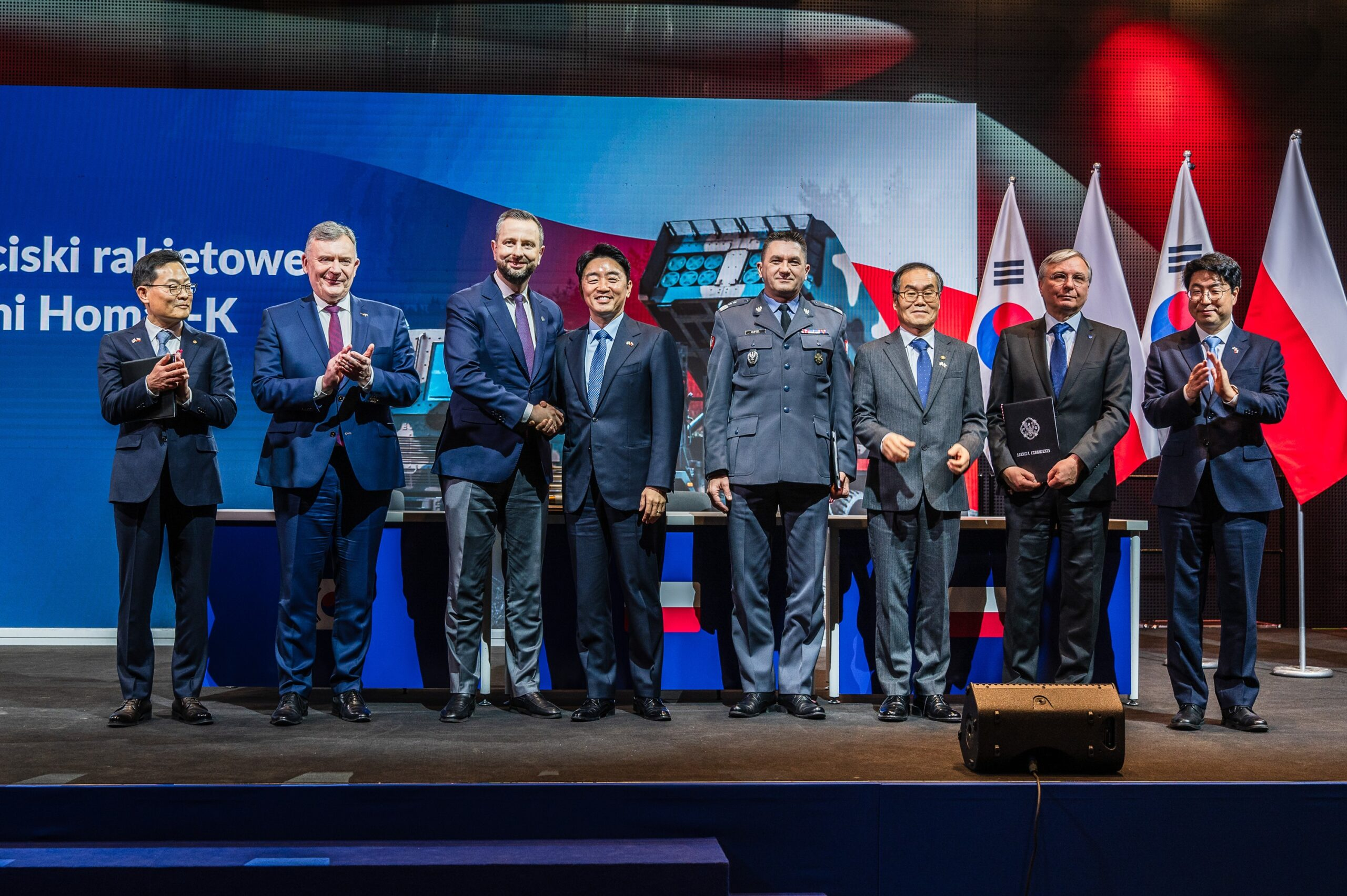
Hanwha Aerospace and Poland’s WB Group have begun construction of a guided rocket manufacturing facility in Gorzów Wielkopolski, marking a new stage in Poland’s HOMAR-K artillery programme. The 4 November 2026 ceremony inaugurated work on the Hanwha WB Advanced System plant, which is intended to manufacture missiles for the Polish Armed Forces and expand the country’s domestic defence manufacturing capacity.
The facility forms part of a Polish–South Korean industrial arrangement established before this week’s groundbreaking. Deputy Defence Minister Magdalena Sobkowiak-Czarnecka attended the ceremony on behalf of Defence Minister Władysław Kosiniak-Kamysz. Poland intends the plant to establish domestic capacity to manufacture guided rockets, with production know-how transferred through the Hanwha WB joint venture.
The manufacturing programme follows an agreement between Hanwha Aerospace and WB Group announced in September 2025 to establish a joint venture and localise production of CGR-080 guided missiles. These weapons have a stated range of approximately 80 kilometres and are intended for the HOMAR-K multiple launch rocket system. The Polish configuration draws on South Korea’s K239 Chunmoo technology within a programme developed for national requirements.
On 29 December 2025, the Armament Agency signed a further executive contract valued at approximately PLN 14 billion gross. The agreement covers thousands of CGR-080 precision-guided rockets under the HOMAR-K programme, including ammunition to be produced in Poland. The PLN 14 billion figure belongs to that supply contract; the ministry has not given it as the capital cost of the Gorzów factory.
The consortium for that contract is led by Hanwha WB Advanced Systems alongside Hanwha Aerospace. Deliveries of the contracted rockets are scheduled to begin in 2030. The production programme has its own intermediate requirements, including completion of the buildings, installation of machinery, process transfer, workforce qualification, and acceptance of the finished ammunition before deliveries can start.
Manufacture of a guided rocket requires controlled assembly and inspection of propulsion, guidance, flight control, structural, and payload components. Each stage depends on traceable materials, suitable handling conditions, and repeatable quality checks. The partners have not published a factory process map or disclosed which subassemblies will initially be manufactured in Poland, so the final division between imported components and domestic operations remains to be established.
The September 2025 joint venture agreement provides for technology transfer in phases, supported by certified quality management and structured employee training. Production transfer will require workers to follow approved manufacturing instructions, inspection teams to confirm dimensional and functional compliance, and the partners to maintain consistent product records between sites. Serial production will also require qualification of equipment, processes, and the completed ammunition against contractual acceptance requirements.
Poland expects the plant to improve its capacity to replenish rocket stocks through manufacture on national territory. A domestic assembly line can shorten some supply routes and support local engineering skills, while imported electronics, materials, or specialist subassemblies may remain necessary until further processes are localised. The extent of industrial independence will become clearer as the agreed technology transfer progresses.
The Polish government expects the plant to employ more than 200 people and create opportunities for companies in the Lubusz region. Hanwha’s 2025 plans envisaged approximately 250 skilled posts, broadly consistent with that ambition. Those numbers are recruitment targets rather than an existing workforce: the 4 November event inaugurated construction, with manufacturing equipment and industrial operations still to follow.
Beyond CGR-080, the partners have outlined an intention to develop future rocket types for Polish and potential allied requirements. Each additional design would demand its own engineering work, tests, approvals, and export permissions. The present procurement contract covers CGR-080 deliveries; future products remain development plans subject to Polish procurement rules and South Korean export controls.
HOMAR-K combines a launcher derived from the South Korean K239 Chunmoo with equipment adapted to Polish requirements and support arrangements. Local ammunition manufacture would add a domestic source of qualified rockets to that fleet, alongside the storage, handling, maintenance, and training needed to keep launchers supplied. The production schedule will determine when Polish output begins contributing to contracted deliveries rather than relying solely on imported rounds.
The immediate milestone is the start of construction at Gorzów Wielkopolski. The planned factory must next complete its buildings, commission production machinery, qualify manufacturing procedures, and prepare the workforce before accepted rockets can leave the site. Hanwha and its Polish partners have tied the current CGR-080 order to deliveries beginning in 2030, while the ministry has not announced a separate completion date for the facility.