IN Brief:
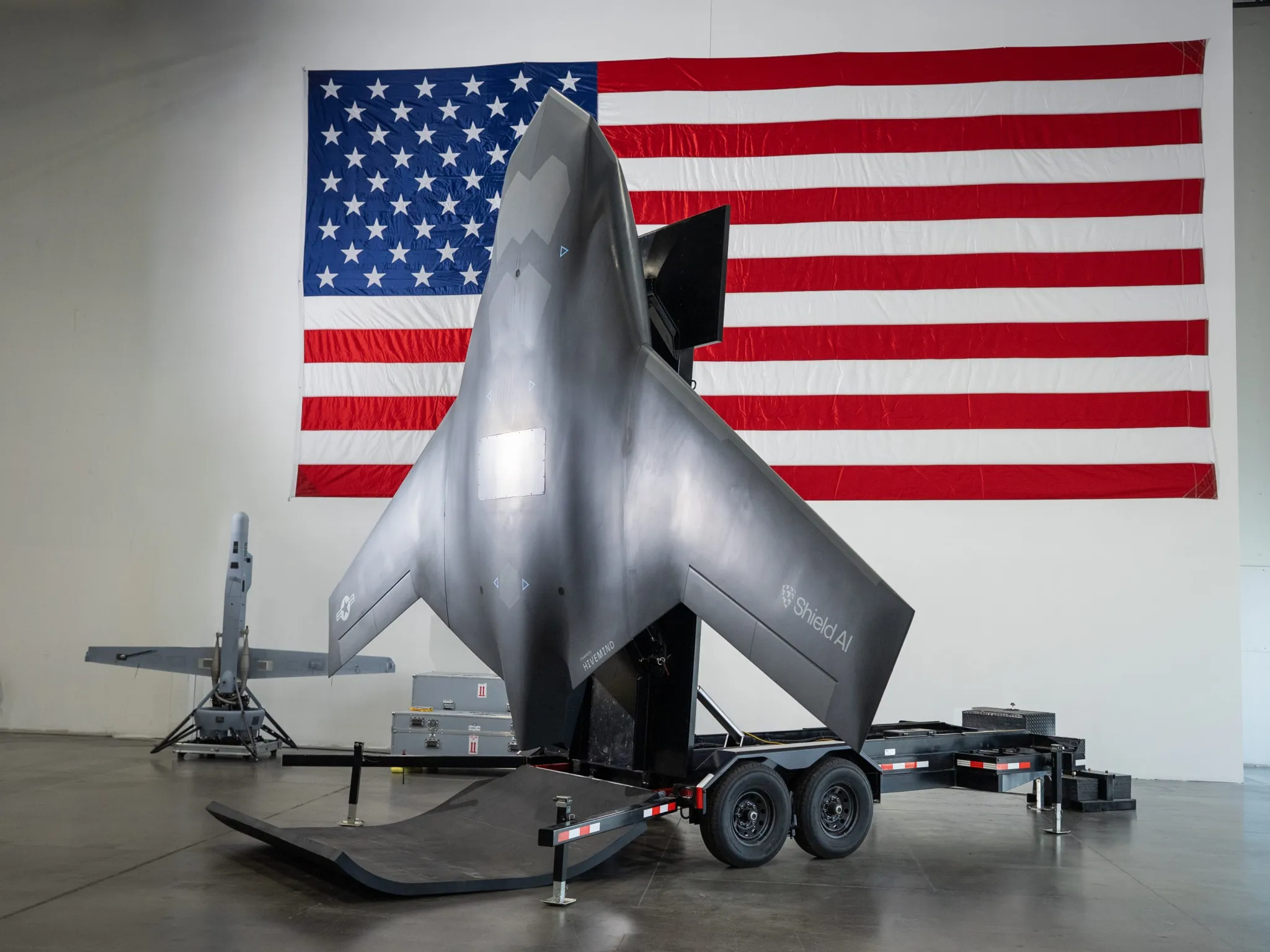
- Shield AI revealed the first full-scale X-BAT 001 prototype on 3 November, ahead of ground tests at its Newton, Kansas flight-test facility.
- The jet-powered, tail-sitting design combines vertical launch and recovery ambitions with Hivemind autonomy, GE F110 propulsion, and a thrust-vectoring exhaust arrangement.
- Untethered vertical flight remains unproven; Shield AI is targeting flight testing in late 2026 or early 2027 and production from 2029.
Shield AI has revealed X-BAT 001, the first full-scale prototype of its proposed autonomous, jet-powered combat aircraft designed to take off and land vertically from a tail-sitting position. Images and video circulated on 3 November 2026 show the prototype ahead of its transfer from the company’s Frisco, Texas development operation to the X-Forge 2 test facility at Newton City-County Airport in Kansas.
A completed full-scale airframe advances the programme beyond the earlier models, digital illustrations and propulsion subsystem tests. Flight qualification still depends on demonstrating how the tail-sitting aircraft responds to thrust changes, disturbances and the transition between vertical and wing-borne flight. Initial work at the Kansas test site is intended to address those control and recovery functions before the prototype can attempt untethered flight.
X-BAT is designed to operate without a conventional runway, allowing potential deployment from ships, small islands, and other locations where a fast-jet airfield is unavailable. The proposed aircraft rises and descends vertically using jet thrust, then transitions to wing-borne forward flight. That operating method differs from a conventional combat aircraft because control must remain effective while airspeed and aerodynamic lift change considerably during the transition between vertical and horizontal flight.
The planned propulsion system combines a GE Aerospace F110-GE-129E engine with an Axisymmetric Vectoring Exhaust Nozzle (AVEN) that redirects thrust to assist control. The companies announced engine, nozzle and control integration trials earlier in 2026, including engine light-off testing. Those results establish progress on a propulsion subsystem, but the 3 November footage does not independently confirm the installed prototype’s complete equipment configuration or readiness for a vertical take-off.
Vertical flight places particular demands on the control system because conventional aerodynamic surfaces have limited authority when airflow over the wing and tail is low. The aircraft must use its available thrust-control mechanisms to manage attitude and position while accounting for engine response, disturbances, and proximity to the ground or launch apparatus. As speed rises, the balance between thrust-based and aerodynamic control changes, requiring software that can manage the transition without loss of stability.
The company intends the aircraft to be piloted by its Hivemind autonomy system, which it says is designed for operations where satellite navigation and communications links may be unavailable. Such an ambition requires onboard navigation, sensing, flight management, and fault handling appropriate to the aircraft’s operating environment. The prototype’s markings identify the proposed autonomy architecture, but images alone cannot verify that every intended sensor, mission system, or autonomous function has been installed and tested.
Early testing is expected to proceed in stages, beginning with supported engine operation and control checks before progressively less constrained vertical trials. Contemporary reporting describes horizontal engine runs with the aircraft held on launch-and-recovery equipment, followed by supported tests and eventual untethered flight. Restraining the airframe during initial tests allows engineers to inspect propulsion response and control behaviour without immediately exposing the aircraft to every risk of unsupported vertical flight.
At the 3 November unveiling, the X-BAT 001 prototype had not publicly demonstrated an untethered vertical take-off, transition to wing-borne flight or autonomous operational mission. Shield AI’s published target placed initial flight testing near the end of 2026, potentially extending into early 2027. The timing of later operational capability will depend on flight data, system integration, airworthiness assessment and customer decisions.
Two full-scale prototypes are planned, allowing engineering and flight testing to proceed as the design develops. Images released in early November show an airframe that differs from earlier promotional models, but the shadowed footage does not independently establish its finished mass, fuel and payload capacity, sensor installation or thrust-control hardware condition. Published photographs should therefore not be treated as evidence that every planned subsystem has been fitted and qualified.
Engineering work extends beyond demonstrating a stable vertical take-off. A combat aircraft also needs to accommodate fuel, internal payloads, thermal management, electrical power, and structural loads while meeting its planned endurance and survivability requirements. Shield AI has described an objective combat radius of 1,000 nautical miles and internal weapon carriage up to the 2,000lb class. These are design objectives rather than verified performance figures for the prototype, and the final envelope will depend on the aircraft configuration demonstrated in flight testing.
Prototype work is centred in Frisco, Texas, while Shield AI has designated X-Forge 2 at Newton City-County Airport, Kansas, as the flight-test and sustainment site. The intended production facility is X-Forge 3 in Des Moines, Washington. Shield AI targets the start of manufacturing in 2029 and higher output in the early 2030s; these remain industrial plans rather than evidence of a contracted fleet or established production rate.
The US Navy has shown interest in runway-independent combat aviation through the Runway Independent Maritime Expeditionary Strike programme, which provides a prospective framework for evaluating such aircraft. Navy interest is distinct from a decision to buy a production fleet. Any operational deployment would require assessment of launch and recovery safety, maintenance requirements, weapons integration, flight-control reliability, and compatibility with the maritime environment as well as conventional airworthiness testing.
The immediate milestones for X-BAT 001 are ground propulsion testing, supported vertical-control trials and, if those succeed, untethered take-off and landing followed by transition flight. Subsequent work would have to establish reliable recovery, mission-system operation, endurance and maintenance requirements. The new prototype provides a physical platform for those tests, while the runway-independent flight capability at the centre of the concept remains to be demonstrated.