IN Brief:
- HD Hyundai Heavy Industries has won its fourth US Navy maintenance, repair, and overhaul contract.
- The USNS Wally Schirra mid-term availability covers more than 80 tasks across structural, propulsion, electrical, and auxiliary systems.
- Work is expected to start at Ulsan in January 2027, with the ship scheduled for return in March.
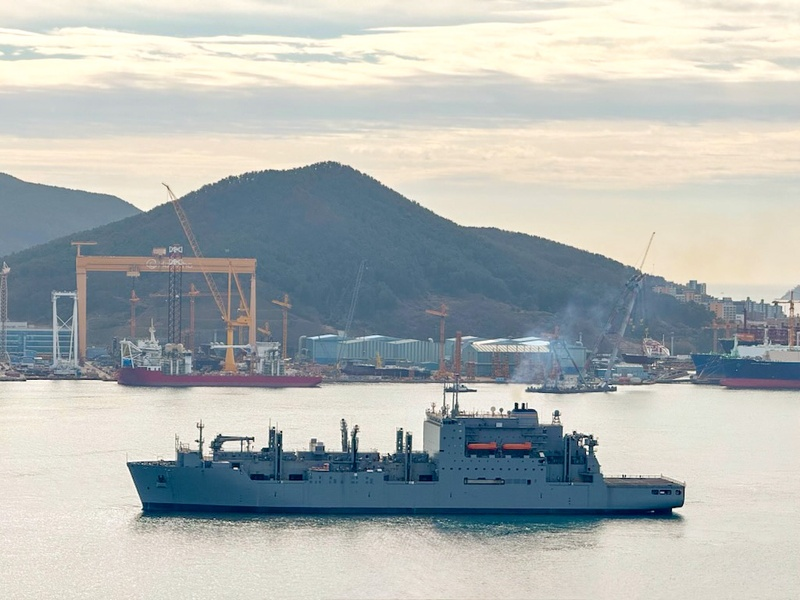
HD Hyundai Heavy Industries has secured a fourth maintenance, repair, and overhaul contract for a United States Navy auxiliary vessel, extending its work for Military Sealift Command. The latest assignment covers a mid-term availability for USNS Wally Schirra, a Lewis and Clark-class dry cargo and ammunition ship operating with the Seventh Fleet. The award places another American naval support vessel in a South Korean shipyard and adds to the company’s experience with US military maintenance requirements.
The roughly 40,000-tonne ship is due at Ulsan in January 2027, with work scheduled for completion in March. More than 80 maintenance items cover hull and structural work, propulsion equipment, electrical systems, and auxiliary machinery, according to the company’s announcement reported by Korean media. The yard plans to conduct the work at a quay near its medium-sized vessel division. No contract value or detailed itemised work schedule has been disclosed, so the confirmed scope remains a mid-term maintenance availability rather than construction of a new naval vessel.
Wally Schirra is approximately 210 metres long, 32.2 metres wide, and draws around 9.1 metres, according to published vessel particulars. It entered service in 2009 as part of the Lewis and Clark class of dry cargo and ammunition ships. Such ships replenish combatants with ammunition, provisions, stores, and other supplies while deployed, reducing the frequency of returns to port. Machinery reliability and cargo handling availability therefore affect the replenishment work on which the operating fleet depends.
Military Sealift Command describes the class as supporting transfers of dry and refrigerated stores and ordnance, with replenishment performed alongside another ship or by helicopter where required. Its engineering systems serve long-distance auxiliary operations and repeated cargo transfer cycles. The public scope for the new Ulsan availability does not identify which cargo-handling installations will be examined or replaced. The confirmed categories instead concern structural, propulsion, electrical, and auxiliary machinery work, so individual equipment upgrades cannot be assumed.
A mid-term availability creates a planned window for inspection and remedial work, unlike repairs organised in response to a single unexpected failure. Structural inspection, equipment servicing, defect rectification, reassembly, and trials can take place within the same period, although the contractor has not released the individual work packages. The 80-plus items should not be taken to mean 80 major replacements: they can cover different inspection and maintenance activities. The scope disclosed does not include a confirmed weapons or combat-system upgrade.
The planned maintenance period from January to March places a defined completion window around a mixed programme of structural and machinery work. Access, repair, reassembly, and inspection must be sequenced to avoid conflicts between trades and ship systems. Following propulsion or electrical maintenance, engineers must verify that the affected systems function correctly before customer acceptance. Structural inspection may also identify additional defects, while the contract does not disclose the critical path or allowances for unforeseen repairs. March is a scheduled handover, not a guaranteed completion date.
HD Hyundai first entered this US Navy maintenance market with USNS Alan Shepard in August 2025 and subsequently worked on USNS Cesar Chavez and USNS Richard E. Byrd. The Korean company says its performance on the Richard E. Byrd contract received the highest ‘Exceptional’ grade in six of seven categories under the US Navy’s Contractor Performance Assessment Reporting System. That assessment concerns earlier work, including quality and schedule performance, rather than the Wally Schirra contract, on which maintenance has not yet begun.
The same vessel previously underwent a seven-month regular overhaul at Hanwha Ocean’s South Korean shipyard, completed in March 2025, according to Military Sealift Command. That was a different contractor and a more extensive maintenance period than the new mid-term availability at HD Hyundai’s Ulsan site. The recurrence of shipyard work reflects the continuing inspection and repair cycle of an active naval auxiliary. The November 2026 contract should not be presented as a continuation of Hanwha’s earlier award.
Repair work on an existing naval auxiliary differs from building a commercial ship to a fixed production design. The yard must establish the vessel’s actual configuration and condition, organise access to installed machinery, and document repairs against customer requirements. Parts availability, approved procedures, and acceptance inspections can affect both the critical path and the final testing sequence. HD Hyundai’s previous US Navy projects may strengthen its record for future competitions, but no subsequent award has been announced alongside this contract.
The Ulsan availability also provides repair capacity relatively close to American logistics ships operating in the western Pacific. It does not establish a new basing arrangement or a wider policy change in how the US Navy procures maintenance. The public schedule places the ship at HD Hyundai in January and targets a March 2027 handover after the specified engineering work and inspections. Actual completion will depend on the condition found and the outcome of customer acceptance testing.