IN Brief:
- The US Air Force announced an indefinite-delivery framework for advanced propulsion work on 20 November.
- The $16.1bn value is a cumulative ceiling shared by participating contractors across propulsion development lifecycle activities.
- Only modest initial obligations were reported; future funded orders and demonstrated propulsion work will determine actual expenditure.
The US Air Force has established an advanced propulsion contracting framework with a cumulative maximum value of $16.1 billion, enabling multiple contractors to undertake research, technology maturation, development, and other work as future requirements arise. The indefinite-delivery, indefinite-quantity awards were announced on 20 November and are expected to run to November 2041. The headline figure is a shared contract ceiling across the participating companies, not an immediate expenditure commitment or a $16.1 billion award to any individual supplier.
The contract is described as advanced propulsion enterprise work and covers continuing improvements through different phases of propulsion development. Awardees span established aircraft and propulsion manufacturers, research organisations, component specialists, and newer engine developers. Boeing, GE, Honeywell, Hermeus, Lockheed Martin, Northrop Grumman, Rolls-Royce, Safran, and RTX appear among the names published in the award record. Entry to the indefinite-delivery, indefinite-quantity vehicle permits subsequent competition or assignment under its terms; it does not guarantee an individual task order. Published accounts differ on the precise number of named participants, so the supplier total remains unasserted here.
An indefinite-delivery, indefinite-quantity vehicle separates the government’s permission to order work from the funding of that work. The $16.1 billion figure limits cumulative orders across the participating contractors over the framework’s lifespan, while specific requirements, prices, and obligations arise through later actions. Contemporary trade reporting describes nominal $1,000 starting awards to participating companies, far below the advertised ceiling. The exact aggregate starting obligation should not be inferred from reports that count the awardees differently. No engine type, aircraft programme, or facility has received a $16.1 billion funded order through this announcement.
An advanced propulsion programme can involve competing design objectives: more thrust may increase thermal loading, while better fuel efficiency can alter combustor, compressor, or turbine requirements. Mechanical endurance, engine control, maintainability, mass, and repeatable manufacture are part of the same engineering trade-off. Rocket propulsion and other non-turbine concepts bring different test and integration constraints. The Air Force has not reserved a portion of the ceiling for a specific technical approach, so the framework cannot be read as a decision to buy one engine architecture.
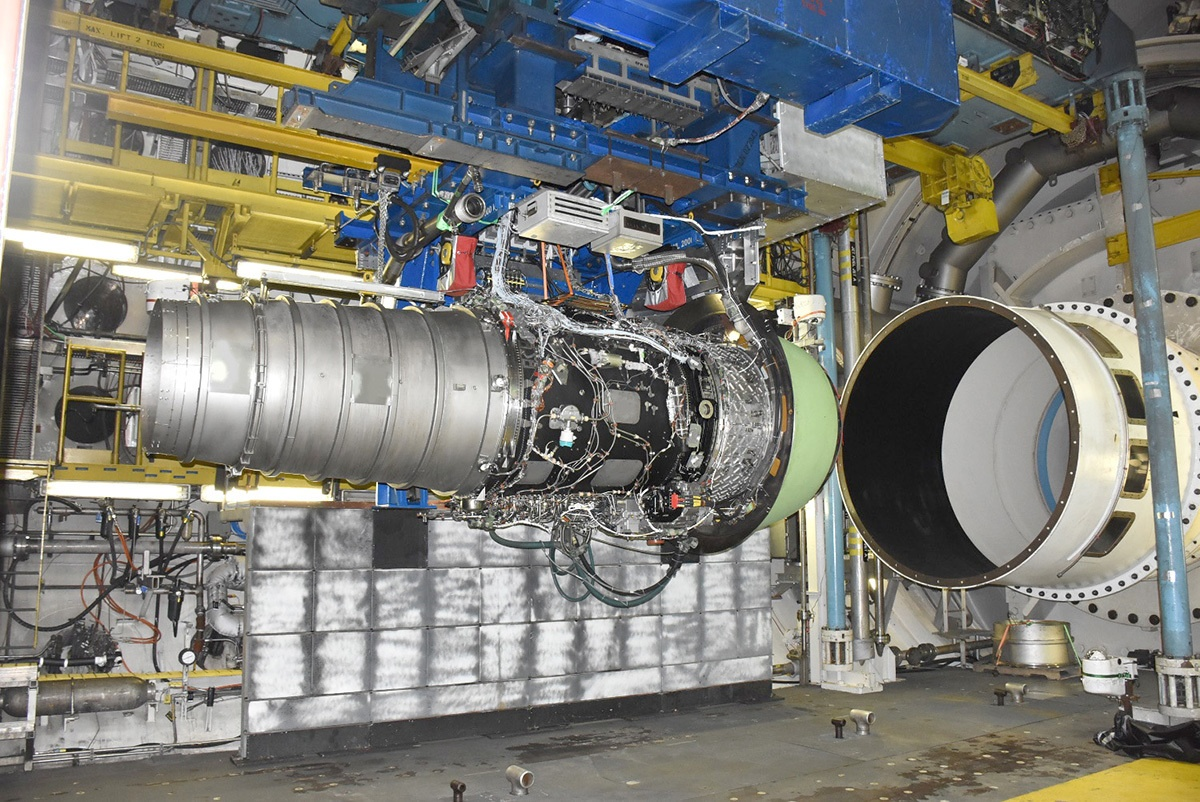
Qualification progresses through measurements taken at increasing levels of system complexity. Candidate materials may need thermal and fatigue testing before components can be evaluated, while an assembled propulsion demonstrator introduces flow, vibration, heat-transfer, and control interactions that a specimen test cannot reproduce. Simulation can reduce the number of experiments but must remain consistent with physical evidence. The Air Force’s contracting vehicle can support activity across this progression. Its award notice does not identify a completed demonstrator, qualified material, or an acceptance decision arising from the new vehicle.
The breadth of the supplier list gives the customer access to different industrial capacities. Large propulsion businesses can integrate complete systems and manage established qualification routes, while smaller specialists may offer focused expertise in manufacturing processes, sensors, materials, or experimental designs. Their participation on the framework creates an opportunity to undertake funded work, not a production allocation. Later task orders should establish whether a company is developing a component, conducting tests, supporting integration, or maintaining an existing design; those functions should not be conflated in reports of contract value.
Fifteen years is long enough for both technology and industrial constraints to change materially. The framework is expected to continue to November 2041, but any resulting propulsion programme will face its own requirements, design reviews, availability of critical materials, and budget decisions. A concept tested early in the period may not be the configuration selected later. The government has disclosed the breadth of the contracting mechanism rather than a production timetable, and future work still depends on specific authorised orders.
Scale-up would require a separate industrial step after technical feasibility. Test hardware can be manufactured in small batches using methods that would be too slow or costly for routine production. Repeatable processes, part inspection, configuration control, and a stable supplier base become more consequential as quantities increase. The November awards contain no factory investments, plant capacities, or unit forecasts, so an engine manufacturer’s presence on the supplier list cannot be treated as evidence of an immediate rise in US propulsion output.
Existing engine programmes can provide experience and facilities that inform new research, but there is no disclosed assignment of this ceiling to a named aircraft or missile. Later research tasks could draw on different areas of propulsion expertise without resulting in the same final system. The relationship between any future task and a platform will become visible when its scope and customer are documented. Until then, attributing the $16.1 billion ceiling to a particular programme would misrepresent the Air Force’s contracting action.
The first test of the framework’s practical scale will be the task orders placed against it: their obligated values, engineering objectives, and delivery dates will establish what the Air Force is actually purchasing. Demonstration and qualification results will provide separate evidence of technical progress, while factory investment or recurring production orders would signal industrialisation. The November announcement establishes a broad route for propulsion research and development through 2041, with future spending and system choices still undetermined.