IN Brief:
- AirBoss Defense Group has received a five-year framework agreement for its modular Bandolier energetic system, with a further five-year extension option.
- The framework includes an initial order worth up to US$12.5 million, with deliveries expected between late 2026 and the first half of 2027.
- Separate glove and protective overboot orders from NATO partner nations are worth up to another US$4.4 million.
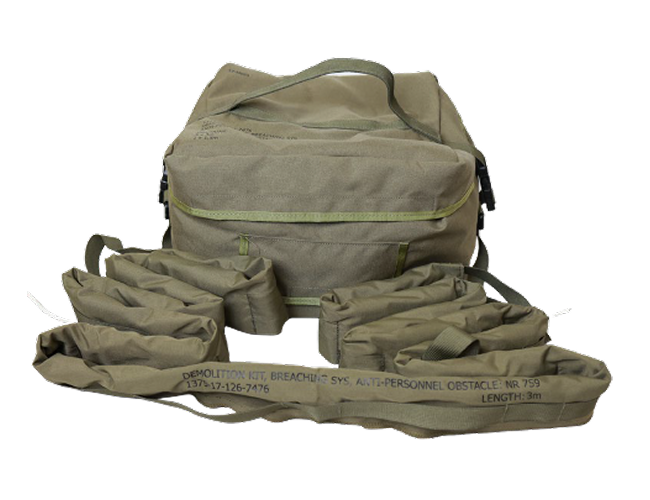
AirBoss Defense Group has secured a five-year framework agreement with an unnamed NATO partner nation for its Bandolier modular energetic system, accompanied by an initial order worth up to US$12.5 million.
The framework can be extended for a further five years, giving the customer a longer procurement route for Bandolier rather than requiring each requirement to be contracted independently. Deliveries against the first order are expected during the fourth quarter of 2026 and the first half of 2027, subject to the conditions attached to the agreement.
Bandolier is a lightweight modular energetic system intended for mobility, counter-mobility, and survivability tasks. Instead of relying on a different fixed explosive charge for every application, the design allows users to configure energetic material around a range of engineering requirements, reducing the need to carry several completely separate charge types.
That modularity changes the manufacturing and logistics problem as much as the field application. A configurable system still depends on tightly controlled energetic materials, initiators, packaging, and safety features, but a common architecture can reduce the number of unique items that must be manufactured, stored, transported, accounted for, and supported. For armed forces, the attraction is therefore partly an inventory and supply consideration rather than simply a question of explosive performance.
AirBoss has also promoted Bandolier for use with conventional emplacement methods and emerging autonomous delivery systems. The latest agreement does not identify a specific drone, ground robot, or other uncrewed integration programme, so the immediate industrial requirement remains the production and delivery of the energetic system itself rather than a new vehicle development effort.
The five-year structure gives AirBoss and its suppliers greater visibility than a series of isolated orders, although it does not guarantee that the customer will purchase equipment across the full period. The initial US$12.5 million commitment establishes a near-term production requirement, while the framework gives the partner nation a route to place additional orders without reopening the basic commercial structure each time.
That visibility matters because energetic production depends on a narrower supplier base than the physical simplicity of the finished product might suggest. Explosive compounds, initiators, casings, safety devices, and other specialist components are subject to qualification and handling requirements that limit the ability to change supplier quickly when availability tightens.
AirBoss has encountered those constraints before. An earlier Bandolier programme worth up to US$45 million experienced supply disruption affecting critical components, delaying deliveries before production resumed. The episode demonstrated the difference between securing customer demand and maintaining the qualified material flow needed to fulfil it.
Longer agreements can help manufacturers place forward orders and give suppliers a clearer view of potential demand, but they do not remove the need for inventory control and second-source planning where alternatives are technically and contractually possible. Energetic materials also carry storage life and transport considerations that make excessive stockholding a poor substitute for stable production.
The latest announcement includes separate orders worth up to US$4.4 million for AirBoss Molded Gloves and Molded AirBoss Lightweight Overboots from several NATO partner nations. Those products belong to the company’s protective equipment portfolio rather than the Bandolier programme and are expected to be delivered during 2026 and 2027. Combined with the energetic system order, they take the recently announced potential order value to US$16.9 million.
Keeping those procurements distinct matters because AirBoss operates across several areas of defence protection and survivability. The company manufactures respiratory and chemical protection equipment, protective footwear and gloves, and the Bandolier system, drawing on a broader materials and rubber manufacturing base within the AirBoss group.
The new Bandolier framework therefore carries two industrial tests. The first is whether AirBoss can maintain a sufficiently stable supply of qualified components to support recurring production after the disruption experienced on the earlier programme. The second is whether the customer makes enough use of the framework to justify the longer production planning horizon created by the agreement.
Neither question will be answered by the maximum contract term alone. Frameworks create procurement capacity, but revenue and factory loading follow from actual orders. The initial US$12.5 million requirement provides the first firm measure and gives the manufacturer a near-term delivery schedule against which performance can be assessed.
Those deliveries begin quickly. AirBoss expects the first shipments before the end of 2026, followed by further deliveries during the first half of 2027. Meeting that timetable will establish the production baseline for a framework that could remain available to the customer for a decade if the extension option is exercised.