IN Brief:
- Australia and Japan will establish a framework for Japanese use of Australian test ranges.
- The arrangement covers long-range precision strike, autonomous capabilities, and Japan’s hypersonic missile programme.
- Regular instrumented testing would connect Australian range infrastructure more closely with bilateral weapons development.
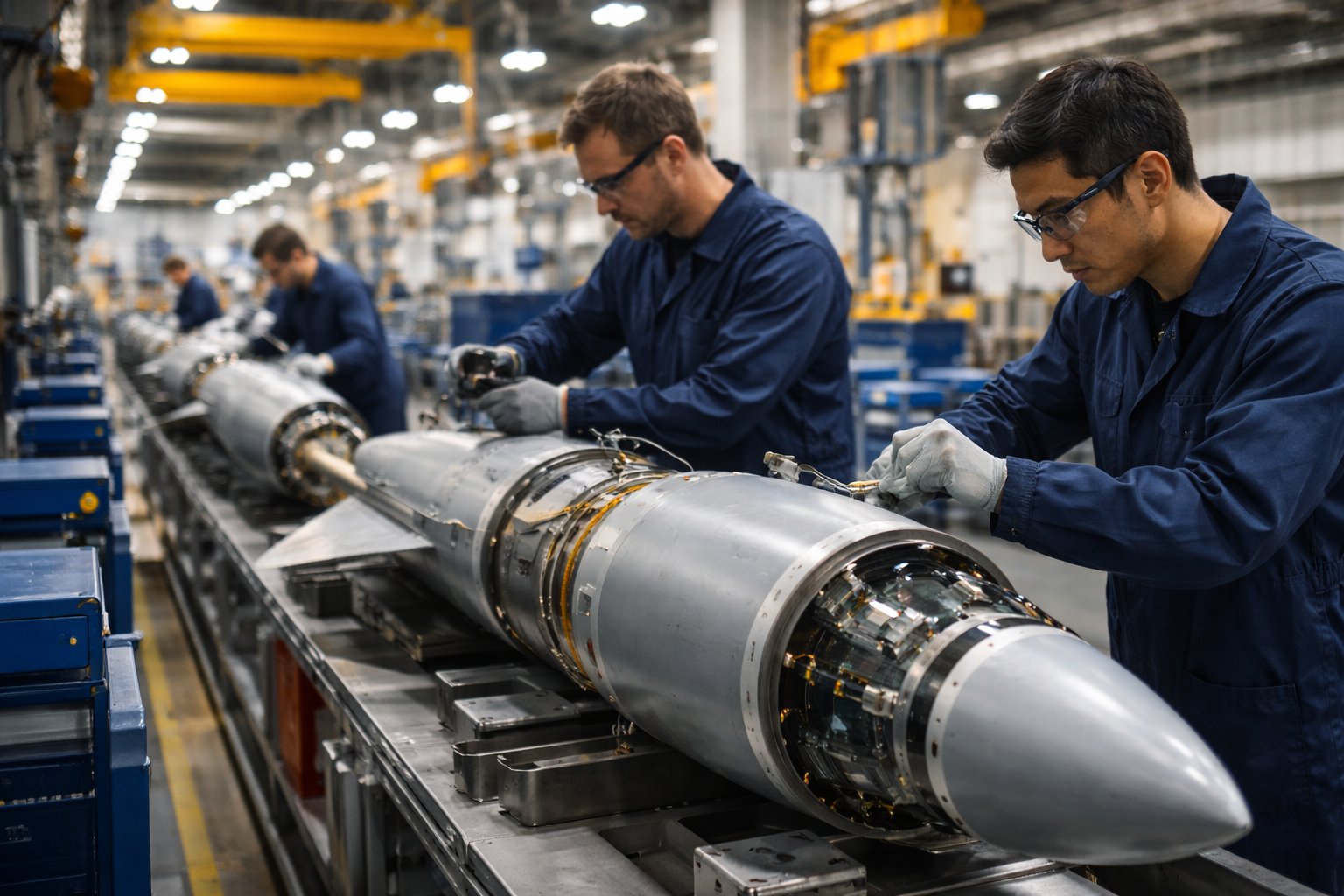
Australia and Japan have agreed to establish a framework for testing advanced weapons and emerging technologies on Australian ranges, including support for Japan’s hypersonic missile programme.
The commitment was set out following a defence ministers’ meeting in Canberra on 18 August. It covers next-generation long-range precision-strike assets and autonomous capabilities, extending a bilateral relationship that now includes weapons development, naval procurement, information sharing, and increasingly complex joint training.
Australia’s Department of Defence and Japan’s Ministry of Defense have not yet published a schedule, range allocation, or list of systems that will be tested. The agreement is therefore a framework commitment rather than a defined flight-test programme, but it addresses one of the more practical constraints facing advanced weapons development: access to sufficient instrumented range space.
Long-range and hypersonic systems require extensive safety areas as well as radar, optical tracking, telemetry, secure communications, range control, and post-flight analysis. Those requirements become more demanding as weapon range and speed increase because test teams need to collect usable engineering data across a much larger flight profile.
Japan’s geography places natural limits on some forms of representative testing. Australia offers large land areas, comparatively open airspace, and established defence ranges where advanced systems can be evaluated without the same spatial constraints. Turning that geographical advantage into a routine test relationship, however, requires considerably more than approving individual launches.
Both governments will need processes covering scheduling, transport of test articles, airspace and maritime clearance, safety cases, classified data, telemetry protection, environmental approvals, and access for engineering teams. Range instrumentation must also generate evidence that can be compared between campaigns rather than producing a separate technical arrangement for every test.
Common data practices could become particularly important if the cooperation develops into repeated Japanese weapons trials. Engineers need access to sufficiently detailed telemetry and tracking information to diagnose failures and refine designs, while Australia has to protect sensitive range systems and any classified information generated through the activity.
The agreement comes as Japan expands its long-range strike portfolio. Japan has already fielded its first boost-glide strike weapon, bringing propulsion, guidance, thermal protection, launcher integration, and production requirements into an operational programme. Access to Australian ranges could provide additional capacity as related systems progress through development and modification.
Test infrastructure is also part of the defence industrial base. Advanced weapons programmes rely on specialist radar, telemetry receivers, optical systems, target equipment, modelling, high-speed data acquisition, communications, and analysis software, together with the engineers required to operate and maintain them.
Regular Japanese use could therefore create work around the range itself as well as the weapon under test. Transport, instrumentation, integration, maintenance, security, communications, and technical support all become recurring requirements when a test relationship moves beyond occasional access.
The arrangement also follows the bilateral Boobook laser programme, whose field trials were completed in South Australia. The two developments point towards a broader model in which Australia contributes test infrastructure and industrial capacity while Japan contributes systems and technologies that need representative evaluation.
No cost, timetable, or first launch has yet been disclosed, so the agreement should not be read as evidence that Japanese hypersonic trials in Australia are imminent. Weapon maturity will still determine when hardware is ready for flight, and range availability cannot compensate for incomplete propulsion, guidance, software, or ground qualification.
The value of the framework will become clearer when it produces booked range time and repeatable instrumented campaigns. At that point, Australian test infrastructure would become part of Japan’s development chain rather than simply a location available for occasional exercises.
That would represent a more consequential form of defence cooperation than joint statements alone. Advanced weapons programmes are constrained by engineering evidence, not diplomatic language, and a range arrangement becomes useful only when it can repeatedly generate the data needed to move a system towards qualification and production.