IN Brief:
- Rheinmetall has received a contract worth several hundred million euros to modernise frigate Bayern.
- Work includes a replacement combat management system and extensive radar, propulsion, engineering, and anti submarine upgrades.
- The refit must reconcile modern equipment with ageing structures, obsolete components, limited access, and legacy interfaces.
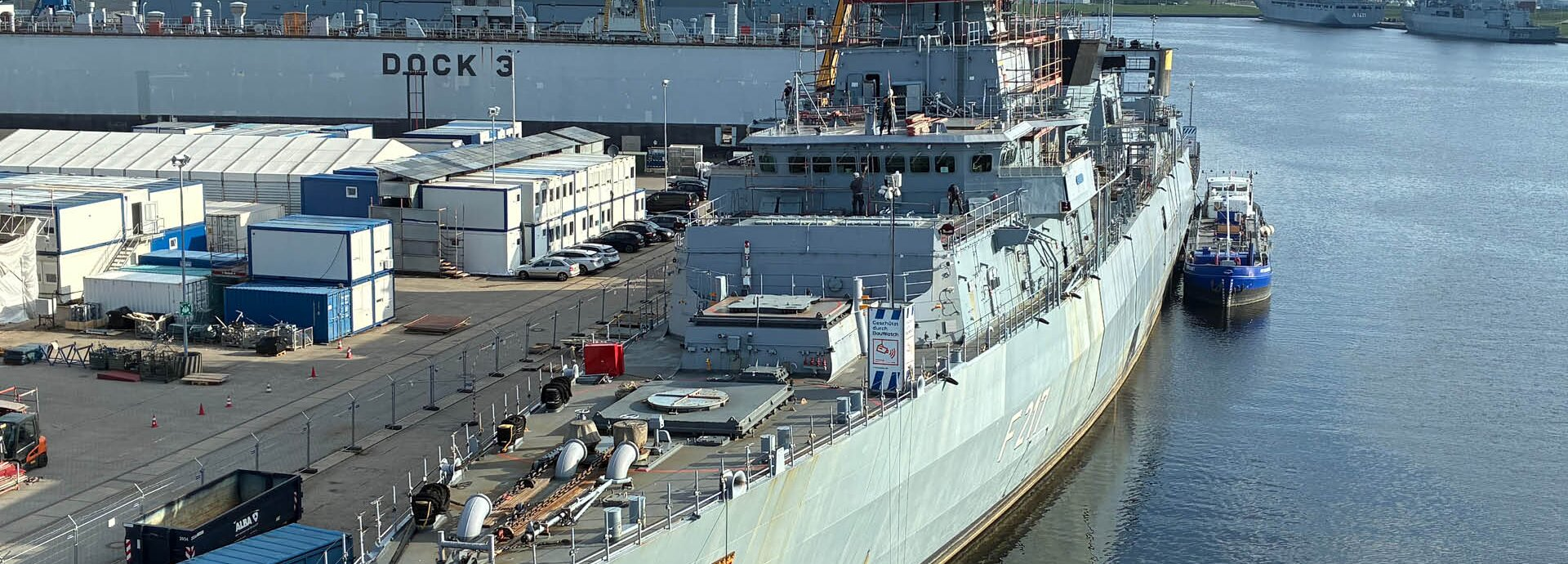
Rheinmetall has received a contract valued in the mid three digit million euro range to modernise the German Navy frigate Bayern, with shipyard work intended to keep the vessel operational until at least 2035.
The 143 metre Brandenburg class frigate entered service in 1996 and is already at Rheinmetall’s Neue Jadewerft facility in Wilhelmshaven. Initial activity covers equipment removal and preparation for dry docking before the principal installation and overhaul work begins.
Modernisation will include a replacement combat management system, upgraded radar equipment, propulsion and engineering work, and improvements to anti submarine warfare capability. Completion is planned for 2029, creating a multiyear workload across design, removal, repair, equipment manufacture, software integration, harbour testing, and sea acceptance.
A refit of this scale differs fundamentally from building a new frigate because engineers must work within an existing hull whose compartments, cable routes, foundations, electrical capacity, cooling, weight distribution, and maintenance access were established more than 30 years ago.
Original drawings may no longer describe every detail of the vessel after decades of repairs and alterations. Physical surveys, laser scanning, equipment inspection, and intrusive access work are needed before replacement systems can be designed and installed with confidence.
Corrosion, fatigue, damaged foundations, inaccessible cabling, or undocumented modifications may only become visible after panels, machinery, and insulation have been removed. Each discovery can alter the work package and disrupt the planned sequence, particularly when replacement equipment has already entered manufacture.
The new combat management system will sit at the centre of the refit, receiving information from radar, sonar, electronic sensors, navigation equipment, communications, weapons, and ship control functions. It must combine those inputs into a coherent operating picture while preserving safe operation when individual systems or networks are degraded.
Software integration cannot be separated from the physical installation. Equipment may rely upon different generations of data standards, timing, networking, and security architecture, so retained systems require gateways or adaptation while replacement equipment undergoes verification against the complete ship.
Removing old machinery can consume almost as much effort as installing its successor. Large units may no longer pass through existing access routes, cables can be buried inside congested trunks, and foundations may require cutting and reconstruction before modern equipment will fit.
Although newer electronics are often smaller, they may demand more cooling, cleaner electrical power, additional cyber protection, and different maintenance access. Weight saved in one compartment cannot automatically be used elsewhere because longitudinal strength, stability, and local deck limits still govern the vessel.
Propulsion and engineering work will require decisions about equipment that has already accumulated decades of operating hours. Components retained during the refit need sufficient remaining life for service beyond 2035, while discontinued controls, sensors, and spare parts may force wider replacement than initially planned.
Anti submarine systems are particularly sensitive to the physical condition of the platform. Machinery noise, structural vibration, power quality, sensor alignment, and processing software all influence performance. Installing improved sonar or signal processing without addressing worn machinery or noisy pumps can prevent the upgraded system from reaching its designed capability.
Responsibility will be distributed across the yard, combat system teams, sensor manufacturers, software suppliers, naval authorities, and businesses supporting legacy equipment. Difficult faults often emerge at interfaces where each individual system appears to operate correctly but the combined ship does not.
European navies increasingly rely upon life extension programmes as new construction struggles to match fleet requirements. Such refits sustain shipyard and equipment work, but they also occupy docks, engineers, and test personnel needed for new vessels and commercial maintenance.
Bayern therefore represents both a fleet solution and a capacity commitment. Modernisation can retain a proven hull sooner than an entirely new frigate could be designed and built, although the uncertainty inside an ageing ship makes schedule and cost control more difficult.
Learning from the first vessel can reduce risk across later F123 work. Survey methods, removal sequences, foundations, interface solutions, cable designs, software tools, and acceptance procedures can be reused, provided material differences between ships are recorded rather than treated as insignificant.
Rheinmetall’s combination of shipyard capacity and defence electronics provides an opportunity to align physical work with combat system integration. Engineers responsible for software and sensors can work more closely with the teams removing equipment, modifying structures, and preparing cable routes.
That organisation cannot remove the constraints imposed by the hull itself, so disciplined surveys, early procurement of long lead equipment, rapid decisions when defects are exposed, and adequate time for testing will remain decisive.
Bayern should return to service with renewed combat, sensor, propulsion, and engineering systems. The broader measure of success will be whether the programme establishes a repeatable F123 modernisation process, rather than producing an expensive collection of solutions that apply only to the first ship.