IN Brief:
- BlackSky announced a seven-figure Gen-3 Assured expansion with an unnamed international defence customer on 22 October.
- The customer doubled its subscription in less than six months after beginning with a Gen-2 pilot.
- The service joins frequent Gen-2 revisits with Gen-3 imagery at a stated 35-centimetre ground sample distance.
BlackSky Technology has expanded a seven-figure Gen-3 Assured imagery subscription with an unidentified international defence customer, reporting that the customer’s commitment has doubled in less than six months. The 22 October agreement increases committed collection access through BlackSky’s existing satellites and Spectra software platform. The company did not disclose the customer, exact price or quantity of additional images, and the development does not represent the sale of a dedicated spacecraft.
The arrangement began as a small Gen-2 pilot before developing into a larger annual subscription. Assured provides agreed tasking access and continuity of image collection over a customer’s areas of interest, rather than depending entirely on individual requests placed whenever satellite capacity happens to be free. BlackSky identifies border monitoring, counter-UAS observation and force protection among the service’s potential applications, while withholding the operational geography and any customer-specific assessment of results.
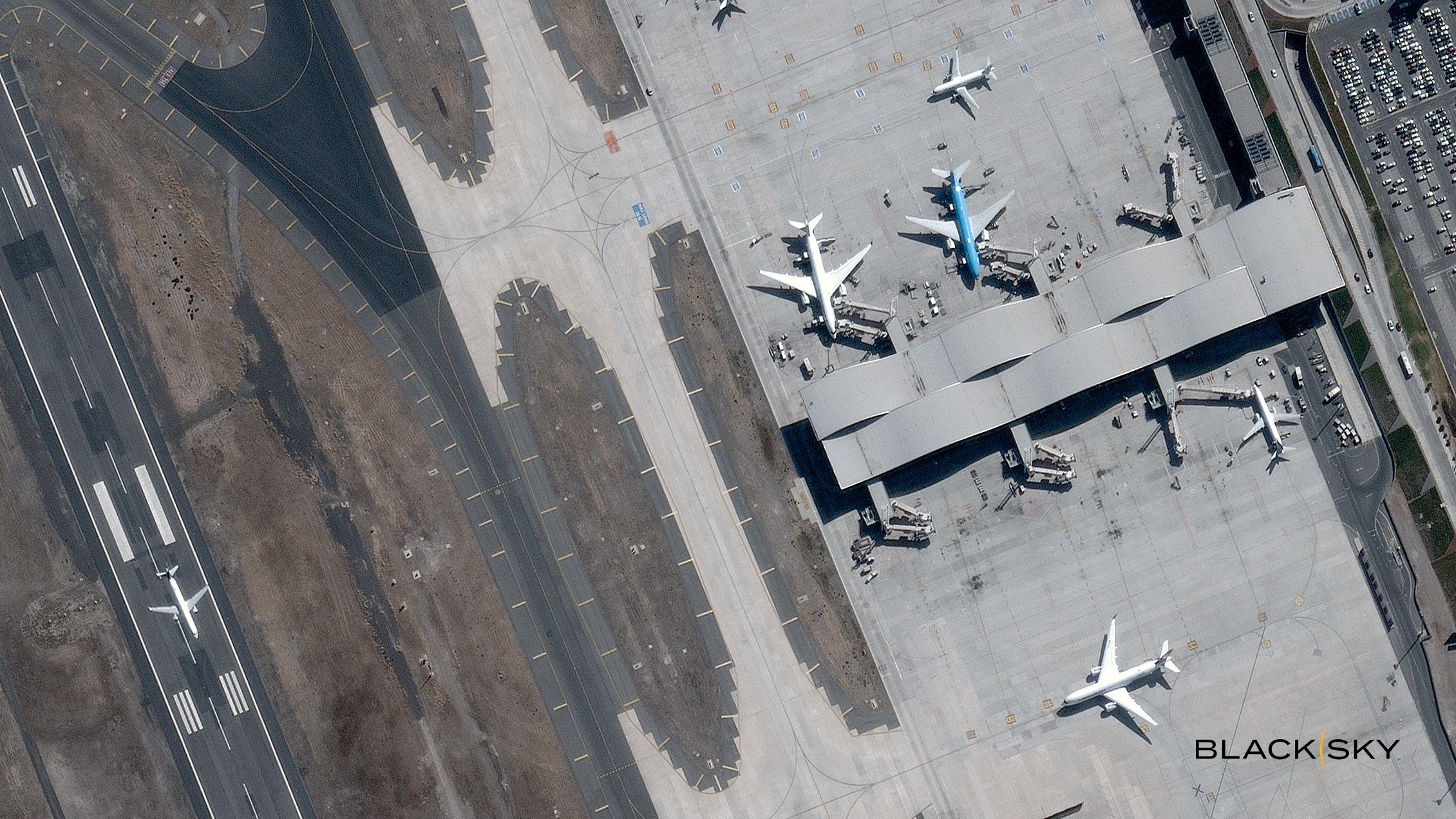
BlackSky combines the high-frequency revisits available from its Gen-2 constellation with imagery from Gen-3 satellites offering a stated 35-centimetre ground sample distance. A ground sample distance describes the scale represented by each image pixel; it does not prove that every object of that size can be resolved or identified. Actual image interpretation depends on atmospheric conditions, viewing geometry, target contrast and the stability of the image acquisition and processing chain.
By using repeated observations as well as greater spatial detail, analysts can compare developments at a location over time rather than rely on one isolated image. A change detected in a frequent collection may justify higher-detail tasking on a later pass, provided the orbit and competing customer requirements permit it. Neither generation can provide uninterrupted video of a fixed point on Earth. Clouds, acquisition geometry and downlink or processing delays still constrain how quickly usable information can reach an analyst.
Customers access the imagery and associated processing through the company’s Spectra software platform, which handles tasking, data delivery and automated analysis. BlackSky says the architecture can support AI-assisted detection, identification and classification of aircraft, vehicles, vessels and other objects. Automated classification is still constrained by image quality and training performance. The newly expanded contract does not disclose accuracy figures, error rates or the extent to which human analysts review suggested classifications before operational decisions are made.
The service model differs from selling a dedicated sovereign satellite. In an Assured subscription, the customer buys priority access and collection commitments from an existing constellation and associated ground and software systems. The provider remains responsible for spacecraft operations and for allocating its collection capacity across commitments. BlackSky separately offers sovereign spacecraft and imagery arrangements, but its October announcement concerns an expanded subscription rather than delivery of a newly manufactured satellite to the customer.
Committed access has value because the amount of imagery a constellation can collect over a particular region is finite. A satellite passes its target for limited periods, the sensor cannot observe every requested location at once, and captured data still requires transfer and processing. The subscription therefore creates an allocation commitment inside BlackSky’s wider operating schedule. The company has not said how many satellite passes, collections per day or delivery-time thresholds are guaranteed to this customer under the expansion.
Combining separate acquisitions into a coherent analytical record requires accurate geolocation and image registration. If an aircraft parking area is observed from different angles or at different times, software must account for those differences before labelling an apparent variation as activity on the ground. Spectra is marketed as the interface for both satellite generations, including AI-assisted classification, but BlackSky has not published validation results, false alarm rates or customer-specific analyst workflows for this expanded subscription.
BlackSky has disclosed several international Gen-3 contracts during 2026, including pilot conversions and subscriptions of different durations. Some customers remain unnamed, so the October agreement cannot safely be added to any particular customer’s earlier orders or matched with other undisclosed accounts. The reported doubling describes this customer’s subscription growth; it is not a statement that the company’s full international order backlog or satellite collection capacity doubled.
The latest agreement increases an existing customer’s access to commercial imaging and automated analysis without specifying a new spacecraft build or deployment. BlackSky still has to allocate satellite time, deliver imagery through Spectra and meet the continuity terms it has sold. Contract length, collection volume and the exact consideration remain undisclosed, leaving performance against competing services impossible to assess from the announcement alone.