IN Brief:
- Havoc's collaborative autonomy and command-and-control software will be integrated across Blue Ops USVs, beginning with Variant 7.
- Blue Ops' modular open-systems architecture is intended to support integration of autonomy, sensors, communications, and payloads.
- Joint operational fleets in Rhode Island and Florida will support demonstrations, testing, training, and multi-vessel evaluation.
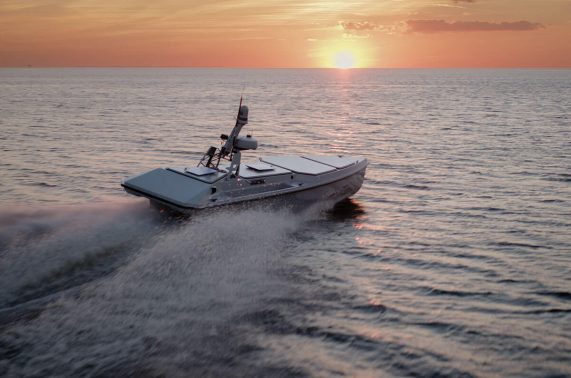
Blue Ops and Havoc are integrating collaborative autonomy and command-and-control software across Blue Ops’ uncrewed surface vessel portfolio, beginning with the Variant 7 platform.
The partnership is intended to support coordinated multi-vessel operations rather than treating autonomy as a function confined to individual boats. Havoc software will be integrated with Variant 7 and additional Blue Ops platforms as they are introduced, while the companies plan to establish operational fleets in Rhode Island and Florida for testing, demonstrations, training, and customer evaluation.
The agreement was announced on 17 August and builds on Blue Ops’ Modular Open Systems Architecture approach. The vessel architecture is intended to allow autonomy software, sensors, communications equipment, payloads, and other mission technologies to be introduced without redesigning the complete platform around a single supplier.
That becomes increasingly important as navies move from trials involving one autonomous vessel towards operations involving several systems under common control. A boat capable of following waypoints independently is a relatively contained engineering problem; coordinating a fleet requires task allocation, communications management, collision avoidance, mission updates, sensor sharing, and predictable behaviour when links degrade or disappear.
Havoc’s collaborative autonomy software is intended to provide that additional layer. The company describes its technology as connecting autonomous assets across sea, air, and land so that platforms can share information and continue operating when communications are disrupted or denied. Blue Ops gives that software a production maritime platform on which those claims can be tested repeatedly.
Variant 7 is already moving through full-rate production in the United States. Blue Ops says the vessel is designed in Maine and manufactured in Maine and Valdosta, Georgia, with research, development, and test activity in Florida. The company has also emphasised US-made and NDAA-compliant navigation, control, marine, and perception components as part of the production architecture.
The vessel has been designed around configurable propulsion and mission systems. Blue Ops completed an integration of the Volvo Penta D4-320 diesel engine and DPI drive earlier in August, connecting the propulsion package with autonomous navigation, remote operation, mission planning, and payload-management functions. That work illustrates the broader modular approach the Havoc partnership is expected to extend into autonomy software.
Open architecture does not remove integration work. Every new software stack still has to communicate correctly with navigation, propulsion, sensor, and safety systems, while updates need to be controlled so that a change in one application does not introduce an unexpected effect elsewhere in the vessel.
Cybersecurity is part of the same problem. A fleet of autonomous vessels may exchange position, sensor, health, and mission information over links that vary in bandwidth and availability. The architecture must protect those interfaces while allowing the vessels to retain sufficient local autonomy when a communications path is unavailable.
Coordinated operation also changes the human-machine interface. One operator supervising several vessels needs a command system that presents the condition and intentions of each platform without requiring constant manual control. Exceptions — a failed engine, lost communications link, navigation conflict, or unexpected contact — need to be surfaced quickly enough for the operator to intervene without turning the supervisory role into several simultaneous remote-piloting tasks.
The Rhode Island and Florida fleets are intended to expose those issues under repeat use. The companies plan to support both single-vessel autonomy and coordinated multi-vessel operations, giving military customers a route to evaluate how the combined architecture behaves outside a one-off company demonstration.
Those sites can also test changes in fleet composition. An open autonomous architecture is more valuable if a new vessel, payload, or sensor can be added without rebuilding the command system around it, but that requires disciplined interfaces, software baselines, and configuration management across every platform participating in the mission.
Blue Ops and Havoc also intend to introduce each other’s systems to government and commercial customers and pursue opportunities requiring integrated autonomous maritime capability. No procurement value, platform quantity, or customer order has been disclosed, so the agreement remains a technical and commercial integration framework rather than a defence acquisition award.
Its next milestones will therefore come from operational integration. The companies need to show that Variant 7 and other platforms can share missions and information reliably, that operators can supervise multiple vessels without excessive workload, and that the architecture continues functioning when communications or individual platforms degrade.
Variant 7’s production status gives those tests a different character from an autonomy demonstration built around a laboratory vessel. Blue Ops is attempting to combine repeatable USV manufacturing with software that can coordinate several platforms at once; whether the approach scales will depend on the quality of the interfaces between those two layers rather than on either product in isolation.