IN Brief:
- The Pentagon has agreed new production frameworks with Boeing and RTX covering SM-3 Block IB and Block IIA components.
- Boeing will lead additional component manufacturing as both interceptor variants move towards higher output.
- The agreements address industrial capacity and supply chains rather than introducing a new SM-3 configuration.
RTX’s Raytheon, Boeing, and the US Department of War have agreed new production frameworks intended to increase output of components for Standard Missile-3 Block IB and Block IIA interceptors.
The two agreements, announced on 14 August, address industrial capacity rather than a new interceptor design. The department said production of both variants will accelerate, with Boeing driving additional component manufacturing as part of an effort to move more hardware through the supply chain and into completed missiles.
No new annual production figures, quantities, or agreement values were disclosed. That limits what can be said about the eventual increase in finished-interceptor deliveries, but the decision is significant because missile output can be constrained long before final assembly if specialist components are not available at the required rate.
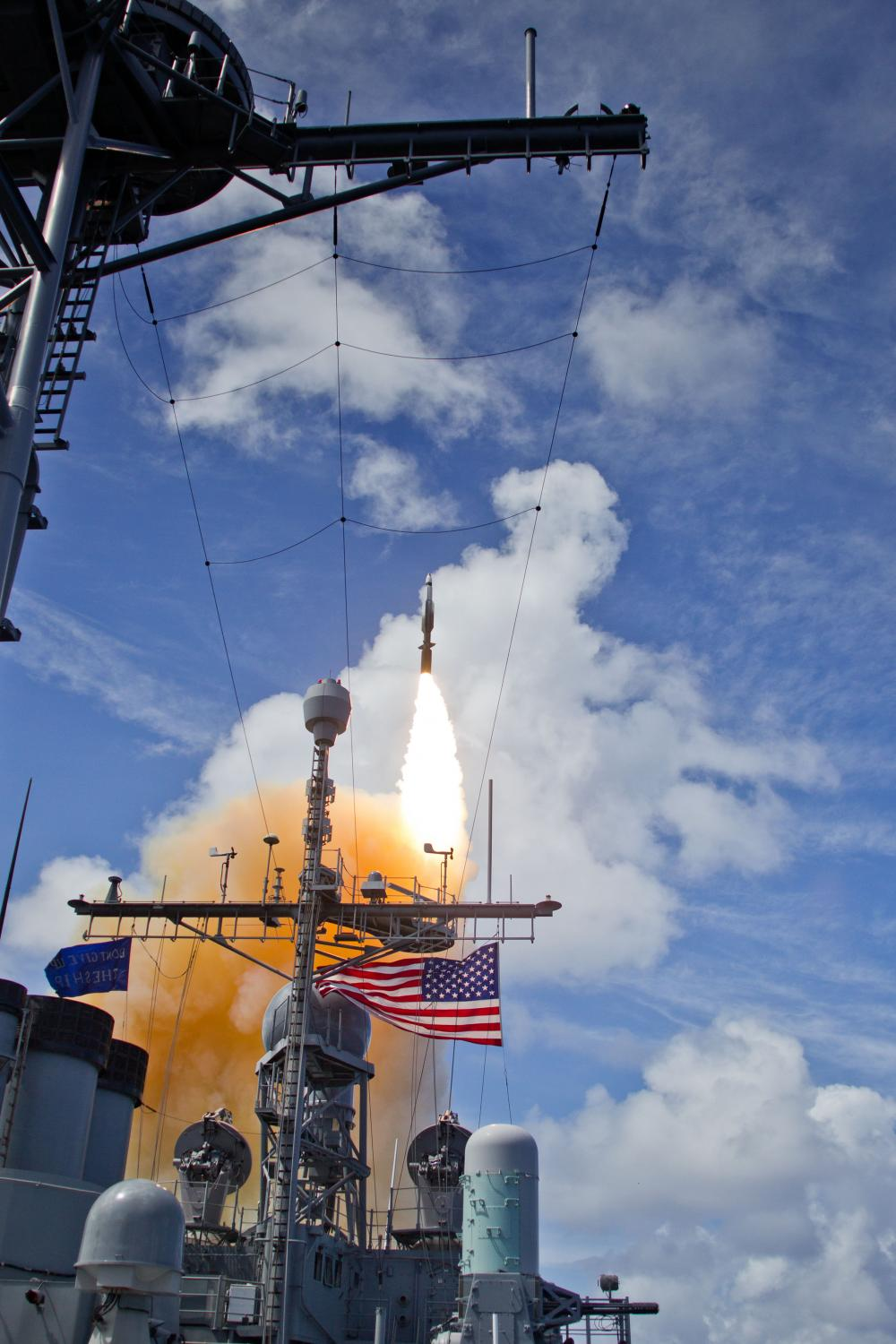
SM-3 forms part of the Aegis Ballistic Missile Defense architecture and destroys ballistic targets through kinetic impact outside the atmosphere. The interceptor can be employed from suitably equipped ships and from Aegis Ashore installations, linking the production base to US naval inventories and allied land-based missile-defence infrastructure.
Block IB and Block IIA perform the same broad mission but use different hardware. RTX describes Block IB as incorporating an enhanced two-colour infrared seeker and an upgraded steering and propulsion system used to manoeuvre the kinetic vehicle during the final phase of an interception.
Block IIA was developed cooperatively by the United States and Japan and uses larger rocket motors and a larger kinetic warhead. The design increases the area that can be defended while improving the interceptor’s ability to search for, discriminate, acquire, and track more demanding ballistic targets.
Those differences make a production increase a supply-chain exercise rather than a simple instruction to run an assembly line faster. Propulsion systems, seekers, guidance hardware, precision structures, electronics, energetic materials, and test equipment have to arrive at compatible rates, often from suppliers that support other missile programmes at the same time.
A constraint at one specialist manufacturer can therefore limit interceptor deliveries even if a prime contractor has additional integration capacity. Missile components may require dedicated tooling, controlled manufacturing processes, specialised materials, and lengthy qualification, making it difficult to substitute another supplier quickly when demand rises.
RTX had already agreed a wider set of production frameworks with the Pentagon in February covering SM-3 Block IB, Block IIA, SM-6, Tomahawk, and AMRAAM. The company said several weapon families were expected to reach between two and four times previous production rates, although it did not publish equivalent annual targets for the two SM-3 variants.
The company has also completed a $115m expansion at its Alabama operation where parts of SM-3 and SM-6 are integrated into finished munitions. The August agreements extend the production drive further into the component base, where additional manufacturing capacity is needed if higher final-assembly throughput is to be sustained rather than achieved through temporary inventory drawdown.
Block IIA reached full-rate production approval in 2024, removing one of the programme-management barriers to sustained manufacturing. Full-rate approval does not eliminate physical capacity limits, however. Increasing output after a production process has matured can still require new tooling, additional qualified labour, larger test facilities, or investment in suppliers several tiers below the prime contractor.
The Pentagon has linked the latest frameworks to its Acquisition Transformation Strategy, which is intended to allow more direct engagement with companies throughout the industrial base. For missile production, that potentially gives government greater visibility of bottlenecks that would otherwise remain inside prime-contractor supply chains until they begin affecting delivery schedules.
Longer production planning can also change supplier behaviour. A company producing a specialised component in relatively small volumes has little commercial reason to add machines, floorspace, or trained staff for a short surge. Multi-year demand gives suppliers a clearer basis for investment, particularly where equipment has little use outside defence manufacturing.
That visibility matters for SM-3 because the interceptor is a technically complex weapon produced in far smaller numbers than conventional ammunition. Capacity cannot be expanded cheaply by adding a generic production line, and quality failures discovered late in assembly can waste components that took months to manufacture.
The August agreements therefore sit at the less visible end of missile readiness. They do not change the guidance system, range, or kill mechanism of SM-3, and the Pentagon has not yet attached a new annual interceptor target to them. Their value will be measured in whether Boeing, RTX, and lower-tier suppliers can remove enough component constraints to turn planned production increases into additional missiles delivered to Aegis users.