IN Brief:
- Paveway IV and Brimstone 3 have completed safe-carriage and release qualification on Protector RG Mk1.
- Testing concluded a six-year UK–US effort involving aircraft, weapon, software, safety, and certification specialists.
- Operational strike capability will depend on production configuration, weapons stocks, training, ground control, and support readiness.
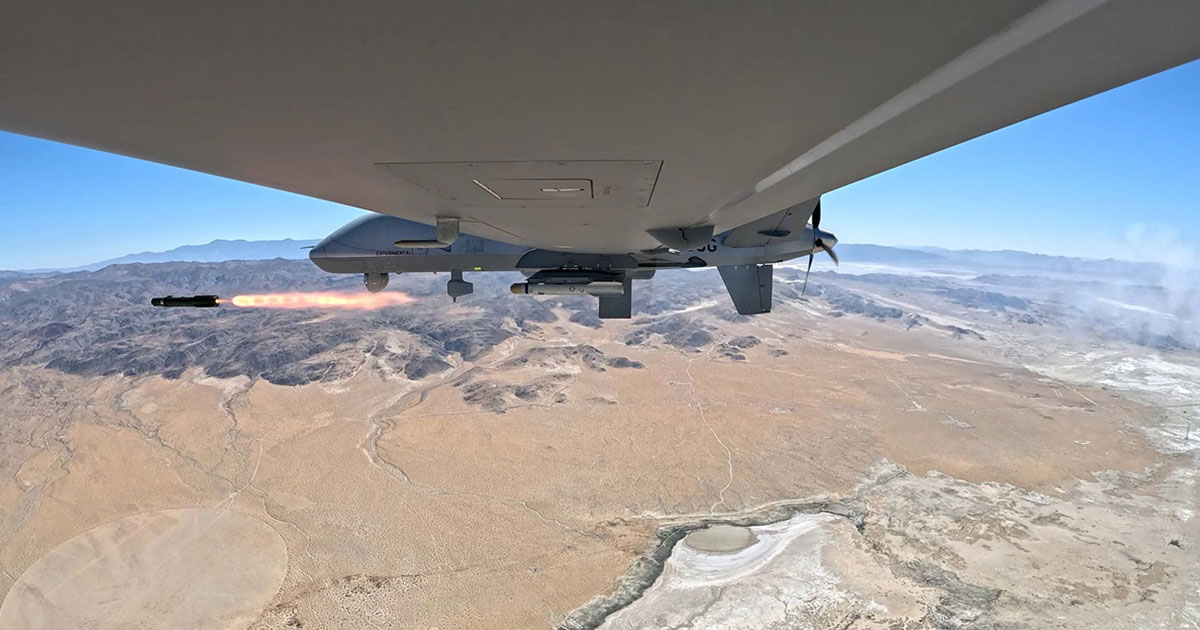
General Atomics has completed qualification testing of the Paveway IV guided bomb and Brimstone 3 missile on the Royal Air Force’s Protector RG Mk1, moving the remotely piloted aircraft towards an operational precision-strike role.
The final activity took place on 18 June at General Atomics’ facilities in Southern California, concluding a six-year UK–US programme covering safe carriage, weapon separation, software integration, and certification evidence. The work was conducted under UK Ministry of Defence approval and marks the first occasion on which General Atomics has led weapons qualification for an international customer.
Protector is derived from the MQ-9B SkyGuardian but incorporates UK-specific communications, certification, ground-control, weapons, and mission-system requirements. Aircraft are continuing to arrive at RAF Waddington as the service develops its operational fleet, training organisation, maintenance capacity, and supporting infrastructure.
Paveway IV gives Protector a precision-guided bomb combining laser and satellite-aided guidance, while Brimstone 3 supplies a smaller air-to-surface weapon suited to moving and fixed targets. Their different mass, aerodynamic behaviour, interfaces, and employment profiles required separate modelling, ground work, carriage trials, and release testing.
Weapon integration extends far beyond attaching a store to an available hardpoint. Engineers must demonstrate that the aircraft can carry each weapon across its approved speed, altitude, manoeuvre, and environmental envelope without excessive loads, vibration, heating, or interference.
Release testing must also establish that the weapon separates cleanly under representative conditions. Aircraft attitude, wake turbulence, pylon geometry, weapon mass properties, release timing, and control-surface movement can all alter the path of a store immediately after launch.
Software carries an equally large share of the qualification burden. Stores-management functions must identify the weapon, monitor its condition, apply safety interlocks, transfer targeting information, and execute release commands. Ground-control interfaces must present those functions accurately to remote crews, whose decisions pass through communications links rather than controls inside the aircraft.
From qualification aircraft to operational fleet
Protector received a UK Military Type Certificate in 2025, allowing the large uncrewed aircraft to operate within a broader range of airspace, including over populated areas. Certification also imposes tighter configuration control than many earlier military UAV programmes, particularly once weapons are integrated.
Changes to wiring, pylons, mission computers, software, ground stations, or weapon interfaces must be assessed against an approved baseline. A seemingly limited modification can affect safety evidence, maintenance instructions, training, spare parts, and the validity of previous testing.
Production aircraft must consequently match the qualified configuration or enter a controlled retrofit programme. Pylon hardware, interface units, harnesses, software loads, and ground-system updates need to arrive in the correct sequence, while differences between development aircraft and operational examples must be documented and resolved.
Weapon availability has to progress alongside aircraft integration. A cleared platform cannot sustain strike operations without missiles and bombs, handling equipment, storage facilities, test sets, trained armourers, and an established replenishment route. Both Brimstone and Paveway sit within a European precision-weapons market already under pressure from higher consumption and stockpile expansion.
Protector’s long endurance offers a different operating pattern from crewed fast jets, but persistent armed missions place heavy demands on satellite communications, intelligence support, ground-control stations, maintenance crews, and aircraft serviceability. Fleet output will depend on the entire support system rather than the endurance of an individual aircraft.
Engine support, sensors, landing gear, software updates, and specialist components will influence availability alongside the weapons themselves. A relatively small fleet leaves limited tolerance for maintenance delays or configuration differences, particularly while training and operational requirements grow simultaneously.
The MQ-9 family is also evolving towards control of other autonomous aircraft and air-launched effects. US Special Operations Command’s work on MQ-9 swarm control is expanding the aircraft’s interfaces with distributed sensors, collaborative platforms, and mission software.
Protector’s immediate role is more defined, combining persistent intelligence gathering with certified British weapons. Nevertheless, the same ground architecture and communications networks could support additional payloads or autonomous systems during later upgrades.
Qualification of Brimstone 3 and Paveway IV closes one of the programme’s longest technical workstreams. Converting that evidence into operational output will now require sufficient aircraft, weapons, trained personnel, spare parts, secure communications, and maintenance capacity to sustain missions rather than demonstrate individual releases.