IN Brief:
- Vertical Aerospace has publicly flown a full-scale wing tilt-rotor eVTOL aircraft at Farnborough.
- The National Composites Centre supported development of the Gen 2 composite rotor blades and elements of the fuselage.
- The programme is moving from prototype validation towards certifiable, rate-ready structures and a UK-centred supply chain.
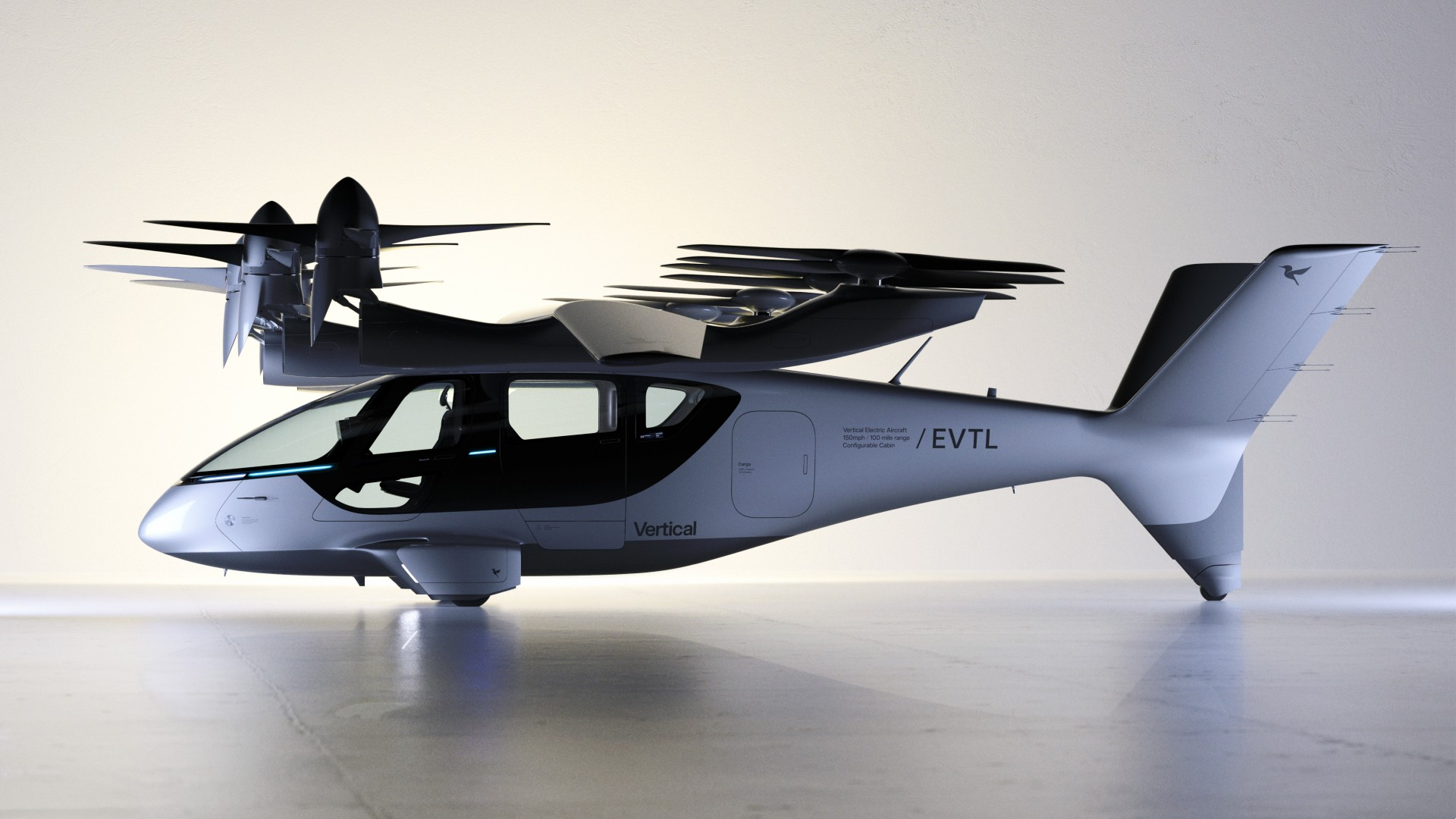
Vertical Aerospace has completed the UK’s first public demonstration flight of a full-scale wing tilt-rotor electric vertical take-off and landing aircraft at the Farnborough International Airshow.
Flying with Gen 2 composite rotor blades developed through work between Vertical and the National Composites Centre, the aircraft demonstrated technology that will inform its successor, VALO. NCC also supported elements of the fuselage and helped assess British manufacturing partners capable of supplying future production.
The flight followed earlier piloted hover, low-speed, and transition testing, while providing a public view of a programme moving from aerodynamic and control-system validation towards certification and industrialisation.
Vertical’s aircraft lifts vertically through its rotors before transferring lift progressively onto the wing during forward flight. The blades consequently operate across a wider range of aerodynamic conditions than a conventional fixed-wing propeller.
They must provide high thrust during vertical operation, remain efficient during wingborne cruise, withstand changing centrifugal and aerodynamic loads, and control vibration and noise. Low mass remains essential because blade weight affects power demand, rotating loads, aircraft structure, payload, and range.
NCC engineers developed a composite architecture intended to build structural performance into the blade rather than restore stiffness through additional mass. The design must also tolerate certification hazards including bird strike, impact damage, environmental exposure, and repeated fatigue loading.
Composite rotor manufacture requires close control over fibre orientation, resin content, ply placement, cure cycles, bonding, internal structures, leading-edge protection, dimensional accuracy, and final balance. Small differences between blades can create vibration or control problems once installed on the same aircraft.
Prototype components can receive extensive hand finishing, individual adjustment, and engineering attention. Commercial production must reproduce the same aerodynamic and structural characteristics within a predictable cycle time and with an economically viable rejection rate.
From flight hardware to production hardware
NCC’s work has extended into manufacturing-route assessment and supplier identification. Around 60% of Vertical’s procurement spending remains within the UK, with approximately 30% directed into the South West.
That regional concentration draws on the Bristol aerospace cluster, where structures, propulsion, certification, systems engineering, and advanced manufacturing expertise sit within a comparatively compact area. Proximity can accelerate development, although suppliers still require stable volumes, investment confidence, and defined quality standards before committing capacity.
Electric vertical take-off and landing programmes frequently combine aerospace certification with production ambitions closer to the automotive sector. The two models do not align easily: aviation requires complete traceability, safety evidence, environmental qualification, and configuration control, even where annual aircraft output is expected to rise above traditional aerospace volumes.
Composite production can become a bottleneck when lay-up, curing, trimming, inspection, or repair remains heavily manual. Automation may improve repeatability and output, but expensive tooling and equipment become difficult to justify while geometry and structural details continue changing during certification.
Propulsion creates another connected production system. Motors, inverters, batteries, high-voltage distribution, thermal management, rotors, actuators, sensors, and flight-control software must operate collectively, while failures have to be contained without losing safe control.
Certification will require Vertical to freeze a repeatable configuration rather than carry a series of individually successful prototype solutions into service. Changes to blades, structures, propulsion, software, or electrical systems can affect evidence gathered elsewhere in the aircraft.
Potential defence applications broaden the industrial requirement beyond commercial passenger transport. Hybrid-electric or autonomous variants could support logistics, surveillance, medical evacuation, and other government missions where runway independence and reduced acoustic signature offer operational value.
Military use would introduce secure communications, navigation resilience, payload integration, environmental hardening, and deployed support. Hybrid propulsion may also prove more attractive than battery-only power where range, payload, and limited charging infrastructure outweigh the benefits of a fully electric configuration.
Britain’s emerging hybrid-VTOL engineering base already includes Marshall’s work on the Cavorite X7 control model, which is addressing transition-flight behaviour and certification evidence. Archer’s Bristol defence hub is drawing on the same regional skills for autonomous and hybrid-electric military aviation.
The Farnborough flight demonstrated that Vertical’s full-scale aircraft can operate publicly using British-developed composite blade technology. Commercial readiness will depend on certification, design stability, supplier investment, inspection capacity, and the ability to manufacture identical structures repeatedly.
Rotor blades provide a useful measure of that progression. They began as a difficult structural and aerodynamic problem, became full-scale flight hardware, and must now develop into certifiable production components. The wider aircraft programme faces the same transition across every critical system.