IN Brief:
- Thales Australia is developing Bushmaster as a transport, control, and support node for autonomous ground vehicles.
- Guardian Angel is a locally developed prototype that has undergone live-fire testing and supports modular armed and non-armed roles.
- Further field integration will determine whether the rapid prototype can become a practical crewed-uncrewed operating system.
Thales Australia is developing a concept in which Bushmaster protected mobility vehicles would transport, control, and support autonomous ground systems, using the company’s Guardian Angel unmanned ground vehicle as the first practical example. The approach gives an established crewed vehicle a potential command-and-support role around robotic platforms rather than treating autonomy as a separate fleet.
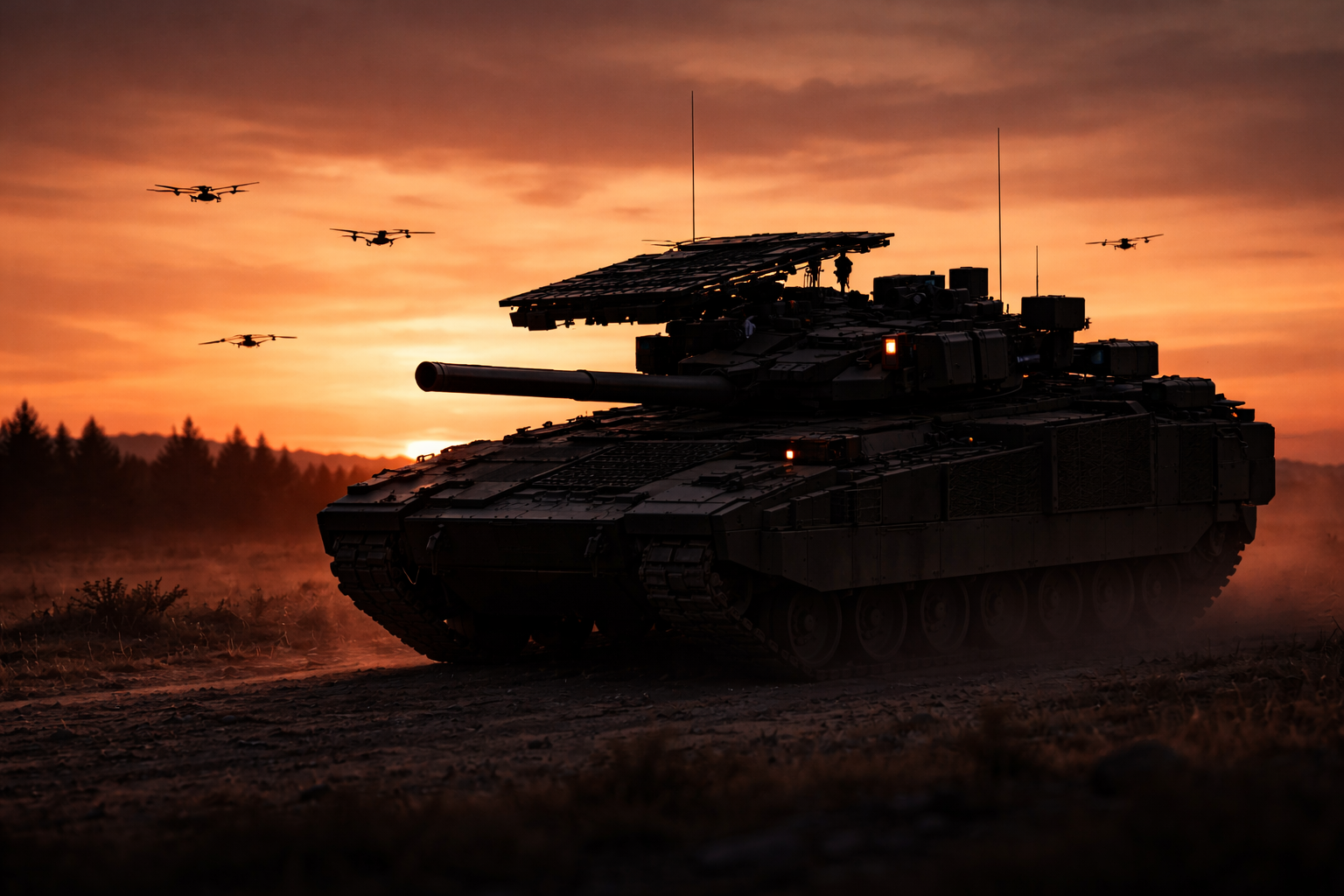
Guardian Angel was unveiled in August after a rapid Australian development effort involving Thales, Chaos 1, and W&E Platt. Thales describes the vehicle as a prototype proof of concept, and company representatives say it has already undergone live-fire testing. The system can accept remote weapon stations and other effectors, while its modular design also allows configurations for logistics, casualty evacuation, and other support tasks.
The Bushmaster connection is more specific than simply showing the two vehicles together. Thales says Guardian Angel could be deployed, controlled, and supported from Bushmaster vehicles depending on the mission and the level of autonomy fitted to the UGV. The Bushmaster 5.6 Mulga utility variant, unveiled at Eurosatory in June, has also been identified as a possible control node and transport platform for robotic systems.
That creates a substantial systems-engineering problem. An unmanned vehicle still needs transport, charging or refuelling, communications, mission planning, operator interfaces, recovery procedures, maintenance, and spares. Using a protected mobility platform as part of that support architecture could reduce the amount of dedicated equipment needed to field the robot, particularly if the autonomous system is expected to work ahead of a convoy or operate in areas where commanders want to limit crew exposure.
The concept also fits the way land forces are beginning to experiment with mixed crewed and uncrewed formations. Robotic vehicles are being considered for reconnaissance, logistics, casualty movement, weapons carriage, and electronic warfare, but each role places different demands on payload, autonomy, communications, and human supervision. A modular UGV can cover several of those tasks only if the surrounding command and support system can adapt at the same pace.
Bushmaster offers Thales an existing platform family with a substantial operational and industrial base. The vehicle has been produced in Australia for years and exported to several customers, while the Mulga variant broadens the architecture towards utility and mission-system roles. Integrating robotic control functions into that family could allow autonomy to enter service through a vehicle ecosystem that already has established maintenance, training, and logistics arrangements.
Guardian Angel’s six-week prototype cycle is relevant because it shows how quickly hardware can be placed in front of users when the objective is experimentation rather than immediate service acceptance. That speed does not remove the qualification burden that follows. Reliability, safety, electromagnetic compatibility, cyber assurance, weapons integration, human-machine interfaces, and maintainability still have to be demonstrated before a prototype can become a deployable military system.
Communications will be one of the harder constraints. A UGV controlled from a Bushmaster has to maintain useful links while terrain, buildings, distance, interference, and hostile electronic activity degrade the radio environment. Increasing onboard autonomy can reduce the amount of continuous control traffic required, but it also raises the standard expected of navigation, obstacle handling, mission logic, and fail-safe behaviour when the link is interrupted.
Operator workload creates a parallel challenge. A protected vehicle crew cannot simply absorb responsibility for several robotic systems without changes to displays, procedures, staffing, and training. The practical value of the mothership concept will therefore depend on whether autonomy genuinely reduces the amount of attention needed per vehicle, rather than shifting a larger supervisory burden into an already busy crew compartment.
Thales has said lessons from Guardian Angel are already being applied to more complex autonomous platforms. That makes the prototype useful even if its current configuration never becomes a production vehicle: it gives engineers and soldiers a physical system around which to test payload interfaces, control concepts, support arrangements, and the limits of rapid development.
No Australian Defence Force procurement has been announced for Guardian Angel, and the Bushmaster mothership concept remains developmental. The next meaningful milestones will be more representative field trials, integration work, and evidence that the UGV can be deployed and supported routinely rather than demonstrated in isolation.
For Australian industry, the attraction lies in joining a proven protected vehicle with a locally developed autonomy programme without waiting for a clean-sheet platform. The difficult work now sits in the interfaces — communications, software, payloads, power, operator control, and support — that will determine whether Guardian Angel becomes part of a usable formation or remains an impressive six-week prototype.