IN Brief:
- Barracuda-500M missiles would be deployed from roll-on, roll-off pallets through the C-390’s rear ramp.
- The system could add kinetic and non-kinetic effects while preserving the aircraft’s transport role.
- Engineering will centre on carriage, mission software, communications, safe separation, certification, and weapon production.
Embraer and Anduril are developing a pallet-launched stand-off weapon capability for the C-390 Millennium, allowing the transport aircraft to deploy Barracuda-500M missiles without permanent conversion.
Their agreement covers roll-on, roll-off mission systems based on established aerial-delivery methods. Missiles would be loaded aboard the aircraft as palletised equipment, connected to mission hardware, and released through the rear cargo ramp.
Anduril’s Barracuda family has been designed around simplified manufacturing and software-defined mission functions. The 500M can be configured for kinetic or non-kinetic payloads, opening potential applications across strike, electronic attack, decoy, and other stand-off missions.
The C-390 can carry approximately 26 tonnes and fly at around 470 knots, while supporting cargo, personnel transport, aerial refuelling, medical evacuation, firefighting, and operations from temporary or unpaved runways. A removable launch system would add another task without consuming an aircraft permanently as a dedicated bomber.
Such reversibility gives operators access to additional launch capacity during high-demand periods while retaining the transport fleet for routine work. It does not remove the need for detailed airworthiness, weapons, software, and operational clearance.
Cargo handling becomes weapons engineering
Once connected for a mission, the pallet can no longer be treated as ordinary freight. Its structure must restrain the missiles during taxiing, turbulence, manoeuvre, and emergency landing loads before releasing them predictably into the disturbed airflow behind an open cargo ramp.
Extraction equipment, parachutes or deployment mechanisms, pallet motion, and weapon separation must be modelled and tested. A load that fails to clear the aircraft cleanly could strike the ramp, contact another pallet, or remain entangled behind the fuselage.
The aircraft’s centre of gravity will change as successive pallets leave the cargo bay. Load-planning procedures and flight-control limits must keep the C-390 inside its approved envelope throughout the release sequence, including aborted drops and partial deployments.
Mission systems add further complexity. The aircraft must receive target data, initialise each weapon, verify status, upload mission information, control release timing, and maintain secure communications where weapons remain connected after launch.
Cyber separation between palletised equipment and flight-critical networks will require particular attention. Interfaces must allow the mission system to access navigation and timing information without creating an uncontrolled route into aircraft functions.
Safe carriage also encompasses batteries, energetic materials, electromagnetic compatibility, temperature, vibration, and emergency procedures. Aircrew and loadmasters will require training that extends beyond conventional cargo operations into weapons handling, targeting, and release management.
The continuing expansion of Europe’s C-390 delivery and production pipeline gives any common mission kit a growing potential user base. That advantage will weaken if each customer demands a separate communications architecture, weapon type, or certification baseline.
Launch capacity depends on missile output
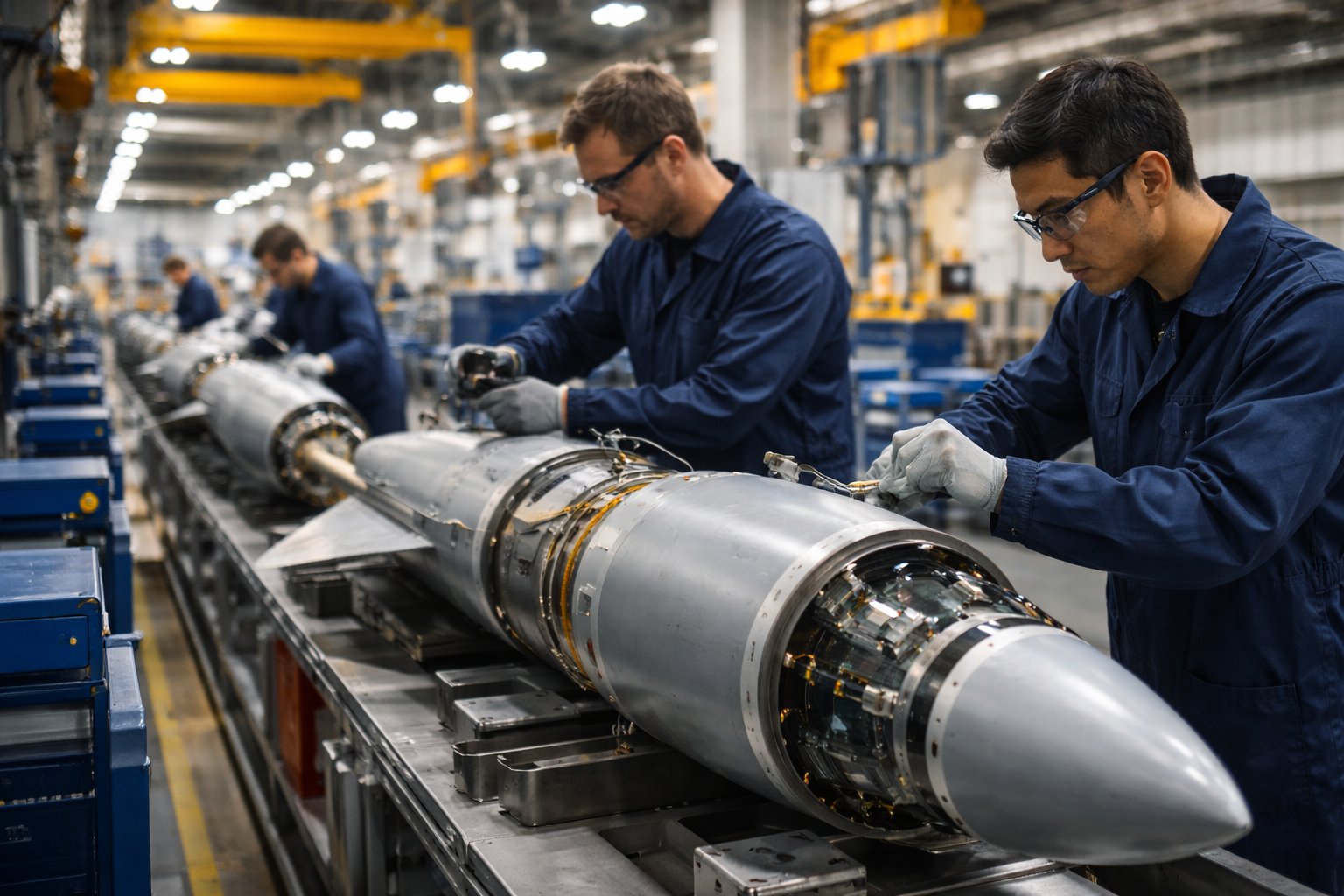
Palletised strike transfers part of the industrial burden from specialised aircraft into expendable weapons. Its operational value therefore depends on a production base capable of supplying missiles in quantities that match the enlarged launch capacity.
Anduril has designed Barracuda around reduced part count and manufacturing methods intended to support higher output than conventional cruise-missile programmes. Volume will still depend on motors, seekers, processors, actuators, structures, warheads, and test equipment supplied through an industrial base already facing growing demand.
Storage life and health monitoring will influence readiness. Palletised weapons may spend long periods in depots or deployed locations, requiring batteries, seals, electronics, and energetic materials to remain within specified conditions without frequent disassembly.
The pallets themselves will become a separate product line, requiring restraint equipment, release mechanisms, power distribution, communications hardware, and inspection. Reusable launch equipment must be robust enough for transport operations while remaining simple to install and remove.
Certification requirements may differ among customers, particularly where the C-390 retains civil-derived airworthiness processes alongside military weapons clearances. Export controls will also govern access to software, targeting data, and weapon interfaces.
Training presents another continuing demand. Airlift crews selected for armed missions need tactics, electronic-warfare awareness, mission planning, and targeting instruction, while maintainers require equipment and documentation covering both aircraft and weapon systems.
Palletised strike separates weapons capacity from a permanently dedicated launch platform, but it does not make that capacity inexpensive or technically simple. Embraer and Anduril must produce a system that installs quickly, separates safely, protects the aircraft’s networks, and remains sufficiently common across operators to justify sustained production.