IN Brief:
- Mangrol is the third of eight Mahe-class ASW shallow-water craft being built by Cochin Shipyard.
- More than 80% indigenous content supports India’s domestic naval manufacturing and systems-integration base.
- Seven of eight hulls have been launched as activity shifts towards integration, acceptance, and fleet introduction.
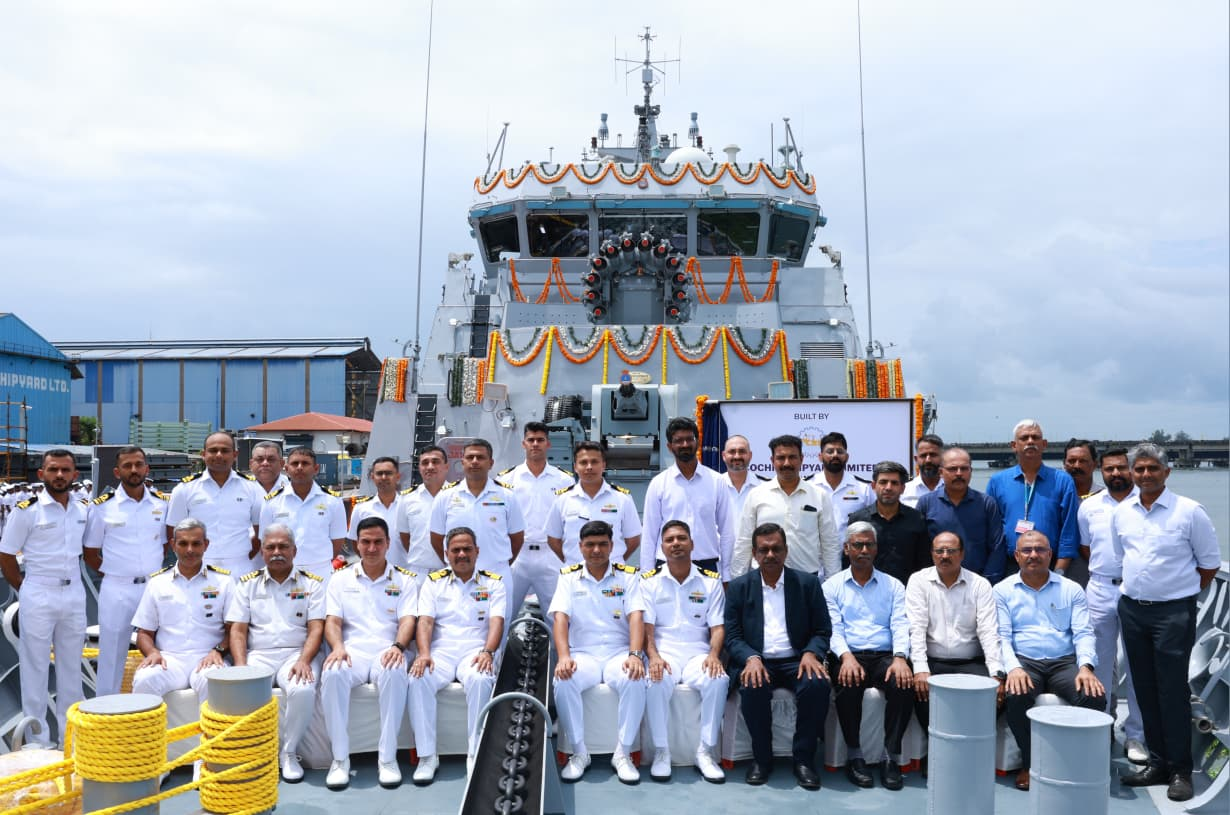
Cochin Shipyard Limited has delivered Mangrol, the third Mahe-class Anti-Submarine Warfare Shallow Water Craft built at its Kochi yard for the Indian Navy, moving another vessel from the eight-ship programme into naval custody.
The ship was delivered on 21 August and carries more than 80% indigenous content, according to India’s Ministry of Defence. Mangrol is configured for underwater surveillance, anti-submarine warfare in coastal waters, low-intensity maritime operations, and mine warfare, with waterjet propulsion, torpedoes, anti-submarine rockets, radar, and sonar forming the core of its mission equipment.
The vessel continues the name of an earlier Indian Navy minesweeper and takes its current name from Mangrol, a coastal town in Gujarat. More important industrially, another domestically designed and built hull has passed the delivery threshold while later ships remain in production and outfitting.
India contracted Cochin Shipyard in April 2019 to build eight ASW shallow-water craft. The class is intended to replace the Navy’s older Abhay-class anti-submarine corvettes and is designed around littoral missions where detecting, tracking, and prosecuting submarines in relatively confined coastal waters requires a different balance of size, manoeuvrability, sensors, and endurance from a larger blue-water combatant.
Published class data puts the vessels at about 78 metres long and 11.36 metres wide, with a draught of roughly 2.7 metres. The design has a maximum speed of 25 knots and endurance of around 1,800 nautical miles, while the shipbuilder has identified indigenous hull-mounted sonar and low-frequency variable-depth sonar as central elements of the underwater-surveillance fit.
That combination creates a substantial integration task inside a compact hull. Anti-submarine warfare depends on the interaction of acoustic sensors, combat-management functions, navigation, communications, weapons, propulsion, and electrical systems rather than on any single item of equipment, so achieving a repeatable configuration across the class is as significant as launching the steelwork itself.
The delivery follows commissioning of INS Mahe, the first ship of the class, in November 2025 and INS Malvan, the second, in July this year. Cochin Shipyard also launched Machilipatnam, the seventh of the eight planned vessels, on 29 July, leaving several stages of the programme running in parallel — commissioning and delivery at the front of the sequence, with construction, outfitting, integration, and testing continuing on later hulls.
Parallel production can expose weaknesses in a naval supply chain quickly. Equipment arriving late on one vessel can affect several hulls behind it, while changes arising from early trials may need to be incorporated into ships already under construction. A stable configuration, by contrast, allows the yard and its suppliers to carry production lessons into later builds without repeatedly reopening major design work.
The programme is also part of India’s wider effort to retain more naval manufacturing value domestically. The Ministry of Defence has repeatedly put indigenous content above 80%, with domestic manufacturers supplying equipment and systems alongside the prime shipbuilder. That percentage has strategic weight only if those suppliers can continue producing, supporting, repairing, and replacing their equipment throughout the fleet’s service life.
Waterjet propulsion suits a shallow-water design because it removes exposed propellers and can support high manoeuvrability, although final acoustic performance depends on the complete machinery and hull arrangement. The Navy’s mission set also requires a vessel able to move between surveillance, mine-warfare, and low-intensity operations without the operating burden of a larger surface combatant.
Mangrol’s handover does not complete the process. Commissioning and in-service acceptance remain ahead, while the remaining ships must move through outfitting, harbour trials, sea trials, acceptance, and delivery. With seven of eight hulls already launched, however, the programme is increasingly becoming a test of systems integration and repeatable acceptance rather than basic hull construction.
The next useful milestones will be commissioning of Mangrol, delivery of the remaining vessels, and evidence that sonar, weapons, propulsion, and combat-system integration can be accepted consistently across the class. Those steps will show whether the Mahe programme is producing a repeatable fleet capability as well as a succession of completed ships. Repeatable delivery across the remaining hulls will be the stronger industrial test.