IN Brief:
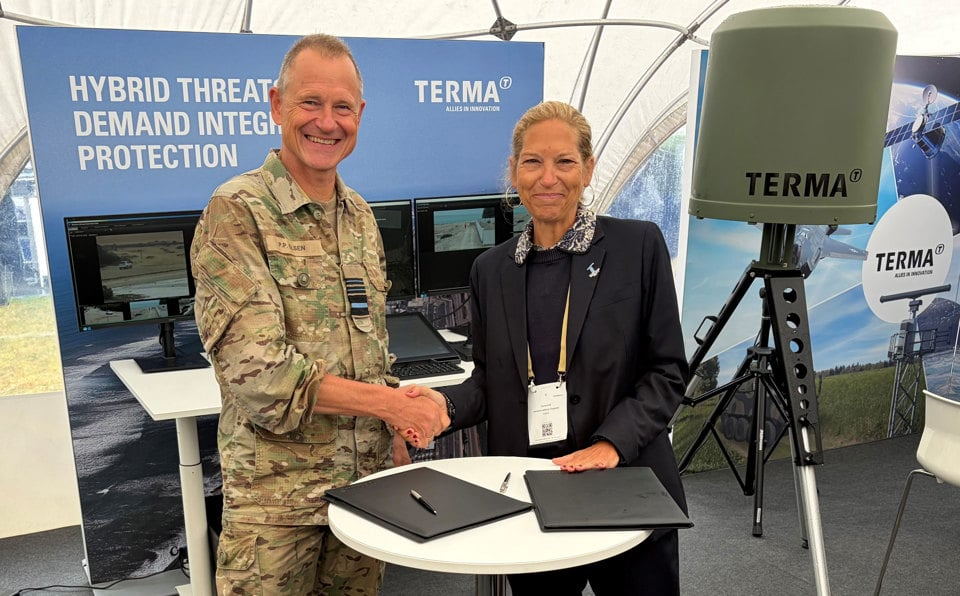
- Denmark has selected Terma to deliver an integrated national command-and-control layer for counter-drone operations.
- Helion and OSL Technology's FACE platform will combine military, civilian, critical-infrastructure, and third-party sensor data.
- The modular architecture is designed to absorb additional sensors and countermeasures while retaining Danish control of operational data.
Terma has been selected by the Danish Ministry of Defence Acquisition and Logistics Organisation to deliver an integrated national command-and-control system for counter-drone operations. The architecture will connect existing and future sensors operated by the armed forces, civilian authorities, and critical-infrastructure organisations into a shared drone situational picture.
Denmark already operates detection systems across several organisations, but their information is held in different locations and technical environments. Terma’s contract addresses the layer between those installations, allowing data from distributed sensors to be collected, correlated, processed, and presented to operators without requiring every organisation to replace its existing equipment.
The system is built around Helion, Terma’s sovereign multi-domain data backbone. Helion is intended to connect existing and future sensors and transform their outputs into information that can support tactical decisions at both local and central levels, providing the common data architecture beneath the wider counter-drone network.
The solution also integrates FACE, a command-and-control and data-fusion platform developed by OSL Technology, which became part of Terma in 2025. FACE can combine information from Terma radar and surveillance equipment with third-party sensors and countermeasures, while artificial intelligence assists with processing, classification, and prioritisation of the incoming data.
Counter-drone operations depend on more than detecting an object. Multiple sensors may see the same aircraft, provide tracks at different levels of accuracy, or generate alerts from legitimate activity and environmental clutter. The command layer has to reconcile those inputs quickly enough for operators to identify incidents that need attention and coordinate the appropriate response.
Lieutenant General Per Pugholm Olsen, chief of DALO, described the agreement as an “important cornerstone in the ongoing effort to build a strong counter-drone capability”. The network is intended to support sites beyond conventional military installations, including airports, ports, energy facilities, government buildings, and other critical infrastructure.
Terma says Denmark will retain national control of operational sensor data while the architecture remains open to technologies from multiple suppliers. That provides a route to add or replace radars, radio-frequency sensors, electro-optical systems, command tools, and countermeasures without rebuilding the entire national structure around one manufacturer’s product family.
Open architecture carries its own engineering burden. Each additional system introduces interfaces, timing requirements, cyber-security controls, data formats, track-quality questions, and testing requirements. Interoperability depends on those interfaces performing consistently under operational load rather than simply accepting a nominal connection in a laboratory.
OSL contributes experience from established counter-drone deployments. The business has acted as prime contractor and system integrator for Heathrow Airport’s counter-drone system since 2019 and supplies counter-drone capability to Norway’s Ørland and Evenes air bases through a framework with the Norwegian Defence Materiel Agency.
Those deployments give the Danish programme access to experience from both civilian and military operating environments. Airports and defence sites present different rules and response options, but each requires sensors to operate around legitimate aviation, communications, buildings, vehicles, and other activity that can complicate classification.
The Danish programme is structured to expand over time. Additional sensors, sites, countermeasures, and other capabilities can be incorporated as requirements change, giving the network a longer development path than a one-off purchase of detection equipment. That is particularly relevant in counter-UAS work, where aircraft designs, communications methods, navigation techniques, autonomy, and attack profiles can change faster than conventional procurement cycles.
Terma has not disclosed the contract value or a complete deployment timetable. The known scope centres on the national command-and-control layer and the gradual connection of currently fragmented systems, leaving individual sensors and effectors to be selected or integrated as Denmark develops the wider capability.
The resulting programme places systems integration at the centre of counter-drone procurement. Individual radars and effectors remain necessary, but a national network also has to determine what has been detected, whether several sensors are observing the same target, which authority owns the incident, and what response is available at that location.
Denmark is now building that connective layer around technology already deployed across military and civilian sites. The success of the programme will be measured less by the number of sensors connected than by whether operators receive a coherent, timely picture when those systems begin reporting simultaneously.