IN Brief:
- DroneShield’s Q4 2026 software update routes unfamiliar drone-like RF signals from RfRecon into DroneSentry-C2 for operator assessment.
- The company reports a 44% improvement in thermal classification accuracy, plus higher fixed-wing identification precision and recall.
- Compatible DroneSentry-X Mk2 units can share detections for coordinated disruption, while the DroneSentry-C2 software update is scheduled for 3 November.
DroneShield has announced its fourth-quarter 2026 software update for counter-uncrewed aircraft systems, introducing unfamiliar-signal alerts, revised camera classification and coordination between connected electronic countermeasure units. The Australian company’s release covers detection, identification, tracking and response functions, with updates distributed to compatible equipment through its Mission Ready Services subscription. No new equipment procurement, production order or operational acceptance is announced.
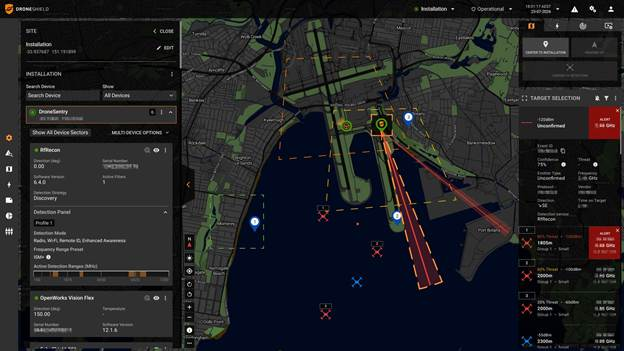
One change connects RfRecon radio-frequency intelligence equipment more directly with the DroneSentry-C2 command system. Signals that exhibit characteristics associated with drones, but do not match entries already held in DroneShield’s threat library, can now appear in the command dashboard for investigation. Operators can filter the records by frequency range when examining uncertain detections. The alert identifies a potentially relevant transmission; it does not establish that every unfamiliar signal belongs to a hostile drone.
Radio-frequency identification often draws on known emissions from aircraft, controllers and communications links. An unfamiliar emitter can therefore present an identification problem even when equipment detects radio activity in the relevant band. Routing uncertain observations into DroneSentry-C2 means they can be assessed alongside recognised tracks and other sensor information, rather than treated as confirmed identifications. The company has not published a false-alarm rate or an independent evaluation of the new unknown-signal feature.
Vision-based classification receives a separate set of changes. DroneShield reports a 44% improvement in thermal-camera classification accuracy and, for fixed-wing drone identification, improvements of 18% in precision and 8% in recall. It also reports better target detection in standard video, without providing a numerical result for that measure. Precision describes the proportion of identifications flagged by a model that are correct, while recall concerns the proportion of relevant targets that the model identifies. The release does not give test-set composition, starting performance values or independent validation data, so the figures should be treated as company-reported comparisons.
The thermal and visible-light changes sit alongside a new workflow linking radio-frequency sensors and compatible optical cameras. With compatible Bosch Starlight cameras, an RF detection provides a directional cue for the camera to search before attempting to lock on to and track an object. RF reception and passive imaging can operate without transmitting radar signals, although successful confirmation still depends on the sensor geometry, visibility and the camera’s ability to acquire the object. DroneShield has not specified a detection range or a probability of successful visual acquisition for the combined arrangement.
A directional cue narrows the camera search, while imagery can add evidence about the object associated with a transmission. It does not remove the need to associate observations made at different times and from different positions. A bearing cue does not by itself give the target distance or guarantee a camera lock; the operator still depends on successful target acquisition and track continuity. Those considerations become more demanding where multiple emitters or moving objects occupy the same area.
The software update also changes how connected DroneSentry-X Mk2 units exchange information for electronic countermeasures. According to DroneShield, a detection made by one unit can be shared with other connected units, supporting a coordinated disruption response against a selected drone. The company also says its jamming control can concentrate energy on frequencies used by that drone instead of applying a broader response. No measured disruption-success rate, coverage comparison or quantified interference reduction for a specified installation was released.
Electronic disruption operates differently from passive RF monitoring. A receiver observes signals already in the environment, whereas jamming transmits energy and can affect other radio systems using neighbouring or shared spectrum. Targeted frequency selection may reduce unwanted effects, but the outcome depends on the emitter, waveform, antenna placement and local spectrum conditions. Restrictions on transmitting counter-drone signals also vary by jurisdiction, and the October announcement does not grant customers new authority to operate active countermeasures.
DroneSentry-C2 remains the system’s central point for consolidating sensor observations and presenting response options. DroneShield describes its platform as usable through locally hosted or cloud arrangements and capable of incorporating both company and third-party sensors. The fourth-quarter release adds streamlined user-interface and connectivity configuration, together with compatibility for Sentrycs firmware 6.7.1. The release identifies compatibility, not a newly commissioned deployment or completed customer acceptance test involving Sentrycs equipment.
Distribution is tied to the company’s Mission Ready Services offering, which provides subscription-based software enhancements and support. DroneShield says the service spans more than 4,200 software-enabled devices in the field. That figure describes the wider supported installed base, not 4,200 individually confirmed installations of this exact release. Although the company announced the quarterly update on 14 October, availability is staged: the DroneSentry-C2 software release is scheduled for 3 November 2026, according to trade reporting of the release.
The update extends earlier investment in software-defined RF sensing and interoperability. In August, DroneShield introduced RfRecon as a portable RF intelligence product, while earlier software releases expanded the DroneSentry-C2 platform’s ability to work with different sensors and effectors. The October development connects unfamiliar-signal alerts and visual confirmation more closely to the command workflow, making it a separate technical change from a new research facility, sensor launch or hardware manufacturing milestone.
No contract value, new hardware production quantity or named military acceptance trial accompanies the software announcement. The extent of each installation’s upgrade will depend on compatible sensor hardware, cameras, electronic countermeasures and software versions; the release does not imply that every device receives every feature. DroneShield’s stated rollout will continue with the planned 3 November command-system release, after which operators can assess the updated detection and response functions on compatible equipment.