IN Brief:
- 3ME Technology has been selected for the US Defense Innovation Unit's PRISM prototype programme.
- EdgeVOLT will be supplied in standard form and a cold-weather configuration using South 8 Technologies LiGas cells.
- Testing will examine whether the Australian system can provide resilient tactical energy storage across demanding field conditions.
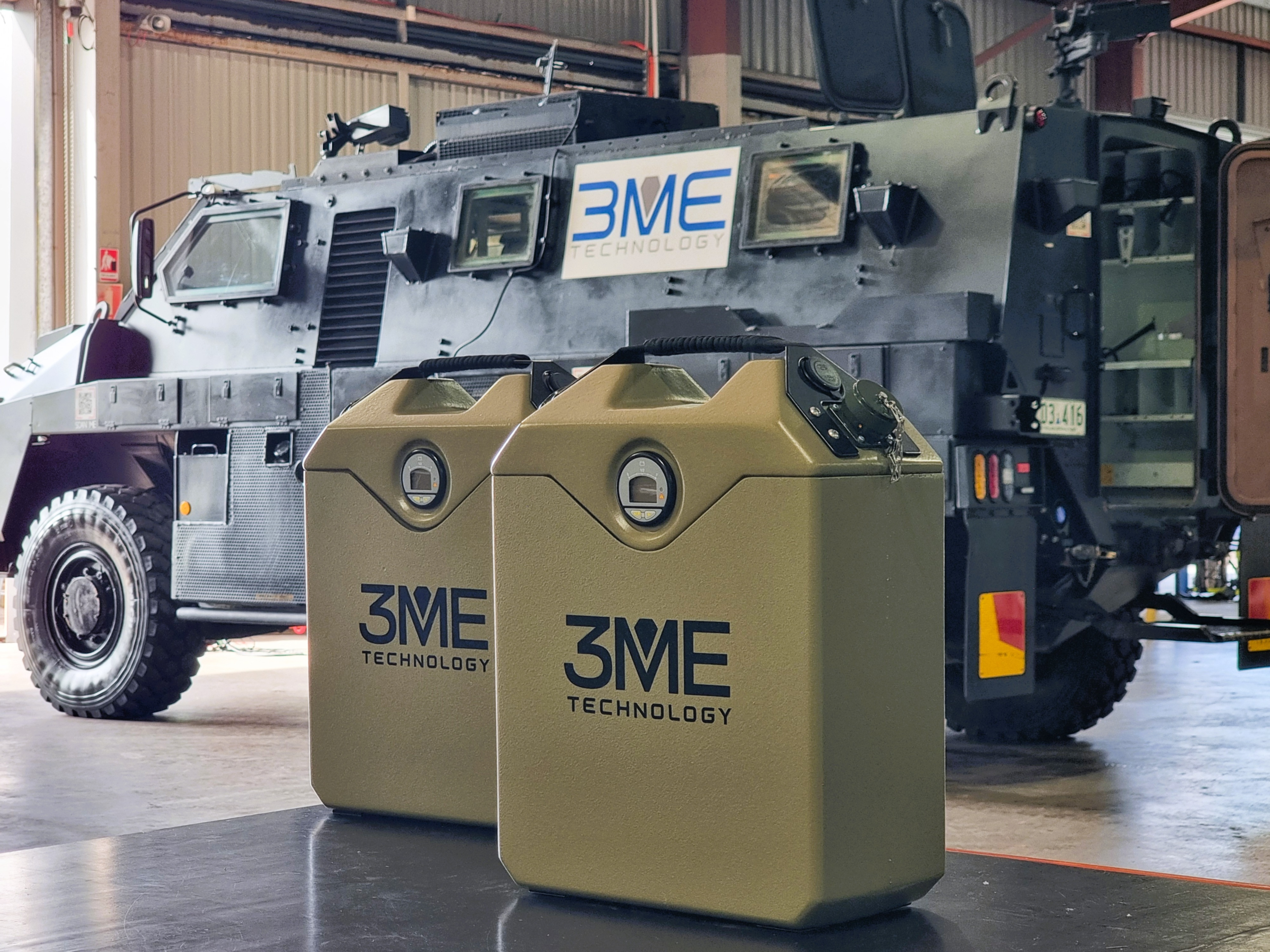
3ME Technology has been selected by the US Defense Innovation Unit to deliver and demonstrate its EdgeVOLT portable energy storage system under the Portable Resilient Integrated Storage Module programme. The Australian company will provide both its standard system and a cold-weather configuration intended for operation in unusually demanding temperature conditions.
PRISM is a prototype effort focused on rugged, deployable energy storage rather than conventional fixed battery installations. EdgeVOLT is designed as a modular system able to support communications equipment, sensors, field infrastructure, autonomous platforms, tactical vehicles, microgrids, and other equipment operating away from established electrical networks.
The cold-weather configuration will incorporate LiGas battery cells developed by South 8 Technologies. According to the programme announcement, those cells are engineered for operation between -60°C and +60°C, extending the intended operating envelope into temperatures that can substantially reduce the performance of conventional lithium-ion systems.
Cold conditions affect usable capacity, internal resistance, charging behaviour, and power delivery, while batteries deployed in tactical environments must also cope with vibration, handling, transport, weather exposure, and irregular charging cycles. The programme therefore combines a demanding electrochemical problem with the mechanical and systems-engineering requirements attached to deployable military equipment.
EdgeVOLT’s modular architecture allows energy capacity to be configured around the intended load rather than treating portable storage as one fixed-size product. 3ME positions the system for distributed energy delivery close to the equipment consuming the power, an approach intended to reduce dependence on long cable runs or continuous generator operation at every location.
Justin Bain, chief executive of 3ME Technology, said the programme would test Australian-developed systems against “power and endurance challenges for defense users”. The company has experience developing battery and electrification systems for mining, marine, aerospace, and military applications, environments in which equipment has to operate under sustained mechanical and thermal loads.
That background also gives 3ME in-house battery testing capability. The company says it can test heavy-industrial battery systems and loads up to 750kW, control temperature, provide external cooling, conduct charge and discharge testing, and simulate electrical conditions associated with real equipment. Those facilities provide a useful engineering base for the PRISM prototypes, although military qualification will add its own environmental, safety, interoperability, and support requirements.
The electrical burden carried by land forces has expanded as communications, sensors, electronic warfare equipment, uncrewed systems, computing, and distributed command infrastructure have proliferated. Generators remain central to deployed power, but fuel consumption, transport, maintenance, acoustic signature, and thermal signature all influence how those systems can be operated.
Battery storage can shift part of that load without removing the underlying logistics requirement. Energy still has to be generated and transferred into the batteries, while pack life, charging rate, safety, weight, energy density, environmental tolerance, and maintainability determine whether the system improves operations or simply introduces another item requiring support.
The programme also provides a practical test of defence technology movement between Australia and the United States. 3ME is an AUKUS Authorised User, and the company links its participation in PRISM to the Pillar II framework intended to ease collaboration around advanced technologies. A prototype evaluation is a more concrete measure of that process than another memorandum or technology forum because hardware enters a US-led acquisition activity.
Selection for PRISM does not guarantee a production order. DIU programmes are designed to place promising commercial and dual-use technologies into accelerated defence evaluation, after which performance, cost, military demand, and contracting decisions determine whether a system progresses further.
For 3ME, the immediate task is to show that EdgeVOLT’s modular architecture and extreme-temperature variant can deliver useful power under conditions representative of deployed operations. If the prototypes perform as intended, the company will have established more than a battery specification: it will have demonstrated that an Australian tactical-energy system can survive a US defence evaluation and compete for broader adoption.