IN Brief:
- Three additional N3X satellites will increase Kongsberg's proprietary constellation from three spacecraft to six.
- Integrated AIS receivers and passive RF sensors support detection of dark vessels, spoofing, and anomalous maritime activity.
- The new spacecraft are scheduled for early 2027 after operational use of the first constellation by Norwegian authorities.
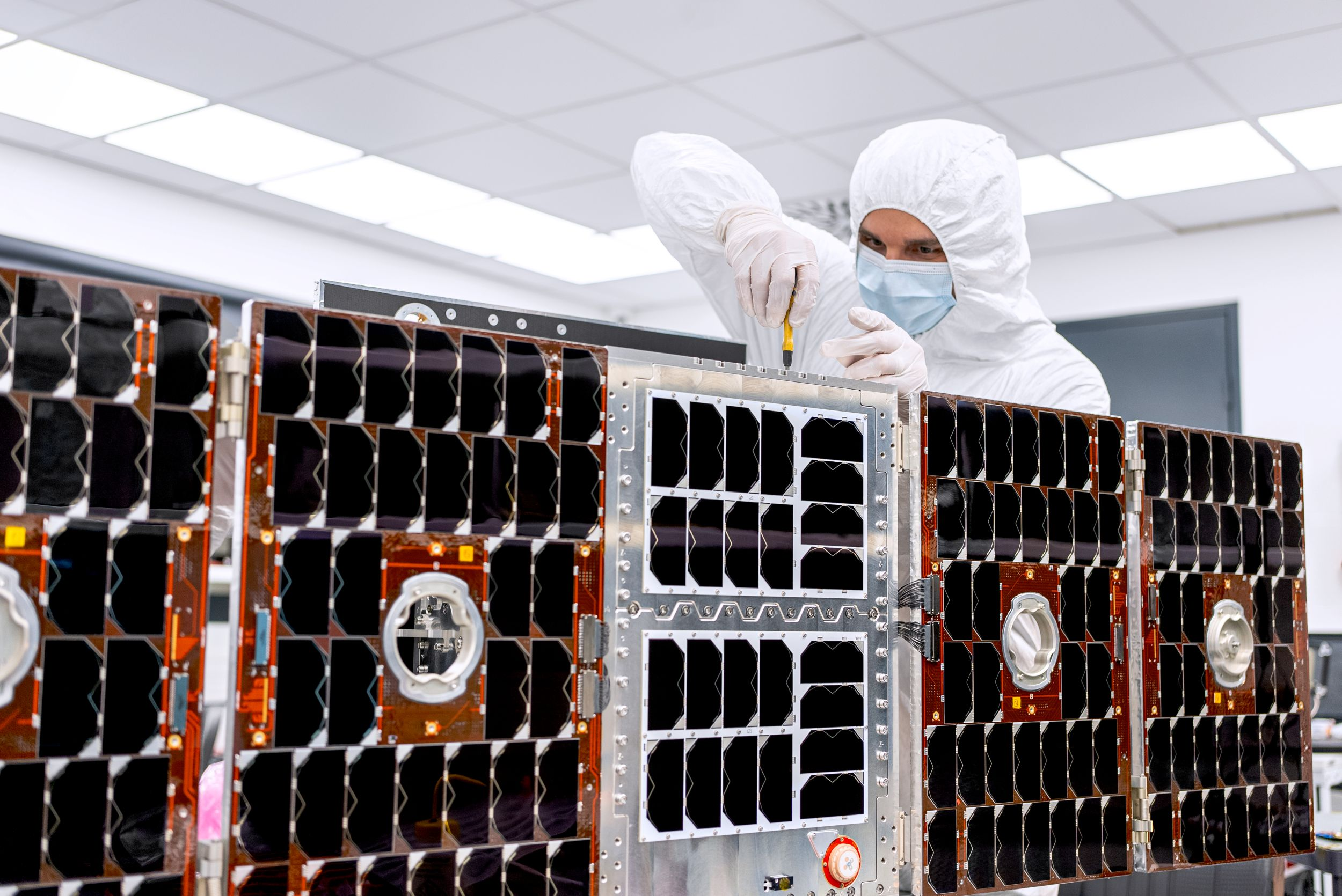
Kongsberg will add three satellites to its N3X maritime surveillance constellation in early 2027, doubling the system from three spacecraft to six as Norway increases its use of commercial space infrastructure for defence and government monitoring. The expansion is intended to improve revisit rates and provide surveillance data more frequently across maritime areas of interest.
The first three N3X satellites were launched during 2025 and are already providing data to the Norwegian Armed Forces and government agencies including the Norwegian Coastal Administration, Directorate of Fisheries, and Norwegian Customs. Kongsberg says their operational performance provided the basis for ordering the additional capacity.
Each spacecraft carries an Automatic Identification System receiver and passive radio-frequency sensors. AIS provides identification and navigational information transmitted by equipped vessels, while passive RF sensing provides another means of detecting activity when those cooperative signals are absent, inconsistent, or deliberately manipulated.
Kongsberg identifies dark-vessel tracking and the detection of AIS spoofing among the missions supported by N3X. A vessel that switches off its AIS transmitter may still emit radar or other radio-frequency signals, while a ship transmitting misleading positional information can potentially be identified when its reported location conflicts with independent sensor observations. Combining the two data sources therefore provides a more useful surveillance picture than relying on AIS alone.
The satellite programme is built around several businesses within the Kongsberg group. Kongsberg NanoAvionics supplies the spacecraft platforms, Kongsberg provides the payload and overall system integration, and KSAT handles ground services and satellite operations. Secure data delivery completes a chain that runs from sensing in orbit to distribution of processed information to the organisations using it.
That architecture places equal weight on the ground segment. Additional satellites reduce the interval between observations, but surveillance data loses value if it sits aboard a spacecraft waiting for a downlink or becomes delayed during processing. Ground-station availability, communications links, processing capacity, and distribution therefore determine how closely the practical service approaches the near-real-time coverage Kongsberg is targeting.
Norway’s maritime geography makes revisit rate particularly important. Government agencies monitor extensive coastal and offshore areas, while defence surveillance extends into northern waters where shipping, military activity, fishing, energy infrastructure, and other operations share the same environment. No single satellite can remain continuously above those areas, so additional spacecraft provide more opportunities to collect relevant signals during a given period.
Kongsberg retains ownership of all N3X satellites rather than transferring the space segment to the Norwegian state. Defence and government bodies consume the resulting data as customers, while spare capacity can be sold to allied and partner countries or commercial users. The arrangement spreads the infrastructure across several revenue streams while allowing Norway to expand capability without operating each satellite directly.
A commercially owned constellation still needs to meet defence requirements for resilience, availability, security, and priority access. Demand can rise quickly during a crisis, creating questions around how capacity is allocated between government, allied, and commercial customers. Secure tasking and distribution are particularly important where passive RF observations expose sensitive patterns of vessel activity.
The N3X expansion also reflects the shorter development cycle possible with microsatellites. Large bespoke surveillance spacecraft can take many years to design and procure, while smaller platforms can be produced and launched in batches as requirements change. Their individual capability may be more limited, but a constellation can compensate through quantity, revisit frequency, and incremental replacement.
That approach also creates room for technology refresh. Sensors, processors, communications equipment, and software can evolve between batches rather than remaining fixed for the lifetime of a single large spacecraft, provided changes do not fracture the data architecture or complicate operations unnecessarily. Kongsberg has not detailed whether the three 2027 satellites will differ materially from the first generation beyond increasing capacity.
The company has also not disclosed the value of the expansion. Its more useful programme milestone is the schedule: three operational spacecraft are to become six in early 2027, requiring satellite manufacture, payload integration, launch arrangements, ground-system preparation, and commissioning to run on a relatively compressed timetable.
Once the new spacecraft are in orbit, the measure of success will be less the number of satellites than the reduction in time between useful observations and the speed with which those observations reach operators. Doubling the constellation creates more collection opportunities; Norway’s surveillance architecture still has to turn the additional data into decisions quickly enough for the investment to earn its keep.