IN Brief:
- Latvia tested layered counter-UAS technologies on the locally assembled Hunter infantry fighting vehicle at Ādaži.
- The trials combined RF and optical sensing, electronic and kinetic defeat options, and unmanned ground vehicles.
- Latvia has ordered 84 Hunters with at least 30% domestic industrial participation and first handovers planned for October.
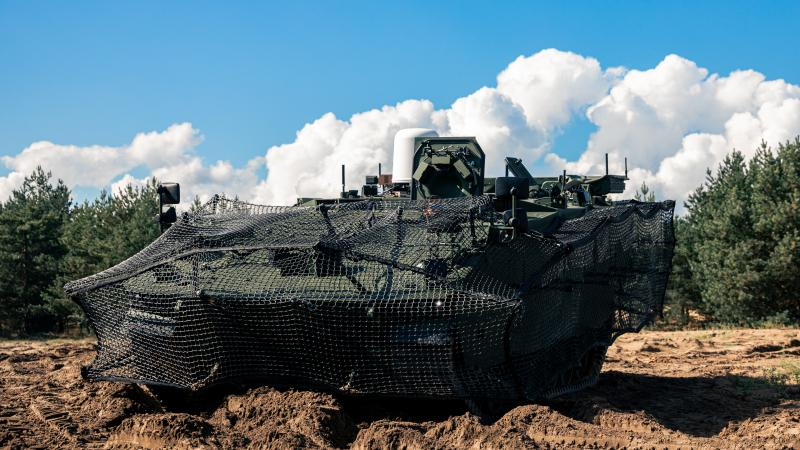
Latvia has begun testing counter-UAS protection on its new Hunter infantry fighting vehicle at the Ādaži training area, using a locally assembled vehicle to assess how layered sensors, electronic countermeasures, and unmanned ground systems can be integrated before fleet deliveries accelerate.
The 27 August trials put the Hunter through static and moving scenarios while multiple drones were introduced around the vehicle. The work followed earlier integration activity by GDELS-Santa Bárbara Sistemas and gave the Latvian National Armed Forces a live view of detection, identification, tracking, and defeat functions operating through the vehicle’s electronic architecture.
General Dynamics European Land Systems is supplying the Hunter as Latvia’s localised version of the ASCOD tracked platform. Running chassis are produced in Spain, while additional components and final assembly are undertaken in Latvia, including work at Patria’s Valmiera facility.
Latvia has ordered 84 vehicles in two tranches of 42. The programme requires local industry to account for at least 30% of activity, with Latvian companies contributing parts manufacture, systems integration, and through-life support rather than limiting domestic participation to final assembly.
The counter-UAS trials extend that industrial model into another integration layer. Radio-frequency and optical sensors were used to detect aerial threats, with the test architecture then passing information into identification and tracking functions before applying either electronic-warfare jamming or a kinetic response.
That sequence places a considerable burden on the host vehicle’s electronic architecture. Sensors, effectors, displays, communications equipment, and power systems have to exchange data quickly enough for the crew to understand the threat without creating a separate collection of stand-alone boxes competing for attention inside an already complex fighting vehicle.
The tests also included unmanned ground vehicles operating away from the Hunter. Those systems carried cameras and sensors, shared data back to the crew’s displays, and were used to examine a decentralised counter-UAS concept in which detection or jamming equipment can be pushed forward from the main vehicle.
For Latvia, that architecture offers a way to separate some sensing and electronic-warfare functions from the crewed platform. It also raises the integration requirement because remote sensors and effectors must remain connected to the Hunter’s command and display environment while operating over variable terrain and communications links.
The fact that the trials were conducted while the vehicle was both stationary and moving is technically relevant. Vibration, vehicle orientation, terrain masking, antenna placement, power demand, and electromagnetic interference can all alter system behaviour once equipment leaves a static test position, while active jamming has to coexist with friendly radios and other onboard electronics.
Those issues are easier to correct while the production configuration is still being established. Latvia’s first Hunters are due to enter National Armed Forces service from October, leaving the current trials close enough to delivery to influence final equipment choices without waiting for a later fleet-wide modification programme.
The local assembly arrangement provides a practical route for incorporating approved changes. Brackets, wiring, antenna positions, processing hardware, software baselines, and power-distribution changes can be fed into later vehicles as production matures, provided the programme maintains tight configuration control between Spanish-supplied structures and Latvian integration work.
The Hunter programme is therefore doing more than introducing another tracked platform. It is creating a domestic support and integration base around a fleet that will have to accommodate communications, sensors, protection systems, and counter-UAS technology likely to change throughout its service life.
That pressure is particularly acute for drone defence because the threat set develops faster than traditional armoured-vehicle replacement cycles. A platform expected to remain in service for years cannot rely indefinitely on one fixed counter-UAS configuration if sensors, control links, jammers, and interceptors continue to change.
GDELS has involved companies from Spain, Latvia, Estonia, Denmark, and the Netherlands in the demonstrated solution, showing that the final configuration is likely to depend on a European supplier network rather than one vertically integrated package. That gives Latvia access to specialist technologies but makes interface management and long-term support more important.
The 27 August event was an operational test rather than a production acceptance ceremony, and Latvia has not said that every demonstrated subsystem will enter service unchanged. Data from the trials will instead be used to select the most suitable final configuration before the fleet expands.
With 84 vehicles planned and the first handovers still scheduled for October, the immediate engineering task is to settle a counter-UAS architecture that can be produced, maintained, and upgraded across the fleet. The test programme has reached that decision point before serial deliveries gather pace, rather than after dozens of vehicles have already been built.