IN Brief:
- YIT will build a Leopard 2A8 assembly and maintenance facility in the Kaunas Free Economic Zone.
- The approximately €30 million project will occupy nearly ten hectares and finish in November 2027.
- Long-term value will depend on assembly depth, repair authority, spare parts, engineering access, and workforce development.
YIT has secured an approximately €30 million contract to design and construct a Leopard 2A8 assembly and maintenance facility in Lithuania’s Kaunas Free Economic Zone.
The project will be delivered for Lithuania Defence Services, with construction scheduled to begin in August 2026 and finish in November 2027. Covering a site of nearly ten hectares, the development will include a principal production building and supporting facilities.
The plant is intended to support assembly and maintenance of Leopard 2A8 tanks, creating domestic industrial infrastructure alongside Lithuania’s procurement of the latest German main battle tank.
YIT’s Lithuanian business will deliver the project under a design-and-build model, using building information modelling throughout design and construction. The facility is also expected to meet A++ energy-performance requirements, an important consideration for a plant operating heavy machinery, ventilation, workshops, heating, and controlled technical areas.
Although the construction contract defines the building, it does not yet establish the full depth of vehicle work to be undertaken. Assembly can range from fitting largely complete imported vehicles to integrating locally supplied structures, electronics, and mission equipment. Maintenance may similarly cover routine servicing or extend into major repair, overhaul, and component rebuilding.
A tank plant is more than a large workshop
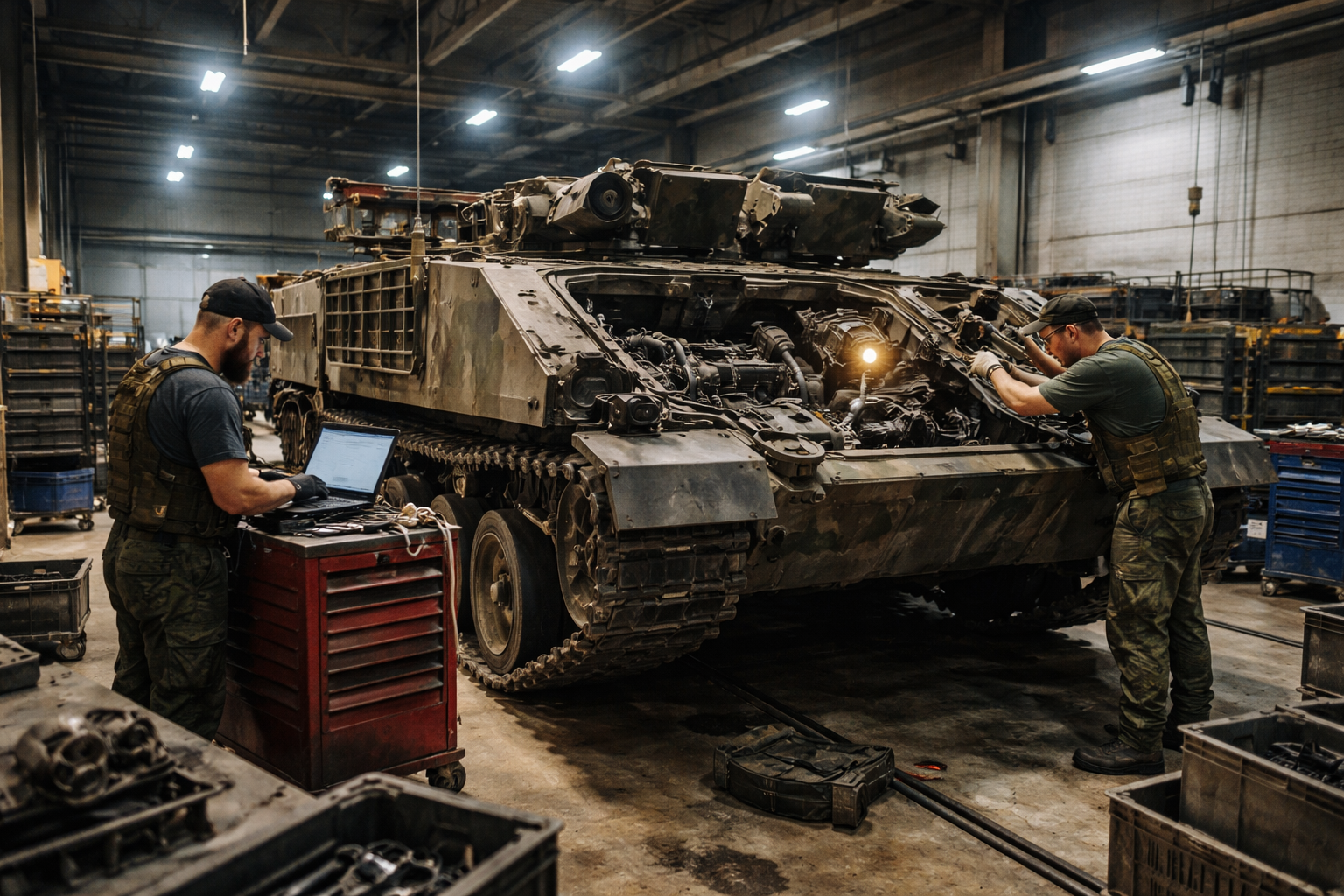
Leopard 2A8 activity requires heavy lifting, protected vehicle movement, specialist tooling, secure stores, test equipment, and controlled areas for electronics and weapons-related systems. Floor loading, crane capacity, door dimensions, extraction, fire protection, and access routes must accommodate a vehicle weighing more than 60 tonnes.
The plant will need separate areas for powerpacks, transmissions, suspension, tracks, turrets, electronic modules, optics, armour, and consumables. Some components require clean workspaces, while others arrive contaminated with mud, oil, or damaged material. Separating inspection, disassembly, repair, and final test prevents one process from disrupting another.
Digital records will follow every vehicle through its service life, capturing fitted parts, software, repairs, modifications, and inspections. Configuration management becomes particularly important when fleets receive staged upgrades or draw components from several national supply chains.
Lithuania must determine which work remains dependent upon German manufacturers and which tasks can be authorised locally. Access to repair manuals and diagnostic software does not automatically confer design authority, so complex structural damage, armour repair, fire-control equipment, and software faults may still require original-equipment support.
Norway’s first Leopard 2A8 deliveries have already begun generating new maintenance, training, infrastructure, and supply requirements elsewhere in northern Europe. Several regional fleets create opportunities for shared spares and support, although national configurations can erode commonality.
Kaunas offers strong road and rail connections and keeps the facility inside Lithuania rather than relying entirely on long-distance movement to Western European depots. Shorter repair routes could return damaged vehicles more quickly during a crisis, provided the plant holds the required parts and retains enough trained technicians.
Proximity to NATO’s eastern flank also creates exposure. A fixed armoured-vehicle facility is easy to identify and depends upon power, transport, communications, and imported components. Physical security, cyber protection, fire resilience, dispersed inventory, and alternative logistics routes should therefore be incorporated before operations begin.
Workforce preparation must start well before construction ends. Heavy-vehicle mechanics do not automatically become qualified tank technicians, while modern armoured vehicles require electronics, software, optics, and systems-integration skills alongside mechanical work. Training will need to cover German technical documentation, controlled tools, safety procedures, and quality standards.
Lithuanian suppliers may gain work in fabricated structures, cables, fixtures, workshop equipment, logistics, packaging, and selected vehicle components. Highly specialised or sensitive items are likely to remain imported initially, leaving the industrial benefit dependent upon whether local companies receive durable production responsibility rather than one-off construction work.
Maintenance may ultimately provide greater long-term value than final assembly. A limited tank order creates a finite production campaign, whereas repair, inspection, upgrades, and spare-parts management continue throughout the fleet’s life. The building should consequently support changing workloads rather than one fixed assembly sequence.
Regional demand could expand the plant’s role. A suitably authorised Kaunas facility might support allied Leopards during exercises, deployments, or repair surges, although that would require common certification and agreements covering parts, warranties, technical data, and engineering authority.
The construction timetable leaves little space for late changes to process layout. Vehicle manufacturers, maintainers, and building engineers must define equipment positions, lifting routes, material flows, and test areas early enough to avoid adapting a completed shell around an immature production plan.
Kaunas will give Lithuania a visible piece of sovereign defence infrastructure, but its strategic value will be measured by the depth of work performed inside it. A local workforce able to diagnose faults, conduct major repairs, and return vehicles to service will provide more resilience than a facility limited to final assembly.