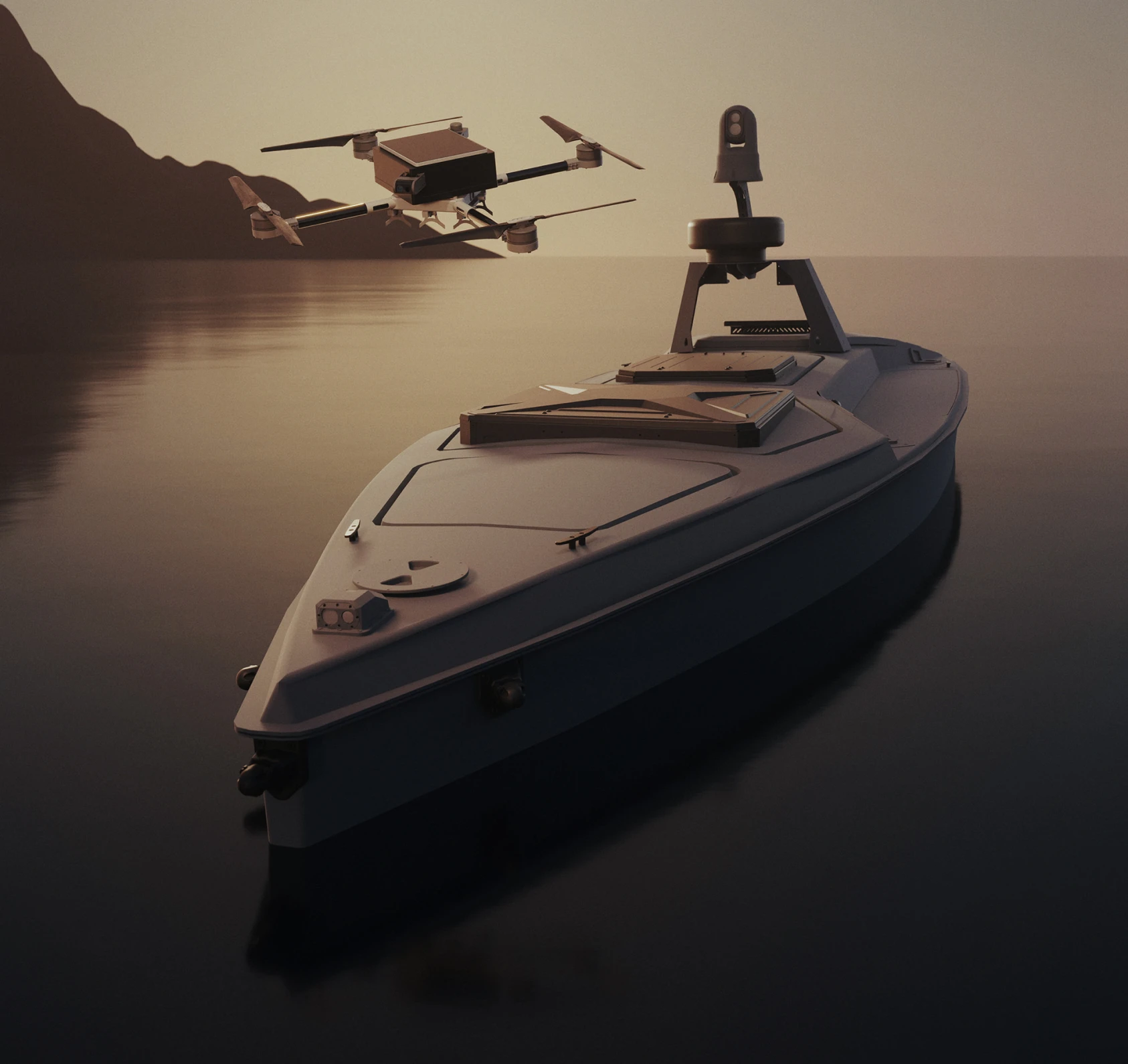
IN Brief:
- Ukrainian intelligence says Magura maritime platforms carried FPV drones used against land targets in Russian-occupied Crimea.
- UFORCE's current Magura architecture includes reusable USV configurations able to transport and launch aerial systems.
- The carrier role extends the platform beyond maritime strike into a combined sea-to-air launch chain.
Ukraine’s Magura uncrewed surface vessels are being used as launch platforms for aerial drones attacking targets ashore, extending a system associated with Black Sea naval operations into a sea-to-land carrier role.
Ukraine’s Defence Intelligence says its Group 13 unit used Magura maritime platforms carrying FPV drones during a series of operations against Russian radar and air-defence equipment in Russian-occupied Crimea. Publicly identified targets have included equipment associated with a Podlyot radar system, a Parol-4 identification radar, two S-400 launchers, and an antenna used to control Orion uncrewed aircraft.
The maritime platform is produced by UFORCE, which is developing the Magura family from one-way attack craft into a broader modular uncrewed-surface-vessel architecture. Its current designs include configurations for surface strike, reconnaissance, logistics, mine warfare, air defence, and operation as a mothership for other uncrewed systems.
The carrier role changes the operating geometry more than simply adding another weapon to a small boat. A shore-launched FPV aircraft is constrained by its own range, communications path, launch position, and exposure to electronic warfare during its transit to the target. Carrying that aircraft aboard a USV moves the launch point closer to the coastline before the airborne part of the mission begins.
The surface vessel can therefore provide endurance and transport while the smaller aerial system performs the final approach. Separating those functions allows each platform to be optimised for a different part of the mission rather than asking one vehicle to provide long maritime range and the terminal airborne strike.
UFORCE’s current MV7 specification illustrates the engineering direction of the concept. The company lists a range of around 800 nautical miles, a speed of approximately 39 knots, and a core payload capacity of up to 650kg, with configurations including attack drones, remote weapon systems, surface-to-air missiles, logistics equipment, and mine-warfare payloads.
UFORCE also markets the MV7 specifically as a UAV carrier able to launch aircraft for inland strikes and subsequently return to base. The company’s concept combines the maritime platform, an aerial effector, communications relay, and command systems into a sea-to-land strike chain rather than treating the USV purely as an expendable weapon.
The distinction between that product architecture and the systems documented in the Crimea strikes is important. Ukrainian intelligence has described the aerial vehicles used in the disclosed operations as FPV drones and has not publicly identified them as a particular UFORCE air platform. The MV7 and the company’s other airborne products therefore show where the architecture is developing, but do not establish the exact aircraft configuration used in every recorded operation.
The same caution applies to reported equipment losses. UFORCE says Russian systems worth more than $80 million have been destroyed during the recent operations. Ukrainian intelligence has publicly described losses worth tens of millions of dollars, but has not independently published the combined $80 million figure, so the larger valuation remains a company claim rather than a confirmed assessment.
What the released material does establish is that Magura is being used to transport aerial systems into a launch position at sea. Ukraine’s Defence Intelligence reported in early August that Group 13 had used Magura platforms equipped with FPV drones against radar-related targets in Crimea, followed by another operation involving two S-400 launchers and an Orion UAV-control antenna.
That builds on the wider evolution of uncrewed naval systems from single-purpose explosive boats into modular platforms carrying different sensors and effectors. A reusable USV can potentially perform surveillance, act as a communications relay, deliver payloads, deploy aerial vehicles, or carry weapons according to its configuration, increasing the number of missions available from the same basic hull.
Such flexibility does not remove the engineering difficulties. Launching a small aircraft from an uncrewed boat requires reliable mechanical handling, communications between the platforms, navigation in a moving maritime environment, power and payload integration, and command arrangements able to function under electronic attack.
Recoverability introduces another requirement. A platform designed to return after launching its aerial payload has to retain sufficient fuel, navigation, communications, and survivability for the return transit, while the operator has to decide whether the tactical value of recovery outweighs the risk of keeping the craft in the operating area.
The architecture nevertheless offers a practical way to extend the reach of comparatively small aerial systems. Instead of using a larger UAV simply to achieve the necessary transit distance, a maritime carrier can transport several smaller aircraft towards the target area, shifting part of the range requirement from the airborne platform to the USV.
That concept is applicable to more than the Black Sea. Any force operating close to a defended coastline faces the problem of placing sensors or effectors near shore without exposing a crewed launch platform. Magura’s latest operating role provides a combat-tested example of one approach: using an uncrewed vessel for the maritime leg, then handing the terminal mission to an aerial system launched offshore.