IN Brief:
- A US Navy Orca XLUUV completed a Pacific transit exceeding 1,000 nautical miles.
- The voyage provides the programme with a new endurance and reliability datapoint for extra-large undersea autonomy.
- Pacific Submarine Force is examining uncrewed systems as tactical extensions of submarines and wider naval formations.
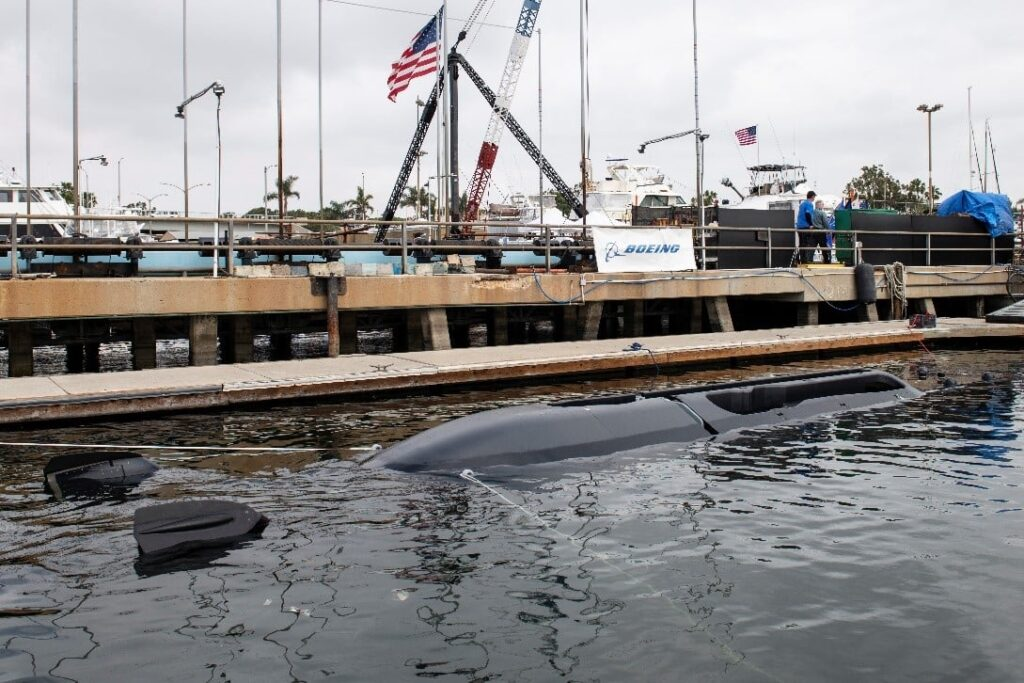
A US Navy Orca extra-large uncrewed undersea vehicle has completed a Pacific transit of more than 1,000 nautical miles, giving the programme a new endurance milestone as the submarine force expands its work with autonomous systems.
Navy teams working with the Program Executive Office for Unmanned and Small Combatants supported the mission, which took the Boeing and Huntington Ingalls-developed vehicle across the eastern Pacific. The service described it as the first time an Orca-class XLUUV had completed a transit exceeding 1,000 nautical miles.
US Navy has not disclosed the precise route, mission duration, speed profile, or degree of human intervention during the voyage. Those omissions limit public assessment of the autonomy architecture, but the distance alone still provides useful engineering evidence for an extra-large system intended to operate for extended periods.
Long-range transit places sustained demands on propulsion, energy systems, navigation, communications, fault monitoring, ballast control, software, seals, and other hardware. Unlike a crewed submarine, an autonomous vehicle cannot rely on personnel onboard to inspect equipment, improvise repairs, or intervene directly when a subsystem begins behaving unexpectedly.
Navigation is particularly demanding because satellite positioning is unavailable while the vehicle remains submerged. An XLUUV has to rely on inertial navigation, onboard sensing, acoustic references, periodic position updates, or combinations of those methods while controlling the positional error that accumulates over time.
The longer the voyage, the more significant small errors become. A deviation that is negligible over several miles can become substantial over hundreds, while energy-management decisions made early in a mission affect the reserve available for later manoeuvring, payload operation, fault recovery, or the final approach to a recovery point.
Reliability becomes a similar cumulative test. Pumps, actuators, propulsion equipment, control electronics, sensors, batteries or other energy hardware, and software must continue functioning through repeated cycles and changing conditions. Failure modes unlikely to appear during a short demonstration become more probable as operating hours increase.
That is why endurance trials matter before a navy relies on autonomous vehicles operationally. Travelling a long distance does not validate every mission system, but it exposes the basic platform and support procedures to stresses that shorter events may not reveal.
Orca sits within the Navy’s extra-large UUV category and has been developed around modular payload capacity and missions that would be difficult to assign to smaller autonomous vehicles. The platform has been associated with intelligence, surveillance and reconnaissance, mine warfare, seabed activity, and other expeditionary tasks as the programme develops.
The Navy is also exploring how large uncrewed undersea systems could operate alongside submarines and surface formations rather than as an isolated technology fleet. That creates different requirements from an independent transit demonstration.
A vehicle operating with a submarine or carrier group has to fit into mission planning, timing, communications, identification, recovery procedures, and command arrangements while avoiding interference with crewed platforms operating in the same area.
Pacific Submarine Force has also discussed concepts in which autonomous vehicles could become tactical extensions of crewed submarines, including missions where UUVs carry sensors, payloads, or other equipment beyond the immediate position of the submarine itself.
Logistics is another possible role. Discussion around Pacific exercises has included concepts in which UUVs transfer critical parts or components between submarines and surface forces, potentially reducing the need for a submarine to expose itself or return to port for comparatively small items.
Such a mission would require considerably more than endurance. Reliable rendezvous, underwater navigation, payload handling, communications, identification, and recovery would all have to function repeatedly before the concept became operationally useful.
The 1,000-nautical-mile transit therefore provides evidence relevant to several future missions without validating any of them individually. Endurance is a prerequisite for distributed surveillance, seabed activity, logistics, and other long-range Pacific tasks, but each mission adds equipment and software that consume energy, space, and integration effort.
Payload modularity creates its own engineering problem. Extra-large vehicles have enough internal capacity for systems that smaller UUVs cannot carry, but every payload affects mass, trim, balance, energy consumption, communications, cooling, and mission software. A modular bay only reduces integration effort if mechanical, electrical, and digital interfaces remain stable across payload types.
Manufacturing and sustainment will ultimately determine whether long-range demonstrations can translate into fleet capability. Large autonomous submarines still require shore facilities, lifting and transport equipment, energy-system maintenance, software support, spare parts, trained technicians, mission planners, and recovery teams.
Removing sailors from the hull does not remove the support organisation around the vehicle. It changes where the people work and places greater emphasis on software, pre-mission preparation, diagnostics, and reliable maintenance between deployments.
The Navy’s challenge is therefore to turn an individual endurance milestone into repeatable availability. One vehicle completing a long transit after intensive preparation is useful development evidence, but fleet use requires several vehicles to achieve similar missions on predictable maintenance cycles and without exceptional shore support.
The Pacific transit strengthens Orca’s technical baseline by exposing navigation, energy management, hardware reliability, and operational procedures across a distance large enough to make small errors accumulate. The next more consequential milestones will involve repetition, operational payloads, and integration with crewed forces.
If Orca can combine long endurance with reliable mission execution and recoverability, the programme will move beyond proving that an extra-large UUV can travel significant distances towards demonstrating that such vehicles can become persistent elements of the Pacific undersea force.