IN Brief:
- The US Army is testing low-profile CROWS integration on M109A7 Paladin and M992A3 vehicles.
- The installation supports closed-hatch weapon operation and future counter-small-UAS capability.
- Artillery survivability is increasingly driven by sensors, remote weapons, and platform integration.
The US Army is testing low-profile Common Remotely Operated Weapons Station integration on the M109A7 Paladin self-propelled howitzer and M992A3 ammunition carrier, as artillery platforms adapt to drone-era survivability demands.
The work is being carried out at Yuma Proving Ground and focuses on a CROWS variant adapted for platforms that were not well suited to older, higher-profile installations. The Paladin creates a demanding environment for mounted equipment. A 155mm howitzer produces heavy recoil, blast, vibration, and dust, while the vehicle still has to meet transport, profile, and operational constraints. A remote weapon station that works on another armoured vehicle cannot simply be transferred without re-engineering.
The main objective is to improve closed-hatch protection. Artillery crews traditionally operate behind the forward line, but drones have reduced that distance advantage. Small unmanned systems can find guns, correct fires, track displacement, and attack support vehicles. Open-hatch weapon operation exposes crew members at precisely the point when loitering munitions, shell fragments, and small drones create additional risk.
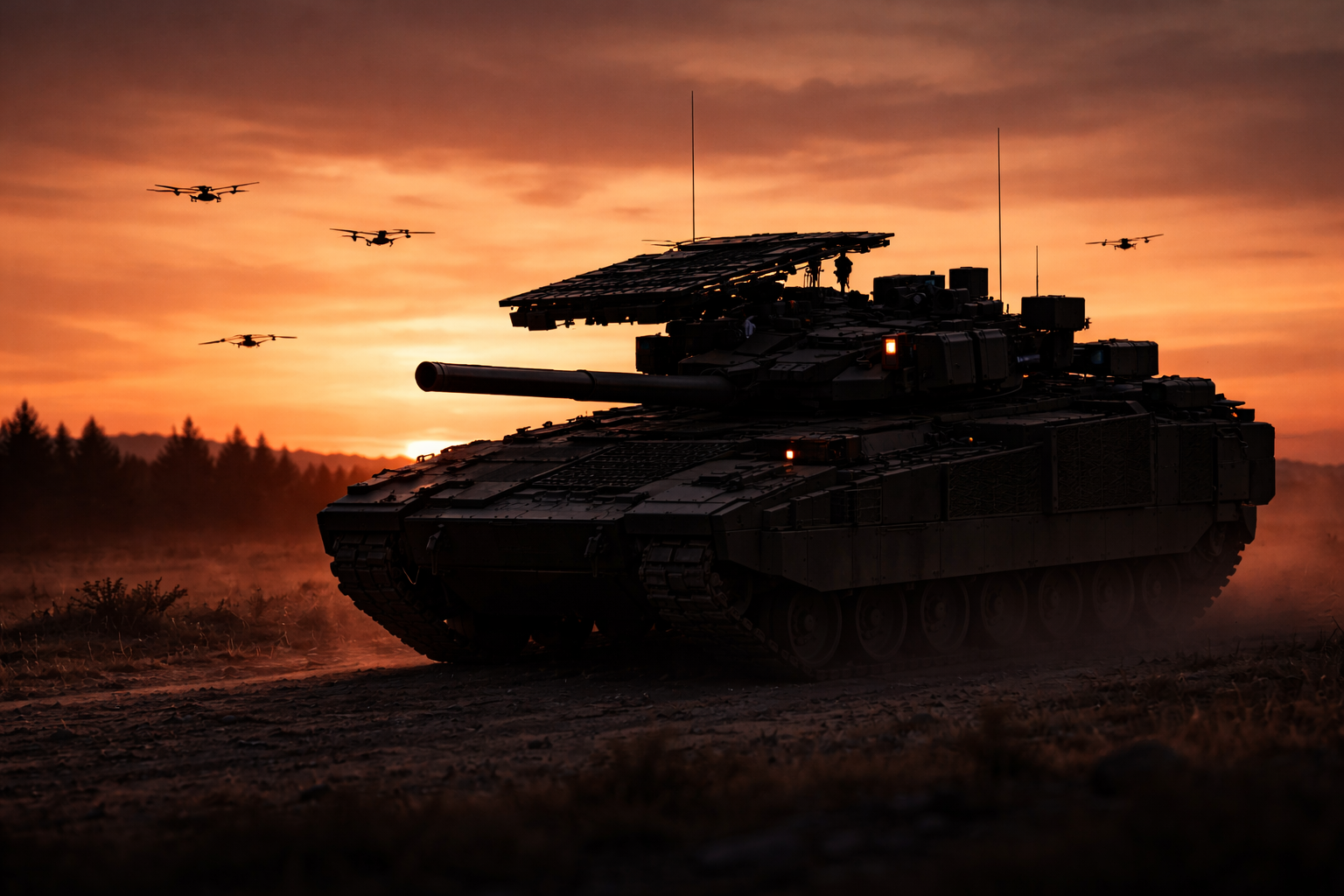
Low-profile CROWS gives crews a route to observe and engage from under armour, with testing also moving toward radar-enabled counter-small-UAS functions. That places artillery inside a broader pattern of platform self-defence. Dedicated counter-drone vehicles remain valuable, but the density of the threat means more combat and support platforms will need organic detection, cueing, and engagement options.
Gun-based counter-UAS demand is already reshaping support for Ukraine, with TRIDON Mk2 funding from Sweden and Denmark showing how rapid-fire, sensor-linked systems are being pulled back into the air-defence market. The Paladin CROWS work sits on the platform-integration side of the same demand. Existing vehicles need practical upgrades that can be fielded faster than entirely new systems.
For manufacturers, the Paladin installation is a reminder that counter-UAS capability cannot simply be bolted onto any available surface. Radar placement, sensor fields of view, power supply, weapon arcs, recoil environment, electromagnetic compatibility, software integration, crew interface, and maintenance access all affect performance. A low-profile design may solve height and transport constraints, but it still has to survive the shock and operating conditions of a firing artillery platform.
The M992A3 ammunition carrier’s inclusion is particularly important. Artillery survivability depends on more than the gun. Ammunition carriers, command vehicles, maintenance assets, and logistics trucks all become part of the target set once drones can observe and strike beyond the immediate front. Protecting the gun while leaving its support chain exposed creates a brittle formation.
The engineering route from trial to fleet upgrade will require production discipline. Developmental testing can prove that a system functions; repeatable fielding requires technical documentation, installation kits, spare parts, training, software support, configuration control, and maintainers who can diagnose faults. Remote weapon stations introduce electronics, sensors, actuators, displays, and software into platforms already carrying complex combat systems.
Power and data architecture will become recurring constraints. As artillery platforms add radars, cameras, electronic-warfare equipment, communications, and remote weapons, older vehicle electrical systems may become stressed. Manufacturers will need to consider upgraded alternators, batteries, power distribution, cooling, and digital backbones. Without those foundations, every new counter-UAS tool becomes another integration burden.
The work also points toward layered defence at the formation level. A Paladin may not need to defeat every drone alone, but it should be able to detect close threats, engage when necessary, and share warning data with nearby vehicles or air-defence systems. That will require networking and fire-control integration beyond a simple remote weapon feed.
The commercial opportunity extends across compact radars, electro-optical sensors, remote weapon stations, programmable ammunition, electronic defeat systems, and vehicle integration kits. Fleets across NATO will face similar upgrade pressure as armies reassess how artillery, logistics, and command vehicles survive under persistent drone observation. New platforms can be designed with these systems from the outset; existing fleets will need retrofit paths.
The Paladin remains a self-propelled gun, but its effectiveness now depends on a wider survivability package. Range, rate of fire, and ammunition supply still define artillery performance, yet mobility, protection, drone awareness, and closed-hatch engagement are becoming equally important. Low-profile CROWS gives the US Army one route into that future, and the manufacturing challenge will be turning a test installation into a repeatable upgrade across the artillery fleet.