IN Brief:
- Lockheed Martin and RTX have begun preliminary discussions around Patriot-related production in Ukraine.
- No final scope, production site, workshare package, or investment plan has been established.
- Components, maintenance, repair, and imported-kit assembly offer more credible early routes than complete interceptor manufacture.
Lockheed Martin and RTX have begun preliminary discussions over whether elements of Patriot production could be established in Ukraine, opening a long industrial process whose eventual scope remains undefined.
No contract, production site, workshare package, investment plan, or delivery schedule has been announced. The activity under consideration could range from selected components and support equipment to final assembly, repair, or a more extensive licensed-production arrangement.
Patriot is not a single product made on one line. The system combines radar, launchers, command equipment, communications, power systems, and several interceptor types, while RTX leads the wider system and Lockheed Martin produces the PAC-3 Missile Segment Enhancement interceptor.
That division makes any reference to local Patriot production unusually broad. Fabricating launcher structures or support equipment presents a very different challenge from producing seekers, solid rocket motors, guidance electronics, or hit-to-kill interceptor assemblies.
Ukraine retains substantial aerospace, missile, electronics, and heavy-engineering capability, although factories and energy infrastructure remain exposed to attack. Any production plan would need to incorporate dispersal, hardened facilities, continuity of power, physical security, and rapid recovery rather than treating those requirements as later additions.
Initial work is more likely to sit below complete system manufacture. Ukrainian companies could potentially produce non-sensitive structures, cables, mechanical assemblies, ground equipment, packaging, or maintenance tooling under controlled qualification arrangements.
Assembly from imported kits would deepen participation while retaining dependence on overseas components. Even that limited route could develop workforce experience, improve repair capacity, and reduce some logistics burdens if the necessary test equipment and technical data were available.
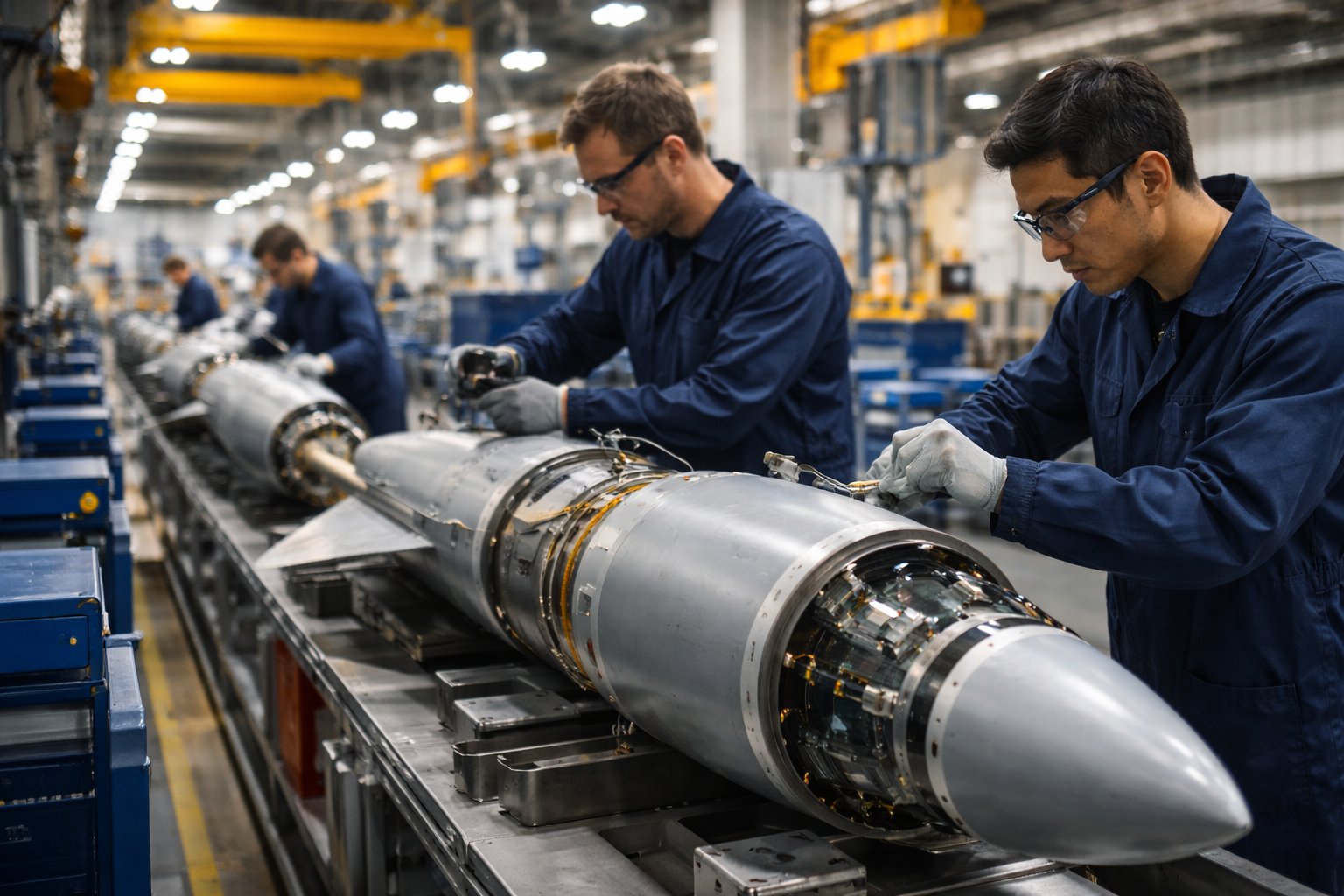
Interceptor production would present a much steeper challenge. PAC-3 MSE combines advanced guidance, control, propulsion, energetic materials, precision structures, and a seeker inside a tightly controlled manufacturing and acceptance system. Every supplier and process must be qualified before a completed missile can be released.
Lockheed Martin is already expanding annual PAC-3 MSE capacity in the United States from roughly 600 towards 2,000 under a seven-year framework. That increase depends on long-term demand, additional workers, new tooling, and process improvements across an established production network.
A parallel Ukrainian capability would have to add output rather than divert scarce equipment, components, or engineers from those lines. The same constraint applies to RTX, which faces rising demand across radar, launcher, and interceptor work while long-lead electronics, motors, energetics, and test infrastructure remain difficult to expand.
Technology protection will shape every work package. Patriot includes sensitive design information, software, performance data, and manufacturing processes subject to US export controls, requiring any Ukrainian facility to operate with strong personnel, information, cyber, and physical security.
Location adds an exceptional risk because a plant supporting a sought-after air-defence system would become a high-priority target. Distributed manufacturing could reduce vulnerability, but splitting controlled processes across several sites increases logistics, traceability, and quality-assurance burdens.
Missile output across the wider sector remains constrained by motors, energetics, seekers, actuators, guidance electronics, and test capacity, as the second-quarter defence-industrial review set out. Those bottlenecks would follow any Patriot localisation effort into Ukraine rather than disappearing at the border.
Wartime urgency also sits awkwardly beside programme timescale. A component line may be established relatively quickly where existing machinery and skills are suitable, while full interceptor manufacture, including approvals and repeatable acceptance, is likely to require years.
Sustainment offers an earlier route to operational value. Local diagnostic, repair, refurbishment, and launcher-support capability could improve availability without waiting for a complete production line, while building technical knowledge that supports deeper workshare later.
Training must cover far more than assembly tasks. Quality engineers, configuration managers, security personnel, test specialists, and supply-chain staff need to understand the documentation and evidence required for a certified weapon system.
Ownership and financing remain unresolved. A Ukrainian state company, private manufacturer, joint venture, or prime-managed facility would carry different responsibilities for capital, liability, security, intellectual property, and protection against wartime loss.
The discussions nevertheless indicate that Ukraine’s future role is being considered beyond equipment receipt. A country consuming large numbers of air-defence weapons has a strong incentive to participate in their maintenance and production, while suppliers need additional capacity to meet expanding international demand.
Industrial progress should be measured through specific work packages, funded facilities, and qualified suppliers rather than broad commitments. A staged programme could begin where Ukrainian industry adds capacity without compromising sensitive technology, then expand as each level of quality and security is demonstrated.
Patriot-related production in Ukraine is therefore plausible as a long-term strategy, but it has not yet become a defined manufacturing programme. The next substantive milestone will be a named site, allocated workshare, and capital commitment capable of surviving both industrial scrutiny and wartime conditions.