IN Brief:
- A seven year agreement creates a potential PAC-3 MSE contracting framework worth $58.62 billion.
- Lockheed Martin plans to triple production capacity by 2030 and expand employment at Camden.
- Output will depend upon propulsion, seekers, electronics, energetic materials, test equipment, and lower tier supplier investment.
Lockheed Martin has received a seven year contracting framework for PAC-3 Missile Segment Enhancement interceptors with a potential total value of $58.62 billion, extending planned production through fiscal 2032.
The arrangement adds an undefinitised contract modification of up to $53.86 billion to approximately $4.7 billion for the first year. Its total represents a potential contracting ceiling rather than an immediate, fully funded purchase of the entire amount.
A longer planning horizon supports Lockheed Martin’s effort to triple PAC-3 MSE production capacity by the end of 2030. Employment at the company’s Camden, Arkansas, operation is expected to rise from roughly 1,200 to about 1,850 as manufacturing, testing, and associated work expands.
The company is also planning between $8 billion and $9 billion of investment across more than 20 US facilities through 2030. PAC-3 forms one part of that broader programme, although sustained demand for the interceptor makes it an immediate test of whether capital expenditure can produce accepted munitions at a higher rate.
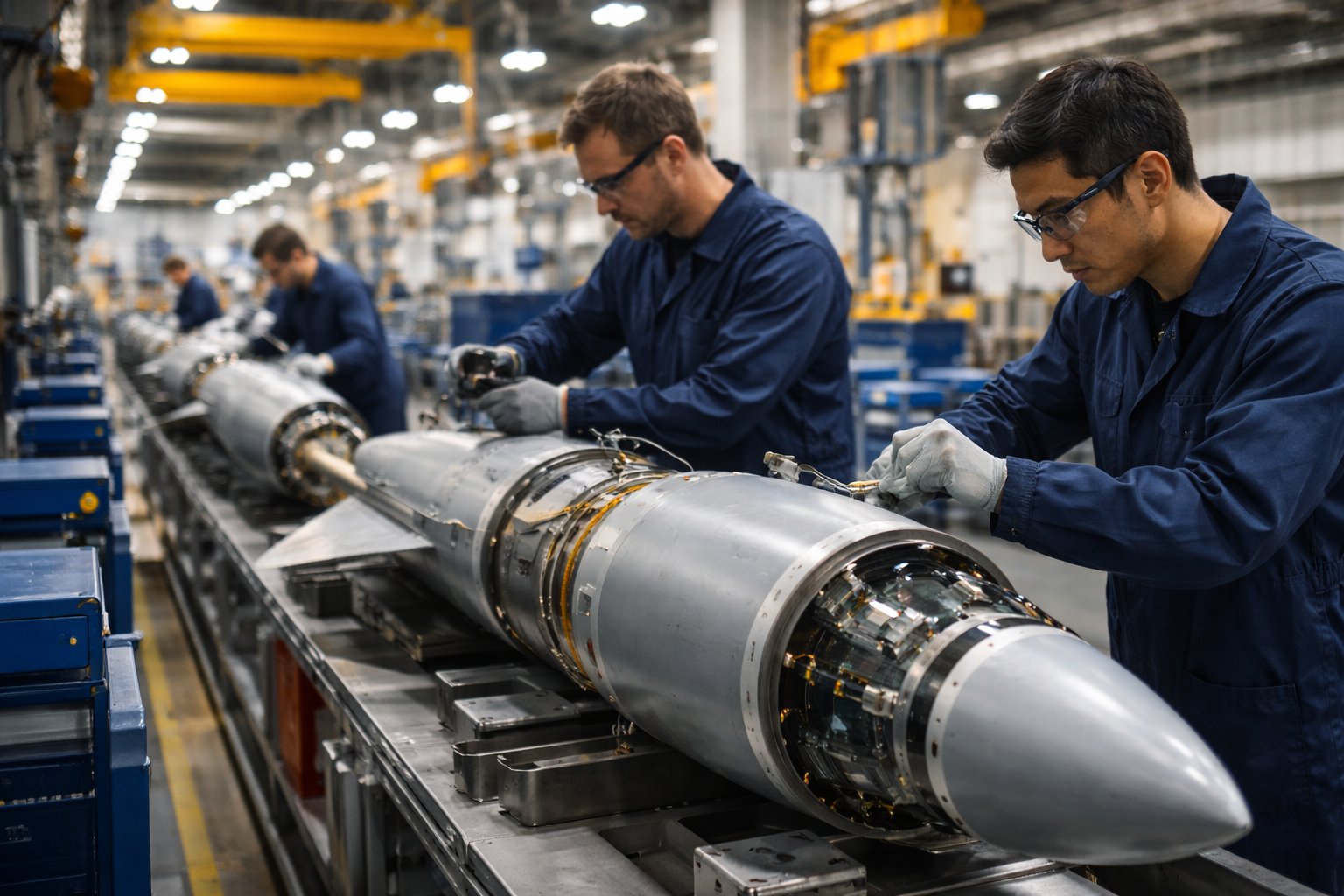
PAC-3 MSE is a hit to kill interceptor used within Patriot and other integrated air and missile defence architectures. Its manufacture combines a solid rocket motor, seeker and guidance electronics, control equipment, structures, energetic material, power, software, and final round assembly under demanding quality controls.
Compact dimensions do not make the interceptor simple to produce. High acceleration and precise terminal manoeuvring impose strict structural and control requirements, while the hit to kill mission leaves little tolerance for variation in propulsion, sensing, processing, alignment, and guidance.
Recent investment has already reached component suppliers, including additional PAC-3 propulsion capacity. Final assembly can increase only as quickly as the slowest critical component, so expansion must proceed across the complete round.
Increasing one factory without matching output in motors, seekers, electronics, batteries, control surfaces, containers, and test equipment creates queues of incomplete inventory. Supplier capacity must therefore rise against a coordinated production schedule rather than a series of unrelated expansion projects.
Energetic material facilities are particularly difficult to enlarge because they require safety distances, environmental controls, specialised handling processes, permits, and trained personnel. Machinery used to mix, cast, cure, inspect, and test propellant cannot be installed inside an ordinary industrial building.
Electronics production faces a different set of constraints. Semiconductor devices and commercial components can become obsolete far more quickly than the missile’s service life, forcing redesign, qualification, stockholding, and software changes alongside the effort to increase quantity.
Seekers require precision assembly, alignment, calibration, and test capacity, while completed interceptors pass through functional inspection before acceptance. Greater output therefore demands additional fixtures, chambers, instrumentation, ranges, and qualified personnel able to approve the result.
Automation can improve consistency in selected processes, but missile production remains dependent upon skilled manual work. Energetic components, precision alignment, sealing, wiring, and final integration require controlled workmanship and inspection rather than simple high speed assembly.
Production growth can conflict with engineering changes intended to reduce cost or improve performance. A redesigned component may support higher output later, yet its introduction requires tooling, drawings, software, supplier qualification, and test evidence while the existing line remains active.
Configuration discipline will determine whether such improvements strengthen or disrupt the ramp. The Army and Lockheed Martin must decide which alterations can enter current production and which should be grouped into controlled future standards.
International demand adds allocation pressure because Patriot users require new missiles, replenishment, training rounds, spares, repairs, and upgrades while the United States rebuilds its own inventory. Factory schedules consequently remain connected to government decisions about customer priority and annual funding.
A longer contract can improve material purchasing and employee retention. Suppliers can order forgings, electronic parts, and specialist materials in larger batches, while training programmes can be organised around several years of demand rather than a brief production peak.
Camden’s employment growth must still be matched with experienced supervision and qualified processes. Rapid recruitment can increase defects when skilled employees are diverted from production to training before new workers become proficient.
Tripled capacity will be visible through accepted interceptors rather than theoretical factory figures. Component availability, first pass yield, test throughput, rework, and supplier delivery performance will determine whether the planned line rate reaches operational inventories.
The $58.62 billion ceiling gives the PAC-3 network enough visibility to invest across a lengthy and technically demanding production chain. Preserving quality while several hundred suppliers increase output will determine whether the framework produces a sustained rise in completed missiles rather than a larger collection of partially resolved bottlenecks.