IN Brief:
- Wicher was rolled out of PGZ Stocznia Wojenna’s hull hall on 9 August.
- The approximately 6,000-tonne hull will be transferred by modular transporters onto a semi-submersible barge for float-off.
- Three Arrowhead 140-derived frigates are being built in Poland under a programme scheduled for completion by the end of 2031.
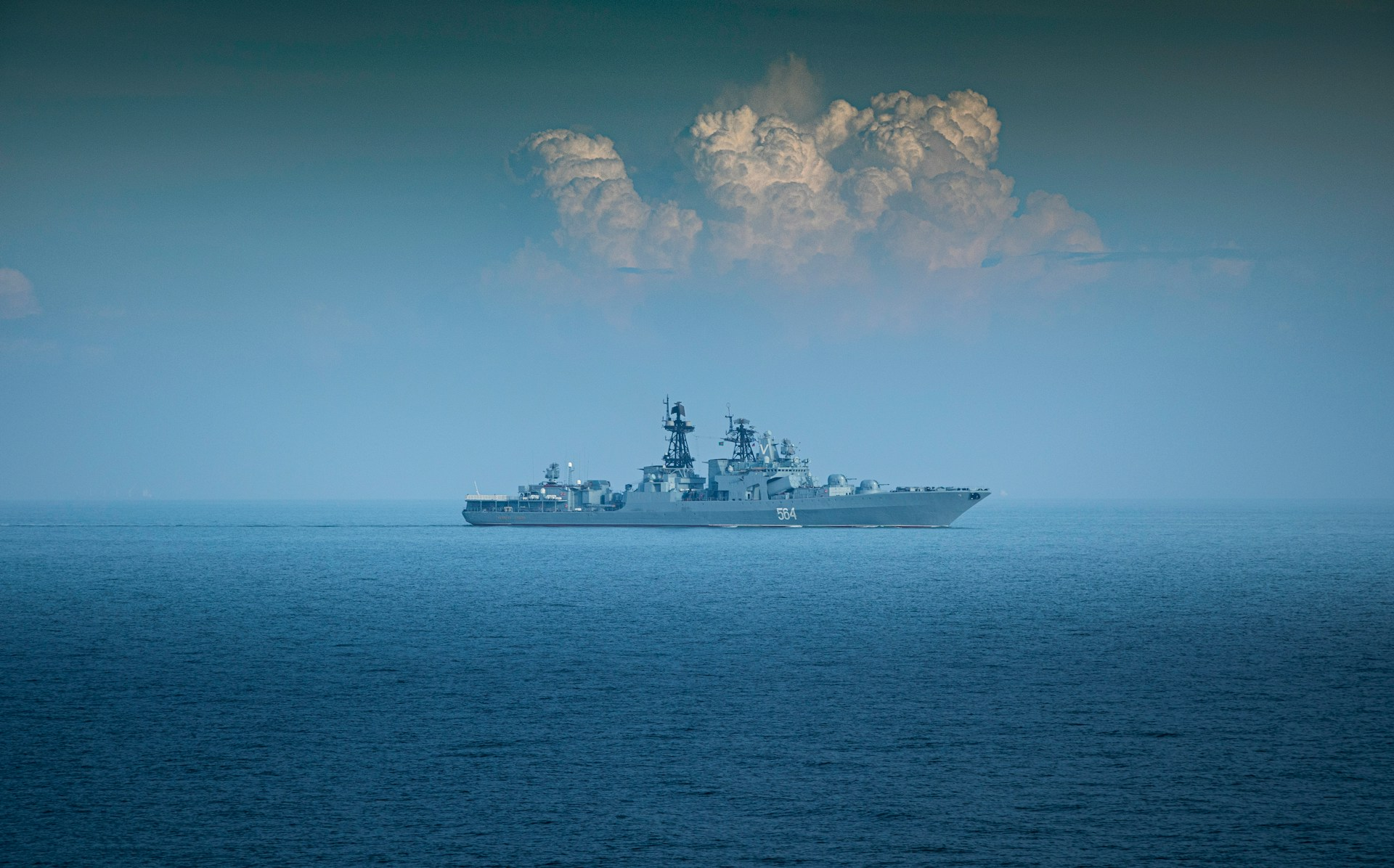
Poland’s first Miecznik-class frigate has left its hull construction hall in Gdynia, beginning a multi-day launch sequence that will culminate with Wicher floating independently for the first time. The ship was partially rolled out on 9 August, with christening scheduled for 12 August and the physical launch operation planned for 13 August.
The staged process is required because PGZ Stocznia Wojenna is not using a conventional slipway launch. The approximately 6,000-tonne construction-stage hull is being moved from the production hall on self-propelled modular transporters and placed aboard the 140-metre semi-submersible BOA Barge 33.
The barge will then be towed into the Gulf of Gdańsk and progressively submerged until the frigate becomes buoyant. Wicher will be checked for watertight integrity before being towed back to the shipyard, because its propulsion system has not yet been installed at this stage of construction. Outfitting and integration work will continue alongside after float-off.
The sequence makes the launch an engineering operation as much as a ceremonial milestone. Moving a hull of this size from an enclosed production facility onto modular transporters, transferring it to a barge, and controlling the immersion process requires the ship’s weight and centre of gravity to be understood closely while temporary structural and support loads remain inside defined limits.
PGZ describes the operation as one of the most demanding shipbuilding movements undertaken by Polish industry. The programme has driven substantial investment in the Gdynia yard, including a 46-metre-high hull integration hall and more than PLN 300 million in production capability. More than 2,000 people are expected to be involved at peak activity across the three-ship programme.
Wicher is the first of three frigates being built by the PGZ-MIECZNIK consortium, led by Polska Grupa Zbrojeniowa and PGZ Stocznia Wojenna. Sister ships Burza and Huragan are already in construction, with the complete programme scheduled to finish by the end of 2031. PGZ puts the value of the three-vessel project at more than PLN 15 billion.
The ships are based on Babcock International’s Arrowhead 140 design, the same underlying platform architecture that supports the Royal Navy’s Type 31 frigate. Poland has adapted the design for its own operational requirements while building the vessels domestically under a technology-transfer and engineering-support arrangement with Babcock.
That model is intended to create more than hull-fabrication capacity. A modern frigate programme depends on configuration management, combat-system integration, electrical engineering, software interfaces, testing, production planning, and through-life technical support. A shipyard that can weld and assemble a hull but cannot modify or support its systems independently retains only a limited portion of the programme’s sovereign value.
Miecznik is therefore being used to rebuild a broader Polish naval industrial base. Babcock provides design and engineering support, while Polish companies carry an increasing share of construction and integration work. Running three ships through the same production system should also create the repetition needed for the investment in new facilities and workforce skills to translate into improved efficiency.
The programme has already moved through successive serial-production milestones. Steel was cut for Wicher in 2023 and the keel laid in 2024, while work subsequently began on Burza. Steel cutting for the third ship, Huragan, followed in April 2026, meaning all three vessels have now entered physical production.
Wicher’s launch does not bring the ship close to operational service. Once afloat, the programme still has to complete major machinery installation, outfitting, combat-system integration, harbour acceptance activity, sea trials, weapons and sensor testing, certification, and final Navy acceptance. Those stages typically expose many of the integration problems that remain invisible while a hull is inside an assembly hall.
The roll-out nevertheless represents an important industrial transition. Poland now has the first Miecznik hull outside the production building while the second and third vessels progress behind it. The ability to keep those ships moving through the yard without the first vessel monopolising engineering resources will be one measure of whether the new production system is functioning as a repeatable shipbuilding line.
Wicher is due to be christened on 12 August, with its controlled float-off following on 13 August. Only then will the first Miecznik technically have been launched, an unusually drawn-out sequence that reflects the scale of the hull and the production infrastructure Poland has chosen to build around its largest contemporary naval programme.