
IN Brief:
- All four Pohjanmaa-class corvettes are now in construction for the Finnish Navy.
- RMC is combining the naval programme with two Arctic Security Cutters for the US Coast Guard.
- Yard investment, series-production methods, and a larger workforce are supporting the overlapping government-vessel workload.
Rauma Marine Constructions is operating the Rauma shipyard with all four Finnish Navy Pohjanmaa-class corvettes in production while preparing and executing work for two US Coast Guard Arctic Security Cutters. The overlapping programmes are placing the Finnish yard’s investment in secure facilities, digital production tools, workforce growth, and series shipbuilding under a sustained government-vessel workload.
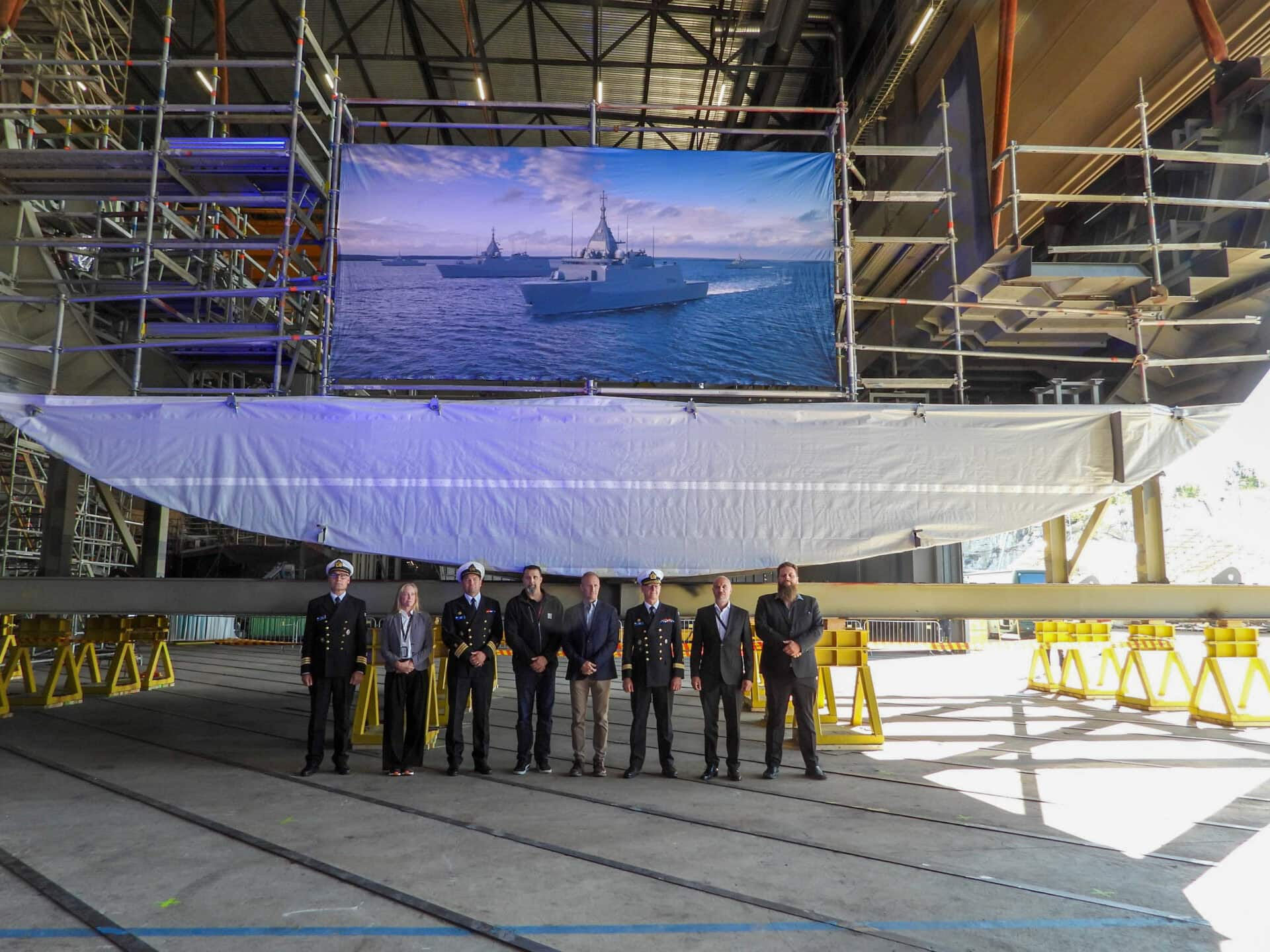
Rauma Marine Constructions, or RMC, reached another naval production milestone on 4 August when the keel of the fourth Pohjanmaa-class corvette was laid. Steel production for the ship began in January, while the first two vessels have already been launched and are being outfitted. The third is at the assembly stage.
The programme gives RMC four related warships at different points in the same production cycle. That allows lessons from early vessels to feed into later hulls while design, steel production, assembly, outfitting, and test teams remain engaged continuously rather than rebuilding a naval-production organisation around individual ships.
The Pohjanmaa vessels are being built for Finland’s Squadron 2020 programme and are designed for year-round operation in Baltic conditions. The 117-metre ships will support surface warfare, anti-submarine warfare, air defence, electronic warfare, and mine-laying missions, combining military integration demands with the structural and marine-engineering requirements of an ice-capable vessel.
At the same time, RMC has secured two Arctic Security Cutters for the US Coast Guard. The projects give the yard a second government customer and an export workload built around Finland’s experience with ice-going vessels. RMC expects the two Finnish-built cutters to be delivered during 2028.
The programmes are not interchangeable. A naval corvette and an Arctic cutter impose different requirements on combat systems, classification, propulsion, mission equipment, security, and regulatory assurance. Running them concurrently therefore tests whether the yard can share industrial infrastructure and labour without confusing programme-specific engineering and configuration control.
RMC has invested more than €60 million in the Rauma yard during the 2020s as its government-vessel workload has expanded. The infrastructure includes a 186-metre multipurpose construction hall capable of accommodating two corvette-sized vessels in a security-controlled indoor environment, steel-processing capacity of about 15,000 tonnes a year, a permanent dry dock, outfitting quays, and a submersible barge used in launching and docking operations.
Digital and organisational changes have accompanied the physical investment. RMC has introduced a three-dimensional design environment and renewed enterprise-resource-planning, project-management, and task-tracking systems, while putting greater emphasis on series-production methods. The objective is to move production knowledge from one vessel to the next instead of treating each hull as a largely separate industrial exercise.
The fourth Pohjanmaa corvette provides a practical indication of that learning cycle. RMC says experience from the earlier ships is now visible particularly in steel production and hull assembly, where repeated processes can be planned and executed with a better understanding of labour, sequencing, tooling, and supplier requirements.
Workforce capacity remains another constraint. RMC’s own programme data puts the direct Finnish employment effect of Squadron 2020 at around 3,600 person-years. The two US icebreakers are expected to account for roughly 2,000 person-years directly and about 5,000 when the broader effect is included, spreading workload through the shipyard’s extensive subcontractor network.
Those numbers help explain why production infrastructure cannot be assessed simply by counting docks and covered halls. Complex shipbuilding depends on designers, production planners, welders, electricians, outfitters, systems specialists, quality teams, and suppliers reaching the required capacity at roughly the same time. A yard can have physical room for another hull while lacking the skilled labour or engineering bandwidth to move it through the programme efficiently.
The American cutter contract also gives RMC an opportunity to sustain military and government-vessel skills beyond one Finnish procurement cycle. Naval shipbuilding capability is difficult to recreate after long gaps because knowledge resides in production teams, supplier relationships, test processes, documentation, and configuration disciplines as much as in buildings and machinery.
Export work can keep that capability active, but it also removes some protection from domestic schedules. An overseas government customer will measure delivery, quality, and contract performance against its own programme, while the Finnish Navy’s corvettes continue to demand secure production and complex systems integration on the same site.
Rauma has spent much of the decade building the infrastructure for that workload. The next measure is delivery rather than investment. Four corvettes and two Arctic cutters now give RMC enough overlapping production to show whether the yard’s series-production methods, digital systems, workforce, and supplier network can translate additional capacity into predictable government-ship schedules.

