IN Brief:
- Missile Defense Agency has awarded Raytheon a $745.39 million action for SM-3 Block IIA all-up rounds.
- The award covers US requirements and Japan Ministry of Defense Foreign Military Sales demand through February 2031.
- Block IIA is already in full-rate production, placing the emphasis on sustained multinational manufacturing and specialist supplier capacity.
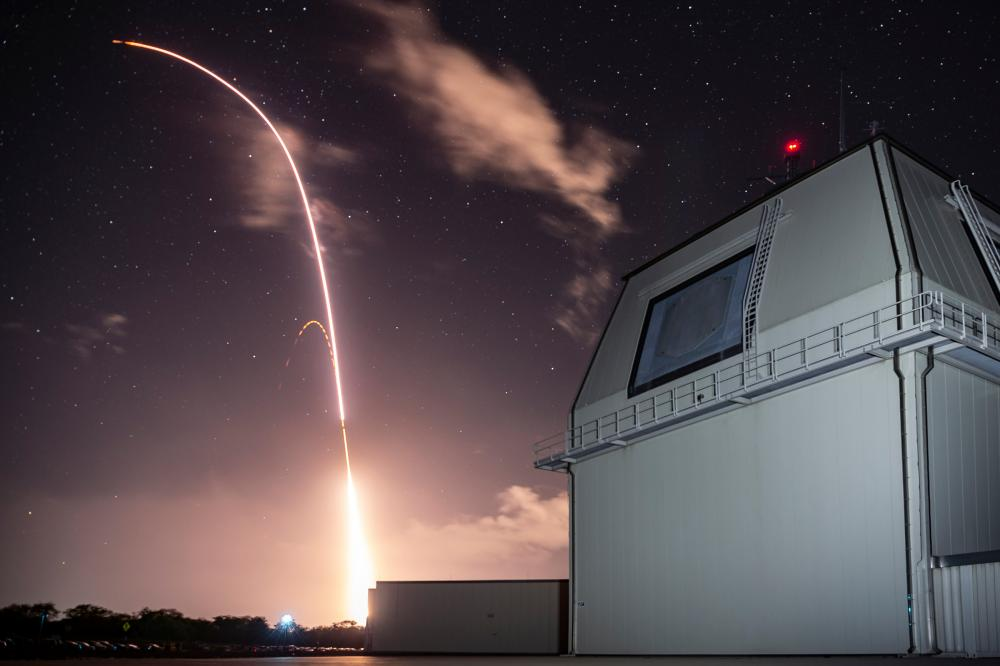
Raytheon has received a $745.39 million Missile Defense Agency contract action to manufacture and assemble Standard Missile-3 Block IIA all-up rounds for the United States and Japan, extending interceptor production through February 2031.
The noncompetitive, undefinitized action covers US government requirements and a Japan Ministry of Defense Foreign Military Sales case. Work will be performed in Tucson, Arizona, and Huntsville, Alabama, with $275.61 million of US fiscal 2026 procurement funding and $277.69 million of Japanese FMS funding due to be obligated at award.
The contract follows Block IIA’s move into full-rate production, a milestone Raytheon achieved in 2024 after an earlier $1.9 billion award covering rounds for the US and Japan. The latest action therefore extends an established production line rather than funding an early development batch.
SM-3 is designed to destroy ballistic missile targets through kinetic impact outside the atmosphere rather than using an explosive fragmentation warhead. Block IIA uses larger rocket motors and a larger kinetic warhead than earlier variants, increasing the defended area and improving the vehicle’s ability to acquire and engage more demanding threats.
Those characteristics place tight tolerances across the manufacturing chain. The booster has to deliver predictable velocity and trajectory, guidance electronics have to maintain precise navigation, and the kill vehicle has to manoeuvre accurately enough to collide directly with the target at very high closing speed.
A defect that creates a minor performance variation in ordinary equipment can consume valuable engagement margin in an exo-atmospheric interceptor. Production quality therefore depends on controlled propulsion processes, precision structures, electronics, sensors, software, alignment, assembly, and extensive acceptance testing.
The multinational nature of Block IIA adds another layer. The missile was cooperatively developed with Japan, and the latest contract again combines US and Japanese demand on a common production programme. That arrangement can support higher volumes and supplier continuity while increasing the importance of agreed configurations and customer delivery schedules.
Japan’s role is not limited to being an export customer. Cooperative development created industrial participation across both countries, requiring technical interfaces and production responsibilities to remain controlled as the missile progresses through successive manufacturing lots.
The prime award also sits above a specialist supply chain that continues to receive separate production work. Recent SM-3 propulsion activity has highlighted the importance of controllable solid-propulsion hardware used to manoeuvre the interceptor’s kill vehicle during engagements.
That subsystem work is adjacent to rather than duplicative of the new Raytheon award. The 7 August action covers complete Block IIA all-up rounds at prime-contract level and identifies customers, funding, manufacturing locations, and completion date.
Full-rate production does not remove technical risk. It indicates that the design and manufacturing system have matured sufficiently for sustained output, but actual delivery rates remain dependent on the capacity and reliability of suppliers providing rocket motors, energetics, seekers, electronics, precision structures, thermal components, propulsion devices, and test equipment.
Many of those suppliers also support other missile programmes. As Western governments increase orders for air-defence, tactical, and strategic weapons, the same specialist facilities can become bottlenecks across several production lines simultaneously.
Long-lead components make production planning particularly important. Certain materials and propulsion items need to enter the supply chain long before final assembly, meaning a sudden increase in demand cannot necessarily be translated into finished missiles within the same financial year.
The contract’s undefinitized structure allows production activity to move ahead before every commercial term has been settled. Such actions can reduce the risk of a break in manufacturing where requirements are urgent, although final contractual details are subsequently negotiated rather than fixed completely on the award date.
The February 2031 completion date provides a longer planning horizon for Raytheon and its suppliers. Missile production depends on machinists, electronics technicians, propulsion specialists, energetic-material workers, quality personnel, test engineers, and systems engineers whose skills become difficult to regenerate if production stops between orders.
Longer continuity also helps with component obsolescence. Commercial electronics can disappear from manufacture within a few years, whereas an interceptor programme can remain active for decades. Engineering teams therefore need replacement parts, redesigns, software compatibility, and qualification evidence ready before existing components become unavailable.
Raytheon says more than 400 SM-3 interceptors across the wider family have been delivered to US and Japanese navies. Block IIA is now the most capable production variant and a central element of the Aegis ballistic-missile-defence architecture used at sea and ashore.
The $745.39 million award consequently extends more than missile assembly. It provides continuing demand through a multinational production network and the specialist suppliers needed to turn propulsion, guidance, structures, electronics, and kill-vehicle hardware into accepted all-up rounds.
Block IIA has already crossed the formal threshold from development into full-rate production. The industrial test through 2031 is whether that production system can deliver qualified missiles for two customers while many of the same suppliers and skills are being asked to expand output across the wider missile sector.