IN Brief:
- The UK order covers 72 155mm L/52 remote-controlled weapon systems and related services.
- Manufacture will take place at Rheinmetall’s new Gun Hall in Telford, strengthening domestic artillery capacity.
- Deliveries are due from May 2028 to June 2031 as Britain and Germany qualify the RCH 155.
Rheinmetall has secured an order to supply 72 remote-controlled 155mm weapon systems for the British Army’s RCH 155 programme, with manufacturing planned at the company’s new Telford facility. Deliveries are scheduled to run from May 2028 until June 2031, turning a major artillery procurement into a defined UK production programme.
The order covers the 155mm L/52 weapon systems, associated services, onboard tools, and support for training materials and technical documentation. Rheinmetall described the contract value as being in the low three-digit-million-euro range. The award was booked in the second quarter of 2026 and sits within the wider British purchase of 72 RCH 155 howitzers announced in May.
Britain’s overall package is valued at nearly £1 billion and includes initial training and in-service support. The procurement is being managed through OCCAR on behalf of the British Army and awarded to ARTEC, the joint venture between Rheinmetall and KNDS Deutschland responsible for the Boxer vehicle family. Government estimates have linked the programme to at least 500 UK jobs across Rheinmetall’s Telford operation, KNDS facilities in Stockport, and the wider supply chain.
Rheinmetall’s production responsibility centres on the weapon installation rather than the complete vehicle. The company will provide 72 elevating masses and the associated equipment needed to turn the automated turret into an operational artillery system. Separating vehicle, turret, weapon, electronics, and support responsibilities is common in multinational land programmes, but it increases the importance of interface control and coordinated qualification.
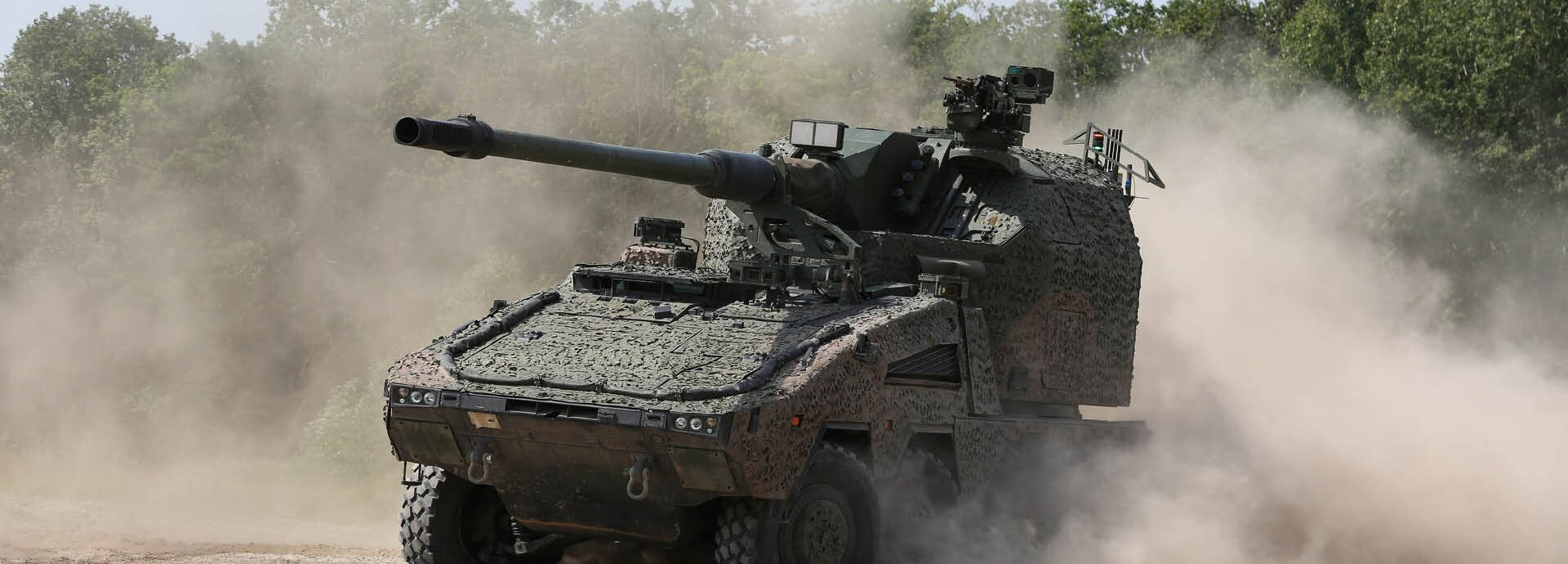
The RCH 155 combines the Boxer drive module with an unmanned Artillery Gun Module derived from the weapon technology used on the PzH 2000 tracked howitzer. Its automated architecture handles navigation, fire-control functions, gun laying, projectile and charge loading, and fuze setting. The system carries 30 fused rounds and 144 modular charges, while the remote turret allows the crew to remain within the protected vehicle cabin.
One of the platform’s most publicised characteristics is its ability to fire while moving, although that capability depends on the complete chain of vehicle stabilisation, navigation, fire control, ammunition handling, and weapon operation. Manufacturing the gun installation in Britain does not remove the need for German and UK partners to qualify the integrated system. Rheinmetall has confirmed that the two countries are working together on qualification before delivery begins.
The Telford decision is also part of a broader attempt to restore sovereign large-calibre weapon production in Britain. Rheinmetall’s Gun Hall is intended to manufacture 120mm and 155mm systems, creating domestic capacity in an area where European demand has risen sharply and where long lead times have exposed the limited depth of existing production. A new building is only the visible part of that effort; qualified tooling, skilled operators, inspection processes, proof activity, and assured material supply determine whether capacity is genuinely available.
For the British Army, the order replaces an ageing artillery capability with a wheeled, automated system built around the Boxer fleet. Commonality at the vehicle level can reduce some training and support complexity, but the artillery mission still requires specialist ammunition, maintenance, diagnostics, and fire-control integration. The inclusion of tools, training support, and technical documentation in Rheinmetall’s contract recognises that the weapon cannot be treated as a stand-alone mechanical delivery.
The production schedule leaves less than two years before the first planned deliveries in May 2028. During that period, the partners must complete qualification, establish the Telford manufacturing flow, secure long-lead components, and align the weapon installations with ARTEC’s wider vehicle programme. The gap between contract award and first delivery is therefore a build-up period rather than idle calendar time.
By June 2031, all 72 systems are due to have been delivered. Whether the programme ultimately produces the wider industrial resilience promised around it will depend on the work retained after the initial order, the extent of UK supply-chain participation, and the ability of the Telford site to support future production and sustainment. The immediate contract, however, moves the RCH 155 from procurement policy into a measurable manufacturing schedule.
Ammunition compatibility will also form part of the qualification burden. The automated loading system has to handle approved projectiles, modular charges, and fuzes reliably across the vehicle’s operating conditions, while software and mechanical tolerances remain aligned. The order does not identify the ammunition types Britain will field with the gun, leaving future munition choices outside this manufacturing award. It does require the weapon system to arrive with documentation and training support for service acceptance.