IN Brief:
- Rheinmetall plans more than 30,000 square metres of logistics and technology capacity at Kassel-Calden Airport.
- The North Hesse Defence Hub will include a 1,200-square-metre training area and a planned drone test centre.
- Vehicle Systems carried a €28.829bn backlog at the end of June 2026, 41% above the previous year.
Rheinmetall will establish a logistics and technology centre at Kassel-Calden Airport as part of a three-digit-million-euro investment intended to expand support capacity for its tactical military vehicle business.
The planned facility will provide more than 30,000 square metres of floor space and is scheduled to enter operation by the end of 2027. It will sit close to Rheinmetall’s existing Kassel plant and combine logistics, technical support, training, and planned drone-testing activities within the wider North Hesse Defence Hub.
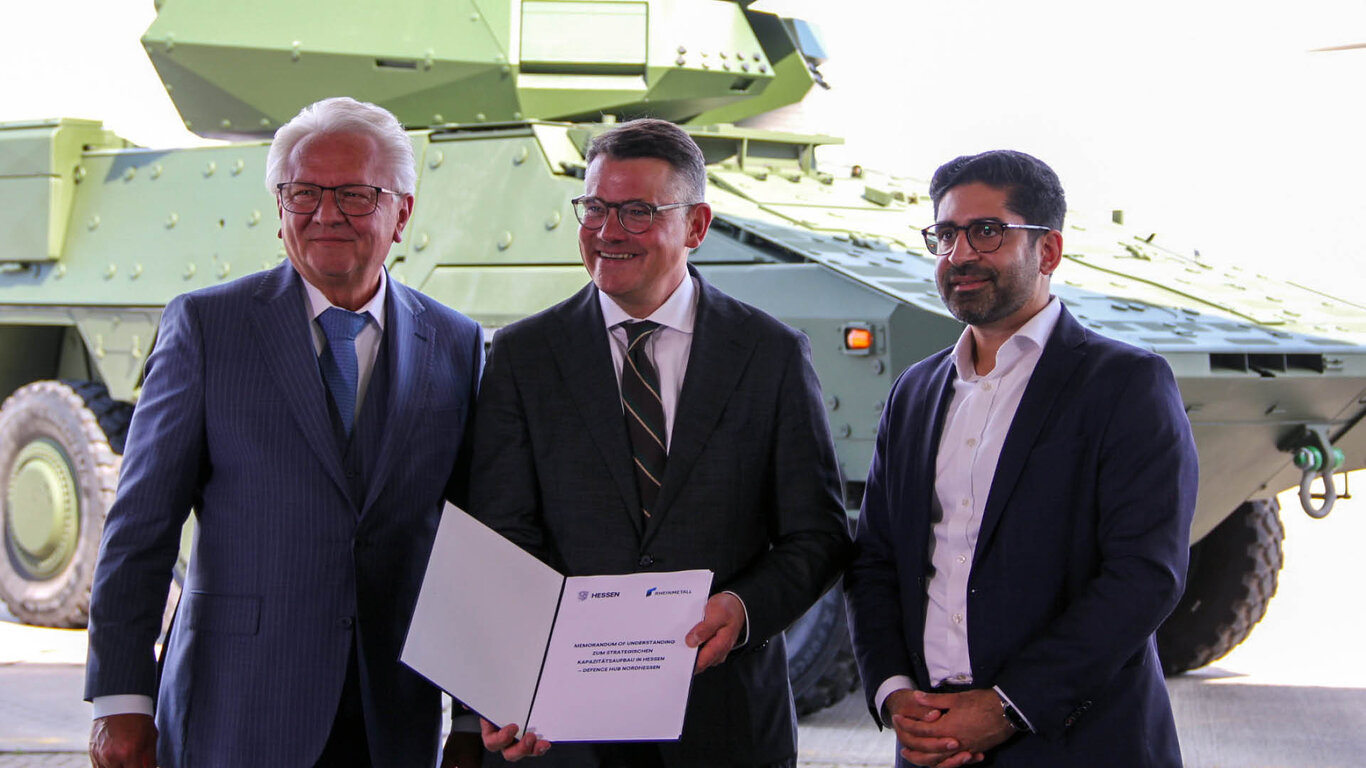
Rheinmetall is developing the site with support from the State of Hesse. The two sides signed a memorandum of understanding at Kassel Airport on 27 August alongside plans to expand existing activities in Kassel and develop additional technologies locally.
The logistics centre is intended to handle domestic and international orders while reducing processing times and improving material movement through Rheinmetall’s Vehicle Systems operation. Kassel is the company’s European centre of excellence for the development, manufacture, and maintenance of tactical wheeled and tracked military vehicles and currently employs about 2,200 people.
Part of the rationale is to move logistics and transport activity away from the established factory. Rheinmetall plans to shift freight flows towards the airport site, reducing lorry and delivery traffic around its existing Kassel operation while releasing space and capacity at the traditional manufacturing location.
The new hub will also contain about 1,200 square metres of training space. Employees from Kassel and other Rheinmetall sites are expected to use the facility for initial and further training, tying workforce development directly to the infrastructure being added around the vehicle business.
A drone test centre is planned at Calden as well. Rheinmetall considers the airport’s infrastructure and local operating conditions suitable for uncrewed-aircraft development and testing, while the proposed Hessian Drone Competence Centre could provide additional links between industrial development, flight activity, and regional research capability.
The investment comes as Vehicle Systems carries a substantially larger workload. The division generated €2.431 billion of sales during the first half of 2026, up 28% year on year, while its backlog reached €28.829 billion at the end of June, 41% above the equivalent point in 2025.
Major orders include another 200 Puma infantry fighting vehicles for Germany and 298 Lynx vehicles for Romania. The wider group entered the second half with an order backlog of €80.5 billion, increasing the pressure on factories, suppliers, logistics operations, test facilities, and trained labour to turn contracted demand into accepted equipment.
A larger backlog does not create physical output by itself. Tactical vehicles depend on fabricated structures, driveline components, electronics, protection systems, weapons, sensors, communications equipment, integration work, testing, customer acceptance, spares, and documentation, all of which have to arrive in the right sequence.
Logistics can become a production constraint just as quickly as machining or final assembly. Additional shifts and equipment offer limited benefit if inbound parts, inspection, storage, kitting, or outbound delivery processes become congested, particularly when several programmes compete for the same factory infrastructure.
Calden is designed as a throughput investment rather than simply extra warehousing. Separating material flows from the existing plant can give the vehicle operation more room to organise orders, prepare equipment, train personnel, and support domestic and export customers without pushing every activity through the established Kassel site.
The airport location also supports the planned drone work in a way that a conventional industrial estate cannot. Access to suitable operating space can shorten the cycle between engineering changes and flight testing, although Rheinmetall has not yet disclosed the scale or programme mix planned for the test centre.
The project adds another layer to Rheinmetall’s wider European capacity expansion. Recent investment has covered ammunition, vehicle production, autonomy, and other defence manufacturing activities, while the North Hesse plan concentrates on the infrastructure around production rather than another dedicated assembly line.
Construction and operation are expected to create additional jobs in the Kassel district, although Rheinmetall has not published a final employment figure for the new centre. Roles are expected to span logistics, warehousing, technical, and administrative functions alongside the training activity.
Operation is targeted for the end of 2027, by which point several European tactical-vehicle programmes will be deeper into delivery. Calden’s performance will be measured by whether the added logistics, training, and test capacity removes constraints quickly enough to keep those programmes moving through production and acceptance.