IN Brief:
- Skylark Labs has received a $4 million low-rate initial production order for 20 ARIES counter-UAS systems.
- Hexadyne Corporation is prime contractor for the wider GCC programme, with potential programme value of up to $32 million.
- The order moves ARIES from US defence demonstrations into an initial international deployment.
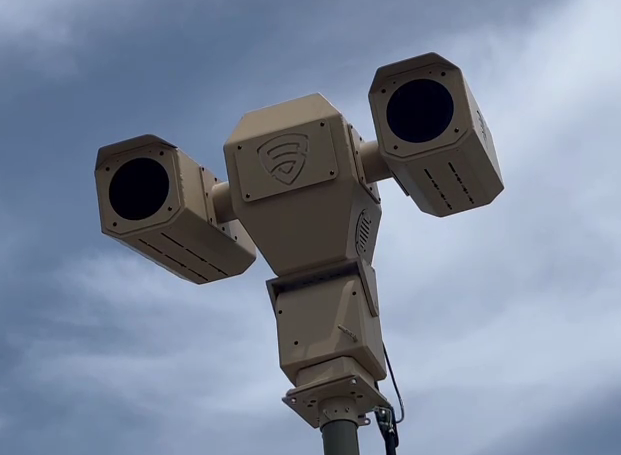
Skylark Labs has secured a $4 million low-rate initial production order for 20 ARIES counter-UAS systems under a Gulf Cooperation Council defence programme led by Hexadyne Corporation, moving the technology from demonstrations into an initial international deployment.
Hexadyne is prime contractor for the wider programme, which the companies say could be worth up to $32 million as requirements expand. The larger figure is potential programme value rather than committed Skylark revenue, while the $4 million order covers a defined initial tranche of 20 systems.
That distinction gives the announcement more substance than a development memorandum while leaving the scale of any follow-on procurement open. The first 20 units will have to be manufactured, integrated, installed, and operated successfully before an expansion across additional sites or missions can be assumed.
ARIES — Aerial Reconnaissance & Elimination System — combines multiple sensor inputs with Skylark’s AI software to detect, track, and classify aerial threats. The company has demonstrated the system using radar, radio-frequency, and optical sensing, with the aim of maintaining useful detection when a small drone presents little or no exploitable RF signature.
That problem is increasingly common in counter-UAS engineering. A radio-frequency detector can provide long-range warning where an aircraft or its controller is transmitting, but pre-programmed systems and so-called dark drones can reduce or remove that signal. Radar provides another route to detection, although very small aircraft can present weak returns and operate against clutter, while electro-optical sensors remain dependent on line of sight, weather, lighting, and effective cueing.
Fusing several sensor classes gives the architecture more than one source of evidence. The practical challenge is deciding whether detections from different sensors represent the same object, maintaining a track as the aircraft moves between coverage areas, and avoiding false alarms generated by birds, legitimate aircraft, friendly drones, or environmental clutter.
Skylark says ARIES uses self-learning AI to adapt as operating conditions and threat signatures change. That is a company description rather than evidence that the system can automatically overcome every new drone configuration, and the move into low-rate production will provide a more demanding test than a controlled demonstration.
Operational deployment introduces problems that laboratory and range activity can hide. Sensors have to remain calibrated after transport and installation, network links need sufficient availability, processing hardware has to operate in local environmental conditions, and operators need a manageable number of alerts rather than a technically impressive stream of unfiltered detections.
The Gulf setting adds its own engineering requirements. Military installations, energy infrastructure, ports, and other critical sites can combine long defended perimeters with high temperatures, dust, strong solar loading, and dense legitimate air activity. A counter-UAS surveillance system must continue discriminating between relevant and irrelevant tracks while its sensors and computing equipment remain within operating limits.
Hexadyne’s role also places ARIES inside a layered counter-UAS architecture rather than treating it as an isolated product. The prime contractor argues that early warning provides downstream systems — including electronic warfare, kinetic interceptors, and point-defence weapons — with the time and targeting information required to respond.
That means interface quality becomes part of ARIES performance. Detecting a small aircraft is of limited value if the track cannot be handed to a command-and-control system in the correct format, with sufficient confidence and sufficiently low latency for another effector to act. Target identity, location, velocity, track quality, and threat assessment all need to move through the architecture without requiring an operator to reconstruct the picture manually.
Twenty production units should expose those integration issues more clearly than a handful of prototypes. Low-rate initial production normally provides enough volume to test manufacturing repeatability, installation processes, software configuration, supply-chain readiness, and field support while retaining scope to modify the system before any larger production decision.
Configuration control will be important if the AI and sensor architecture continues evolving during deployment. A change intended to improve classification against a new drone type has to be tested against existing targets and operating conditions, while software versions across different sites need to remain identifiable so that performance differences can be traced rather than guessed at.
The same applies to hardware. Radar, RF receivers, cameras, edge computers, power supplies, networking equipment, and mounting systems all become part of the production configuration. Substituting a component because of availability or obsolescence can alter sensor performance or software behaviour, creating another qualification task as production scales.
The programme therefore represents a transition from technology demonstration to repeatable systems delivery. Skylark has previously demonstrated ARIES against RF-silent drones at Camp Atterbury; it now has to reproduce the architecture across 20 units and show that detection and tracking performance survive installation at operational sites.
No timetable for completion of the initial deployment has been disclosed, and neither company has identified the GCC customer. The $32 million potential programme value also remains conditional rather than contracted.
The immediate industrial milestone is consequently the $4 million LRIP tranche. If the 20 systems can be manufactured consistently, integrated into Hexadyne’s wider counter-UAS architecture, and supported in the field, the programme has a defined mechanism for expansion. If those steps expose reliability, interface, or sustainment problems, low-rate production provides an opportunity to correct them before the larger headline value becomes relevant.