IN Brief:
- Tactical Photonics has presented a sub-2kg laser designator payload for drone platforms.
- The system uses four-axis mechanical stabilisation and is designed to mark small moving targets beyond 3km.
- Production is planned to scale to 600 units per year from 2027, strengthening Europe’s tactical photonics supply chain.
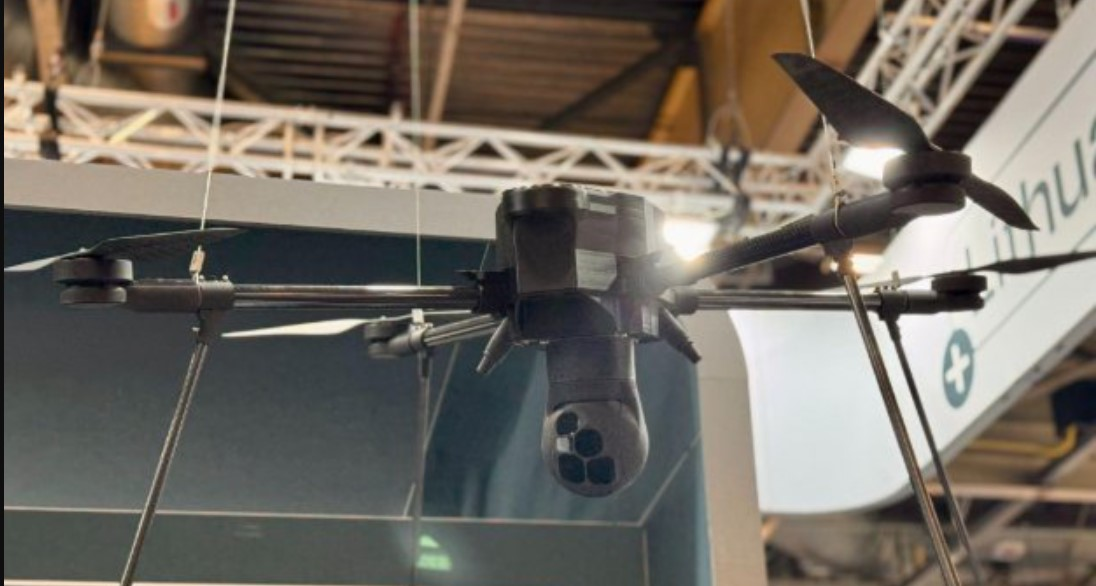
Tactical Photonics has presented a sub-2kg laser targeting payload for drones, giving European unmanned platforms a new route to precision designation in environments where GPS, radio links, and wider electronic systems are increasingly contested.
The Lithuanian company, part of Aktyvus Photonics Group, introduced the payload at Eurosatory 2026 on the Lithuanian national stand. The system functions as a laser designator, marking targets for compatible laser-guided munitions rather than carrying or launching munitions itself. It is designed for integration across fixed-wing and rotary drone platforms, with production planned to scale to 600 units per year from 2027.
The payload uses four-axis mechanical stabilisation and is designed to maintain a targeting lock against small moving targets at ranges beyond 3km. Tactical Photonics is presenting the system as a European alternative to heavier, more expensive US-origin payloads, with freedom from US export-control dependency built into the commercial proposition.
The market is being shaped by contested navigation. Drones have become central to reconnaissance, targeting, artillery correction, strike support, and battle-damage assessment, while many platforms still depend on navigation signals and datalinks that can be jammed, spoofed, or detected. Laser designation does not remove every vulnerability, but it gives forces a targeting method that is not dependent on GNSS in the same way as satellite-guided workflows.
That requirement sits beside wider work on navigation resilience and GPS denial. The growing pressure on GPS-dependent operations and anti-jam GNSS production both show how navigation and targeting resilience are moving into the payload, receiver, and subsystem layers rather than remaining platform-level concerns.
The manufacturing challenge sits inside photonics, stabilisation, and integration. A compact laser designator has to combine optical performance, beam quality, thermal management, vibration resistance, power efficiency, rugged packaging, precision pointing, software interfaces, and operator usability. On a drone, every gram affects endurance, stability, launch method, and airframe compatibility.
Four-axis mechanical stabilisation is especially important for small UAV integration. Digital image processing can assist tracking, but a laser designator still needs physical stability when the aircraft banks, vibrates, or operates in wind. Mechanical axes, control loops, sensors, motors, bearings, and calibration routines become production-critical. If those elements drift, wear, or vary between units, field performance will degrade.
Europe’s supply-chain position gives the payload additional relevance. Laser systems draw on specialist components, optics, coatings, precision mechanical parts, electronics, calibration equipment, and trained photonics engineers. Lithuania’s laser-science base gives Tactical Photonics a credible industrial foundation, but scaling to hundreds of defence-ready payloads a year will still require supplier assurance, environmental testing, quality documentation, and field support arrangements.
Export-control independence adds another market driver. European customers increasingly want alternatives to systems requiring third-country approvals, especially where battlefield demand moves faster than procurement bureaucracy. A European-origin laser payload could support drone programmes needing rapid integration, local support, and allied compatibility without waiting for US-controlled subsystems.
The system also sits between surveillance drones and strike platforms. A small UAV with a designator becomes more than an observer; it can support precision engagement by other systems while remaining lighter and cheaper than a larger armed drone. That creates a useful manufacturing niche, because payload suppliers can upgrade the tactical value of existing drone fleets without requiring customers to buy entirely new airframes.
Tactical Photonics’ production target gives the launch a measurable industrial test. A prototype can prove optical performance; a scaled programme has to prove that performance across batches, customers, and operating environments. If the company can hold accuracy, stability, price, and support while increasing output, Europe will gain a stronger domestic tool for drone-enabled precision warfare.