IN Brief:
- Rheinmetall and General Atomics have signed an MoU to explore Vektrex co-production.
- Vektrex is a manoeuvring 155mm precision-guided munition designed for 39- and 52-calibre artillery systems.
- The work reflects allied pressure to replenish stocks, extend range, and distribute munitions production across trusted industrial bases.
Rheinmetall and General Atomics Electromagnetic Systems are exploring transatlantic co-production of Vektrex, a manoeuvring 155mm precision-guided munition intended to move tube artillery further into the long-range precision fires market.
The MoU covers cooperation around a round designed for extended range, precision effects, and operation in GPS-degraded or contested environments. Vektrex is intended for integration with existing 155mm 39- and 52-calibre artillery systems, giving it a route into allied armies already standardised around NATO-compatible guns.
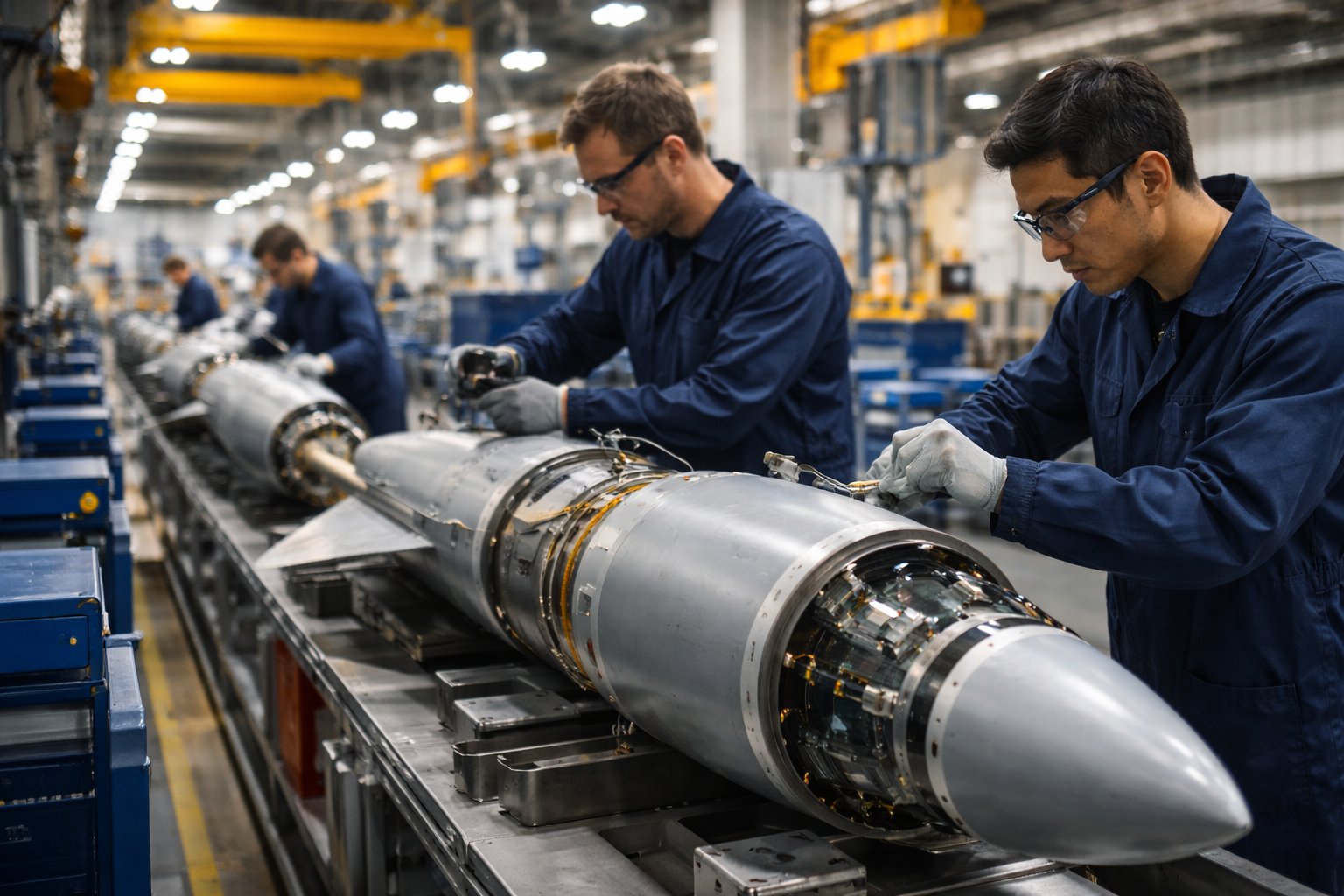
Co-production carries as much weight as the munition’s performance claims. Artillery demand has exposed the fragility of munition supply chains, particularly where explosives, propellants, shell bodies, fuzes, guidance electronics, precision actuators, and test infrastructure have not been scaled for prolonged high-intensity warfare. A precision-guided round adds further complexity by bringing aerospace-style control and sensing requirements into an artillery form factor.
Vektrex is built around a glide-based aerodynamic design that can extend range well beyond conventional artillery projectiles. That creates a difficult manufacturing requirement because the munition must survive gun-launch forces while carrying guidance, control surfaces, power, electronics, and structural elements capable of manoeuvre after firing. Launch survivability is unforgiving, and components that are mature in aircraft or missile applications may still require redesign, qualification, and repeated testing for artillery use.
Compatibility with existing guns is central to the commercial case. Precision artillery becomes harder to adopt when it demands new launcher infrastructure, new logistics, or narrow platform compatibility. A munition that can operate from fielded artillery gives armies a cleaner route to adoption, but it also imposes strict dimensional, ballistic, safety, and handling constraints. The round must fit established artillery workflows while delivering a different performance envelope.
Guided 155mm systems are already stretching conventional assumptions about tube artillery. LORAS has shown how 155mm guns are being pushed closer to rocket-artillery territory, while additive production work on Tomahawk structures points to a wider search for faster, more flexible missile and munition manufacturing: LORAS pushes 155mm guns toward rocket artillery territory and Divergent puts Tomahawk structures on an additive production path. Vektrex sits within that same pressure to extend range, improve survivability, and build munitions in sufficient volume.
Distributed production is becoming a strategic requirement. A single national line can become a bottleneck, a target, or a political constraint. Cooperation between a major European land-systems manufacturer and a US precision-technology company gives allied customers a route towards shared capacity, common standards, and more resilient replenishment.
Co-production remains difficult in practice. Munitions work involves export controls, sensitive technical data, safety certification, quality systems, explosives licensing, machining capacity, electronics assurance, and traceability across every batch. Precision-guided artillery adds calibration, environmental testing, software control, and acceptance trials. A distributed model only works if each site can meet common configuration and inspection standards.
The demand behind Vektrex is straightforward: armies want longer reach from existing guns because artillery remains abundant, mobile, and comparatively affordable compared with many missile systems. Extending the useful range of tube artillery can reduce exposure, widen targeting options, and increase the value of platforms already in service. The trade-off is that cheap unguided volume and expensive precision effects must now coexist in procurement and production planning.
Suppliers will be pulled into a two-speed market. Conventional shells require mass output of bodies, energetics, charges, fuzes, and packaging. Precision rounds require smaller but more complex chains built around sensors, software, actuators, power systems, and aerodynamic control. Defence ministries will need both, and they will expect industry to expand capacity without sacrificing safety, quality, or affordability.
Vektrex is not yet a large-scale production award, but the direction is clear. Allied artillery modernisation is moving towards longer range, better performance in degraded navigation environments, and manufacturing models that spread production across trusted partners. The munition may draw attention for its range, but the co-production framework shows where the market is heading.