
IN Brief:
- Thales and Systematic have formed a strategic partnership around Denmark's integrated air-defence requirements.
- The cooperation combines Systematic command-and-control software with Thales systems, including SAMP/T NG.
- Air C2, surface-based missile defence, NATO interoperability, and Danish industrial participation form the core of the agreement.
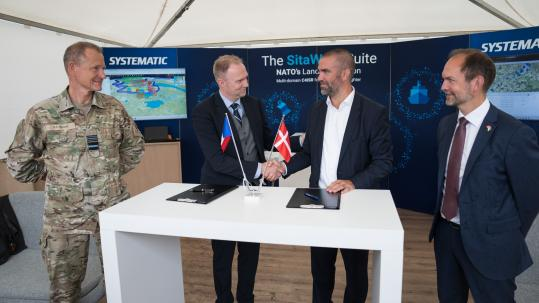
Thales and Danish software company Systematic have formed a strategic partnership to support Denmark’s developing integrated air-defence capability, bringing together command-and-control software and ground-based air-defence technology as Copenhagen rebuilds national and NATO-compatible protection against airborne threats.
The agreement was announced during DALO Industry Days in Herning and is intended to support Danish requirements across Air Command and Control and Surface-Based Air Missile Defence. Systematic will contribute its military command-and-control software expertise, while Thales will provide experience from established air-defence systems, including technology associated with SAMP/T NG.
The partnership is not a new SAMP/T NG order. Denmark has already selected the system for its long-range ground-based air-defence requirement, and the current agreement focuses on how command software, sensors, weapons, and operational networks can be integrated around that and other capabilities as the Danish architecture develops.
That integration task is increasingly important because modern air defence is no longer defined by the performance of a missile battery in isolation. Sensors may be distributed across several locations, track data can arrive from national and allied networks, and engagement decisions may involve weapons operating at different ranges and against very different target types.
A command-and-control layer has to reconcile those inputs quickly enough to provide operators with a coherent air picture and a usable set of engagement options. Data formats, identification, communications security, track quality, latency, and command authority therefore sit alongside radar range and interceptor performance as core engineering requirements.
Systematic has built much of its defence business around operational command-and-control software used by armed forces and NATO customers. Its role in the Danish partnership is intended to complement rather than replace Thales’ air-defence architecture, linking software and operational information with sensors and effectors already selected or considered by Denmark.
Klaus H. Qvist, vice president of business development at Systematic, said the partnership would combine trusted European technology with industrial capability established in Denmark. The arrangement also gives the Danish company a more direct position in a national air-defence programme that will require continuing software integration and support long after the initial equipment has been delivered.
Thales is similarly treating local industrial involvement as part of the programme rather than a separate offset exercise. The companies say the cooperation is intended to strengthen Danish capability and create opportunities for longer-term national value and possible exports, particularly where Danish-developed software becomes integrated with air-defence systems used elsewhere.
The NATO element is equally significant. Danish air defence has to operate within allied command structures and exchange information with systems beyond the country’s borders. An aircraft or missile approaching Danish airspace may already have been detected by another national sensor, while Danish radars can contribute information to a wider NATO picture.
That makes interoperability an operational requirement rather than a procurement preference. A national system that cannot exchange tracks, identification information, or engagement status reliably with neighbouring and allied forces would create gaps despite having capable individual components.
The range of threats also complicates the architecture. Conventional aircraft, cruise missiles, ballistic missiles, and uncrewed systems impose different detection and engagement requirements, while the economics of defeating them vary considerably. An interceptor suited to one target may be unnecessarily expensive or operationally inappropriate for another.
Layered air defence therefore depends on the command system allocating information and weapons efficiently across the network. That becomes harder as more sensors and effectors are introduced, especially when they come from several suppliers and have different interfaces, update cycles, and operating concepts.
Martin Soegaard, Thales country director for Denmark, Ireland, Iceland, and the Baltics, said cooperation with Systematic would reinforce Thales’ long-term Danish footprint while contributing to national industry. The commercial logic is straightforward: air-defence systems remain in service for decades, but software, interfaces, threats, and operating concepts change repeatedly during that period.
No separate contract value or implementation timetable has been disclosed for the partnership. Its importance therefore lies less in the announcement itself than in whether the companies can turn two established technology portfolios into an integrated architecture that works inside Denmark’s wider acquisition programme.
Denmark has already committed to rebuilding substantial ground-based air-defence capability. The next challenge is ensuring that the resulting sensors, missiles, command posts, software, and NATO connections behave as one system rather than a collection of expensive individual purchases. Thales and Systematic are positioning their partnership around precisely that integration problem.

