IN Brief:
- BAE Systems is seeking an Indian industrial partner for potential Tridon Mk2 production.
- The mobile 40mm system is designed to engage drones, cruise missiles, aircraft, and ground targets.
- Domestic manufacture would encompass vehicle conversion, ammunition, sensors, fire control, software, training, and support.
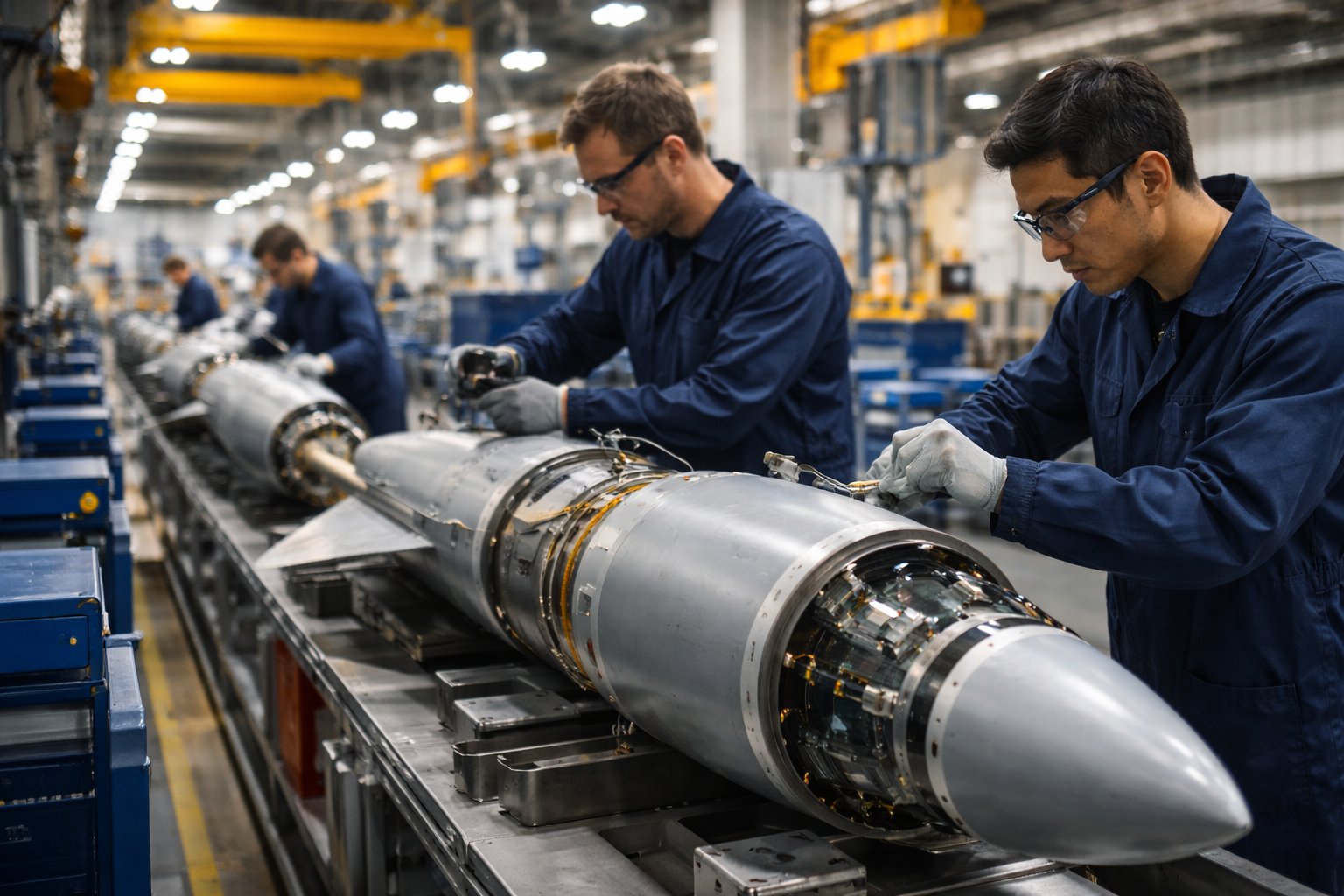
BAE Systems is examining local production of the Tridon Mk2 in India as the country expands its search for mobile air-defence and counter-drone systems.
The company is looking for an Indian industrial partner capable of supporting manufacture and integration if the system is selected for a future requirement. No production award has been disclosed, leaving the scope and depth of localisation dependent on the eventual procurement route.
Tridon Mk2 combines a remotely operated 40mm gun with sensors, fire control, programmable ammunition, and a mobile vehicle platform. It is designed to engage small unmanned aircraft, cruise missiles, conventional aircraft, and ground targets, providing a reusable kinetic layer between electronic-warfare systems and missile interceptors.
Depending on target type, ammunition, and sensor configuration, the weapon can engage at distances of up to approximately 12km. Its appeal rests partly on the ability to fire multiple rounds without replacing a complete interceptor after every engagement.
BAE Systems has already secured a $180 million Swedish order, while Sweden and Denmark have procured systems for transfer to Ukraine. India would open a substantially larger industrial opportunity, particularly if Tridon is selected across air-defence, counter-UAS, and critical-infrastructure protection roles.
Domestic production would extend well beyond mounting a cannon on an Indian truck. A complete system requires surveillance and tracking sensors, electro-optical identification, fire-control computation, secure communications, power generation, operator stations, ammunition handling, and interfaces with wider command networks.
Every component must operate with predictable latency and accuracy under vibration, heat, dust, electromagnetic interference, and repeated deployment. A reliable gun without a stable sensor and fire-control chain offers little protection against small targets crossing the engagement area at speed.
Programmable ammunition will be one of the central industrial questions. Modern 40mm air-defence systems calculate a detonation point and programme the fuze immediately before firing, creating a controlled fragment pattern around the target.
Gun, fuze programmer, fire-control software, and ammunition production must remain closely matched. Variations in projectile velocity, fuze function, or timing data can shift the fragment cloud away from a small drone even when the tracking solution is otherwise accurate.
Local ammunition production would deepen India’s control over cost and availability, but it would require qualified energetic materials, metal forming, precision assembly, electronic fuzes, inspection, and ballistic testing. Small differences across batches can alter pressure, velocity, dispersion, and detonation behaviour.
The barrel and feed system face separate pressures. High rates of fire produce substantial thermal and mechanical loads, accelerating wear across barrels, recoil assemblies, mounts, and ammunition feeds. Accuracy must remain within specification as components heat, cool, and accumulate firing cycles.
Sensor supply may prove harder to scale than the mechanical structure. Radar modules, thermal imagers, optical systems, processors, and secure radios depend on specialist electronics whose lead times often exceed those of the vehicle or gun mount.
A layered system such as the Pandur-based gun, missile, laser, and electronic-warfare configuration illustrates how quickly counter-UAS integration can expand. Sensors and command software have to assign each target to the most economical effective effector while preventing interference or duplicated engagements.
India’s localisation policy will influence how much industrial value remains in the country. Final assembly provides employment and basic production experience, although greater strategic value lies in ammunition manufacture, sensor integration, software support, depot maintenance, spares, and the qualification of Indian subsystem suppliers.
A domestic partner would also need to adapt Tridon to local conditions. High ambient temperatures increase cooling requirements, dust affects seals and moving assemblies, and extended deployment places greater pressure on filtration, lubrication, and maintainability.
Vehicle selection will determine mobility, crew protection, available electrical power, transportability, and the extent of structural redesign. Adding the weapon, ammunition, sensors, communications, and protection can raise mass rapidly, affecting suspension, braking, stability, and cross-country performance.
Software sovereignty will carry similar weight. Fire-control algorithms, threat libraries, communications standards, and command-system interfaces will require continuing modification as India introduces new radars, networks, and operational procedures.
The wider market is crowded. Indian organisations are developing indigenous radars, electronic countermeasures, missiles, guns, and directed-energy systems, while foreign suppliers are pursuing the same requirements with competing industrial packages.
Tridon’s prospects will depend partly on whether it can enter that architecture without creating another isolated fleet. Unique ammunition, maintenance tools, software, training, or support contracts would undermine the commonality India is trying to build.
An Indian manufacturing base could also support regional export and long-term sustainment, provided technology transfer extends far enough to permit configuration changes and repairs without constant intervention from Sweden or the UK.
Quality control would remain closely connected to BAE Systems Bofors. A locally produced barrel, mount, fuze, or electronic assembly must perform identically to the qualified baseline, requiring shared drawings, controlled processes, traceable materials, test equipment, and disciplined configuration management.
The proposed programme therefore joins two industrial pressures that now dominate short-range air defence: customers want lower-cost engagements against numerous drones, while governments want local control over the equipment and ammunition needed to sustain them.
A gun-based system can improve the cost exchange, but only when ammunition, sensors, software, barrels, spares, and trained technicians arrive in sufficient quantity. India’s decision will turn on whether Tridon Mk2 can be transferred as a complete production and support system rather than imported as another finished weapon.